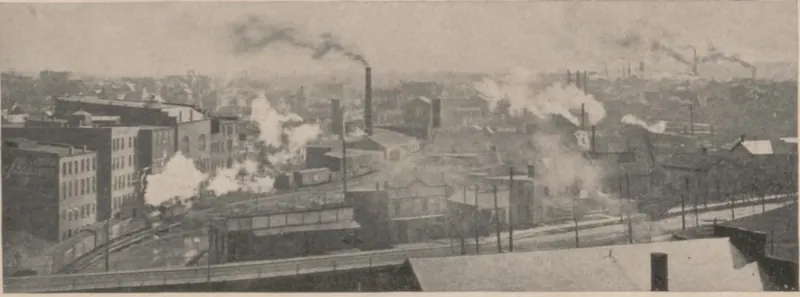
Writing in 1907, the authors of this history of Summit County gave Akron's factories an entire chapter of their own. It reads like a family tree of companies: mills that became potteries, potteries that merged into clay trusts, a match maker who built a city, and a doctor from the East who started the rubber trade. Below are the firms, founders, workers and years the book records, for anyone whose ancestors worked or traded there.
Written from Centennial History of Summit County, Ohio, and Representative Citizens (1908). Everything below comes from that book, and where it gives an opinion, we say so. You can read the full book free on the Internet Archive.
Mills and a bog-iron furnace at Middlebury
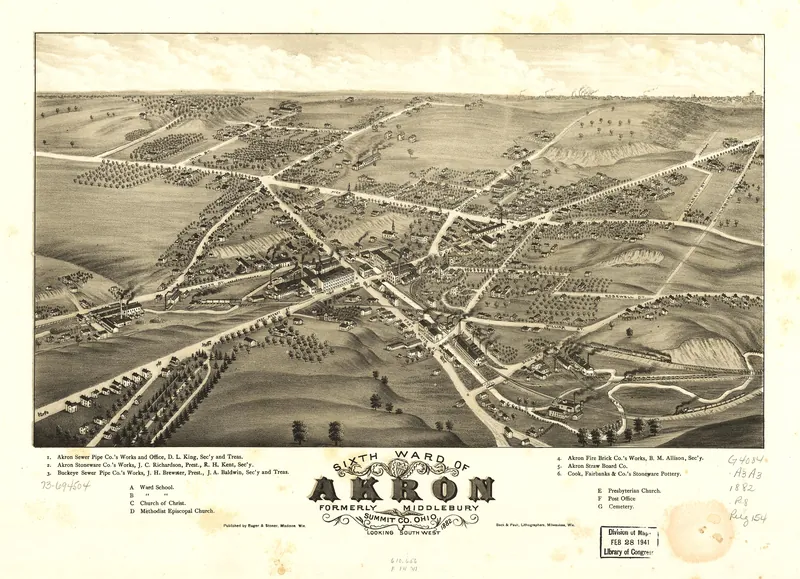
The book traces Akron's manufacturing back to Middlebury, where the Cuyahoga River supplied water power. The first industry it names is a grist mill built in 1808 by Aaron Norton, on Case Avenue ground later occupied by the Akron Sewer Pipe Company. Bagley's Woolen Mills went up on the same stretch of riverbank about ten years later. In 1817 Norton and William Laird erected the Cuyahoga Blast Furnace to smelt the local bog iron, a business the book says turned unprofitable once richer Lake Superior ore arrived.
About 1825 Dr. Eliakim Crosby bought the furnace from Ralph Plum and began making plows and hoes. In 1827 he sold it to Arnold, Daniel and Isaac Stewart and built a grist mill farther east, later sold to Increase Sumner. In 1832, just after the canal opened from Cleveland to Portsmouth, Crosby and his partners built the Old Stone Mill, the first of Akron's large mills.
Potters, sewer pipe and the Robinson clay works
The book praises the local potter's clay and names Edwin H. Merrill, assisted by his brother Calvin J. Merrill, as the pioneer of both stoneware and sewer pipe. In 1847 Edwin began making stone bottles, jugs and smoking pipes on Bank Street in Middlebury. Sewer pipe followed in 1849 under Hill, Foster & Co., made up of David E. Hill, Robert Foster and Reuben McMillen. The firm became Hill, Merrill and Company, then Merrill, Powers & Company in 1855, Hill, Powers & Company after the Merrills withdrew in 1858, and the Hill and Adams Sewer Pipe Company in 1868, when, the book says, only one other such factory existed in the United States. In 1871 it became the Akron Sewer Pipe Company, capital $175,000.
More pipe works followed: the Buckeye Sewer Pipe Company (1872, Joseph A. Baldwin), David E. Hill's own Hill Sewer Pipe Company (1873), Robinson Brothers and Company at the Old Forge (1879, Henry and Thomas Robinson) and the Summit Sewer Pipe Company on Miller Avenue in South Akron (1889). In 1850 Enoch Rowley, Edward Baker and Herbert Baker started making yellowware in Middlebury. That business passed through Johnson Whitmore and Company (1857) and Whitmore, Robinsons and Company (1862), and in 1902 it was incorporated under Maine law as the Robinson Clay Product Company, capital $2,000,000. The E. H. Merrill Company, grown from the pottery Merrill and his son H. E. Merrill opened at South Main and State Streets in 1861, merged into it that year. Joseph C. Ewart began making vitrified roofing tile in 1875.
“…the boy who, in the fifties, had peddled matches which his father had dipped by hand in the little frame building in Middlebury.”
Ferdinand Schumacher and the oatmeal mills
Canal milling grew quickly after 1832, with the Etna Mills (1838, Samuel A. Wheeler and John B. Mitchell) and William Mitchell's Cascade Mills on North Howard Street (1840) among them.
The central figure is Ferdinand Schumacher, born in Celle, Hanover, on March 30, 1822. He came to the United States in 1850, farmed a year near Cleveland, and in 1851 opened a fancy goods store in Akron with Theodore Weibezahn. The industry chapter says he began making oatmeal in 1859 in a frame building on Howard Street that he named the German Mill, with early deliveries made by hand cart. His biographical sketch in the same book gives 1856 instead, so treat either year with care. He built his first mill on South Summit Street in 1863 and later the eight-story Big Jumbo mill. The book calls him the foremost miller in the world by the time fire destroyed the plant on the night of March 6, 1886, a loss of over a million dollars.
A month later the Ferdinand Schumacher Milling Company was incorporated with two million dollars in stock. In July 1891 the principal oatmeal mills of the country combined as the American Cereal Company, capital $3,400,000, which absorbed the Hower company, successor since 1879 and 1880 to the oatmeal works Robert Turner had started in 1870. The main office moved to Chicago, and the book notes that many of Akron's best citizens went with it. In 1907 the Quaker Oats Company took the place of American Cereal. John F. Seiberling's 1883 Seiberling Milling Company, a six-story mill in east Akron rated at 100 barrels a day, became part of the Great Western Cereal Company in 1901.
The Match Town and the founding of Barberton
The book says Akron was once known as the "Match Town." Samuel A. Lane and James R. Miltimore were the pioneer makers, starting in 1838 and quitting after about a year for lack of profit. In 1845 George Barber began making matches in a small barn in Middlebury. The Barber Match Company was formed in 1865, with George Barber as president, and moved to South Akron in 1871. In 1881 it joined twenty-eight other establishments to incorporate as the Diamond Match Company, capital $6,000,000, with O. C. Barber as president. Diamond bought out the rival Miller Match Company in 1888.
Ohio Columbus Barber, who as a boy in the 1850s had peddled matches his father dipped by hand in Middlebury, then built a town. Early in 1890 he, Charles Baird, John K. Robinson and Albert T. Paige bought nearly 1,000 acres of farmland a mile or two south of New Portage in Norton Township, and in May 1891 they organized the Barberton Land and Improvement Company. By the end of 1891 nearly 2,000 people lived on the old Coventry farms. By 1892 the town had the National Sewer Pipe Company (200 men), the American Strawboard Company (200), the Sterling Boiler Company (300), the Kirkum Art Tile Company (500), the Creedmoor Cartridge Company (200), the American Alumina Company (fifty) and the United Salt Company (150). When Diamond Match finished its new factory, its entire Akron plant moved to Barberton, adding nearly a thousand people. John McNamara, born in County Clare, Ireland, who opened a store at New Portage in 1863, was its first postmaster and served as Barberton's mayor from 1900 to 1903.
“In 1832, just after the canal was opened from Cleveland to Portsmouth, milling on a large scale was begun.”
Reapers, twine, tackle and books
In 1864 a branch of the A. Aultman Company of Canton began building mowers and reapers in Akron. As Aultman, Miller and Company, with Lewis Miller as superintendent, it made the Buckeye machine, much of which the book credits to Miller's own invention. After the International Harvester Company was organized, the local firm could no longer compete on equal terms, and in 1905 its assets were sold to Harvester by order of the court. The same group founded the Akron Twine and Cordage Company, a binder-twine maker, in 1885. John F. Seiberling, a former druggist who invented the Excelsior mower and reaper in 1858, brought his Empire Mower and Reaper Works to Akron in 1865.
Smaller trades fill out the chapter: Whitman & Barnes, whose predecessors began making reaper knives and sickles in 1848; Ernest F. Pflueger's Enterprise Manufacturing Company for fishing supplies (1881); and the Akron Varnish Works of Edward George Kubler and John Martin Beck (1878). Paul E. Werner started printing as publisher of the Akron Germania in 1875. The book claims the Werner Company supported four or five thousand Akron people and in 1906 turned out more than 3,000,000 large books.
Goodrich, Diamond and Goodyear: the rubber works
By 1907 the book calls rubber the chief of all Akron industries, with most of its growth in the previous twelve years. It began in 1870, when Dr. B. F. Goodrich came from the East and joined Colonel George T. Perkins, George W. Crouse and others in B. F. Goodrich and Company, the Akron Rubber Works. Incorporated in 1880 with $100,000, The B. F. Goodrich Company had reached $10,000,000 in capital and 3,300 employees. Goodrich was president until his death in 1888, and Perkins followed until January 15, 1907.
The Diamond Rubber Company had 250 employees in 1898 and 2,720 in 1907. Frank A. Seiberling bought the Woolen and Felt Company plant in June 1898 and organized The Goodyear Tire & Rubber Company with $200,000 in authorized capital. Its mill started in December 1898, and the book counts 800 men on the payroll by 1907.
For family researchers, the chapter ends with a list of incorporated Akron companies giving each street address, year and capital, and the biographies name rubber foremen. W. A. Inwood, born in 1877 in Connecticut, came to Akron in 1899, served four years as a Diamond Rubber foreman and became superintendent of its Alkali Rubber Company branch. Dates in the book do not always agree: the list gives B. F. Goodrich as established in 1869 and Diamond Rubber in 1894.
People from this history in our records
These Summit County residents have biographies on our site from the county histories, and each one mentions local business and industry. Their sketches name parents, spouses, and where the family came from.
- Charles W. Seiberling (b. 1861)
- Joseph Wingerter (b. 1864)
- John Chapman (b. 1859)
- John Frederick Seiberling (b. 1834)
- Lewis Miller (b. 1829)
- Charles Miller (b. 1815)
- Frank A. Seiberling (b. 1859)
- Abraham Snyder (b. 1833)
- C. H. Palmer (b. 1850)
- David E. Hill (b. 1825)
- Harry A. Palmer (b. 1851)
- Warren Miller (b. 1840)
- George W. Hart (b. 1798)
- John Chapman (b. 1812)
- Irvin H. Spangler (b. 1870)
- Norman Wise
- S. E. Oviatt (b. 1832)
- Albert Allen (b. 1827)
- Allen Welton (b. 1809)
- George A. Shaw (b. 1853)
- George R. Hill (b. 1855)
- J. Martin Beck (b. 1843)
- John Smith (b. 1836)
- Miner Jesse Allen (b. 1829)
Finding your ancestor in Summit County
- Census records (free through 1950) list each person's occupation and town, so a work family shows up decade by decade.
- Death records: search our Ohio database by surname.
- The county histories themselves: the biographical sections of Centennial History of Summit County, Ohio, and Representative Citizens hold hundreds of family sketches.
- Newspapers on the Library of Congress's Chronicling America carried obituaries, accidents, and local news.
Tell us one grandparent's name. We'll take a free first look at the records and email you back.
Ask about my family →Frequently asked questions
When did the rubber industry begin in Akron?
The county history dates it to 1870, when Dr. B. F. Goodrich came from the East and started B. F. Goodrich and Company, the Akron Rubber Works, with Colonel George T. Perkins, George W. Crouse and others. It was incorporated in 1880. Its company list, however, gives Goodrich as established in 1869.
Who founded Barberton, Ohio?
Ohio Columbus Barber, president of the Diamond Match Company. Early in 1890 he, Charles Baird, John K. Robinson and Albert T. Paige bought nearly 1,000 acres in Norton Township, and in May 1891 they organized the Barberton Land and Improvement Company. By the end of 1891 nearly 2,000 people lived there.
What happened to Ferdinand Schumacher's oatmeal mills?
Fire destroyed the plant on the night of March 6, 1886, at a loss of over a million dollars. The Ferdinand Schumacher Milling Company was incorporated a month later, joined the American Cereal Company in July 1891, and in 1907 the Quaker Oats Company took American Cereal's place.
Who started the stoneware and sewer pipe business in Akron?
The book names Edwin H. Merrill, assisted by his brother Calvin J. Merrill, who began making stoneware on Bank Street in Middlebury in 1847. Sewer pipe followed in 1849 under Hill, Foster & Co., the firm of David E. Hill, Robert Foster and Reuben McMillen.
Photographs on this page are in the public domain. About the images and their sources.