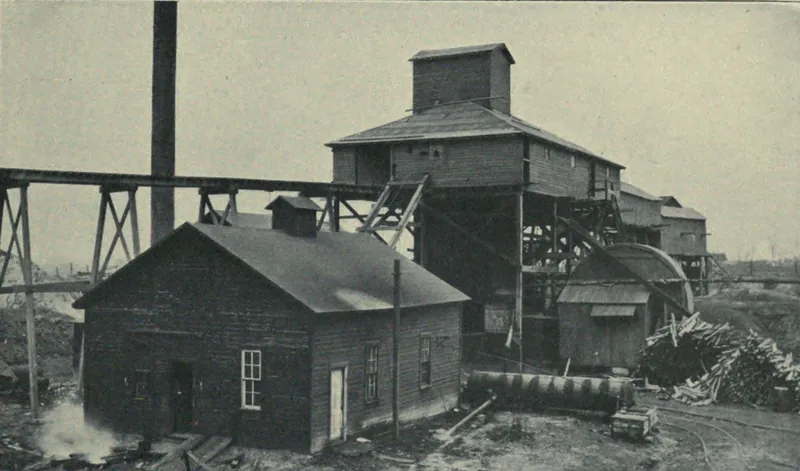
Most of what the 1913 history of Appanoose County says about coal comes through its biographical sketches. Again and again a man arrives from Staffordshire, Glasgow, Ayrshire, South Wales or Sweden, digs coal at Brazil, Mystic or Centerville, and ends up running a mine, a store or a bank. Read together, those life stories show who opened the mines, where the miners came from, and which companies their families worked for.
Written from Past and Present of Appanoose County, Iowa (1913). Everything below comes from that book, and where it gives an opinion, we say so. You can read the full book free on the Internet Archive.
Miners From Britain and Sweden
The county's coal men came a long way. Joseph Turner was born in Staffordshire, England, on November 12, 1845, the son of a mine superintendent, and worked in English coal mines until May 1869. James W. Campbell, born in Glasgow, Scotland, in August 1848, left the mines there in 1869 at twenty-one. Alexander Orr, born in Ayrshire on March 25, 1844, began "trapping in the mines" in 1854, when he was ten. David Lodwick was born January 7, 1864, at Pun Dyram near Dowlais in South Wales, and his father, William, worked in coal mining his whole life.
Few came straight to Iowa. Turner mined in Pennsylvania until 1875. Campbell worked in Pennsylvania and then at La Salle, Illinois, until 1881. The Orrs passed through Colchester and Bushnell, Illinois, and settled at What Cheer, Iowa, in 1875. The Lodwicks spent about twenty years around Youngstown, Ohio. A later group came from Sweden. Louis Anderson, born at Karlstad on March 27, 1861, worked in Michigan lumber and Wisconsin iron mines before reaching the county in the fall of 1887. Andrew Burkland, born in Vestergotland on May 29, 1841, crossed in 1868 with a crew of men sent to build railroads in Michigan.
Marriages often stayed inside the trade. Turner's first wife, Ruth Martin, was the daughter of an English-born coal miner in Pennsylvania, and Campbell's wife, Susan Williams, was the daughter of a Welsh track layer in the Pennsylvania mines.
Brazil and the Phoenix Coal Company
Turner reached Centerville in 1875 and worked in the mines until 1876, then mined in Missouri until October 1882. Back in the county, he and two partners bought forty acres of coal land at Brazil, later adding more. Reorganized as the Phoenix Coal Company, it was run by Turner and a man named Freese for fourteen years.
When Freese sold out, his share went to Campbell. Campbell had reached Centerville in 1881 and dug coal at Brazil until 1886, then bought a stock of goods from John Freeze and kept store for about seven years. (The book spells the name Freese in one sketch and Freeze in the other.) He then dealt in coal with Thomas Phillips before joining Turner. After thirteen years as coal partners, Turner and Campbell sold out and bought the Centerville marble and granite works. Campbell soon sold his half to Turner, traveled briefly for the Southern Iowa Coal Company, and went back into business as a wholesale coal dealer, J. W. Campbell & Company, with J. L. Turner as his partner on the road.
The sketches list Turner's son Frank E. and Campbell's sons Richard and James as miners.
“In 1854, when a little lad of ten years, Alexander Orr began trapping in the mines…”
Mystic: The Orrs and the Lodwicks
Alexander Orr and his brother William were partners from 1875. At What Cheer they opened what the book calls the first railroad mine there, selling it to the railroad company in 1879; the history says those were at one time the largest coal works in Iowa. In 1887 the brothers came to Mystic and opened the Iowa and Missouri mine, which the book calls the first mine opened in Mystic, on land belonging to D. Vankike. The sketch says they worked it until 1900, though it also calls that span "three years." In 1900 they opened the Orr Brothers mine a mile and a half east of Mystic and ran it until William died in 1907. Alexander made out the first poll books in Mystic and served on its first city council.
Next came the Lodwicks. J. B. and L. L. Lodwick leased 160 acres from John M. Elgin, and in 1889 David and another brother, William, arrived and opened two drift mines on it. When the book was written, the Lodwick Brothers Coal Company (David, L. L. and J. B.) was operating five mines around Mystic with a capacity of 850 tons a day, along with two supply stores, and employed about 500 workmen. The book calls it one of the most important industries of that part of the county.
David Lodwick helped incorporate Mystic in 1890, served as city clerk and for two years as mayor, platted the Roosevelt Heights addition, and owned half of the Fruitland addition with T. R. Sedgwick. The book credits him with pushing for the interurban line when the town's merchants opposed it. Older miners settled there too: a man named Forsyth, who had followed coal mining at What Cheer for twenty-four years, moved to Mystic in 1893 to join his son David in the drug firm of Forsyth & Son.
Centerville's Swedish Operators
Andrew Burkland came to Centerville in 1877 as a coal miner, then worked as a stone mason and a contractor around mine operations, and spent his last twenty-five years mainly in coal. He was one of the organizers of the Scandinavian Coal Company, helped start Anchor Mine No. 1, organized the Happy Coal Company with a partner, and sank the White Oak mine, which he owned alone for several years. He later sank another mine in the south part of the city and ran it with his son Alfred as A. Burkland & Son. The book notes that he never learned to write. After his death on April 5, 1912, sons Alfred, Albert and Carl ran the business.
Louis Anderson worked in the county's coal mines until 1888, when he was elected secretary of the newly organized Anchor Coal Company, which sold in 1889 to Jim Wilson, Sr., and a Mr. Phillips. After another stay in Wisconsin he returned to Centerville in 1893 and mined until 1901, then became secretary and manager of a newly organized coal company at Exline. In 1910 he went to Laneville as a coal miner and shipper on his own account, and in July 1912 he became manager and treasurer of the Center Coal Company.
The Johnson brothers held a range of mine jobs. Adolph Johnson, born in Sweden on June 23, 1876, started as a digger and then served eleven years as weigh master for the Scandinavian Coal Company. Oscar W. Johnson was for a time superintendent of the Dewey Coal Mine at Centerville. Axel Johnson farmed in summer, worked in the mines in winter, and belonged to the Mine Workers Union at Exline.
“In 1877 he came to Centerville, Iowa, which has since been his home. His first employment was as a coal miner…”
Exline, Big Mines and the Money Behind Them
Milton B. Maring spent ten years in the coal mines while running a general store at Exline with his brother. In 1906 he bought an interest in the Prairie Block Coal Company and ran its mine five miles southwest of Centerville as secretary, treasurer and general manager until June 1, 1912. The book calls it one of the best mines in the district, with a capacity of 500 tons a day, and says he kept a general store at the mines and was one of the largest stockholders in the Scandinavian Coal Company.
Bankers invested too. D. C. Bradley, born in Centerville on August 13, 1858, had been developing coal properties for twenty years, and one of his mines, No. 30, had a capacity of 500 tons a day. He headed banks at Exline and Mystic and held a controlling interest in the Centerville Light & Traction Company, whose interurban ran six miles between Centerville and Mystic. Cyrus G. Wentworth, a Centerville brickmaker and builder who came in 1857, owned 120 acres of coal property in Center township at his death on September 29, 1906, and leased it to the Rock Valley Coal Company.
What the Sketches Offer Family Historians
These are flattering portraits of men who rose from the pick to ownership, so the ordinary miner mostly appears in family lists as a son who "engages in mining." Still, they name employers worth searching for: Phoenix, Lodwick Brothers, Scandinavian, Anchor, Prairie Block, Center, Dewey and Rock Valley. They also name groups that kept their own rolls: the Swedish Lutheran church of Centerville, the Swedish Congregational church, the Mine Workers Union at Exline, and Walnut Lodge No. 588, A. F. & A. M., which both Lodwick and Orr joined.
The danger shows too. Frank R. Glick, born October 29, 1882, began contracting to sink coal shafts at twenty-one and later mined in Colorado, where a falling piece of coal dislocated his back. After treatment at Kirksville, Missouri, beginning November 14, 1908, he got around in a wheeled chair, and he took office as county recorder in January 1913.
Finding your ancestor in Appanoose County
- Census records (free through 1950) list each person's occupation and town, so a mining family shows up decade by decade.
- Death records: search our Iowa database by surname.
- The county histories themselves: the biographical sections of Past and Present of Appanoose County, Iowa hold hundreds of family sketches.
- Newspapers on the Library of Congress's Chronicling America carried obituaries, accidents, and local news.
Tell us one grandparent's name. We'll take a free first look at the records and email you back.
Ask about my family →Frequently asked questions
Who opened the first coal mine at Mystic, Iowa?
The 1913 county history says Alexander Orr and his brother William came to Mystic in 1887 and opened the Iowa and Missouri mine, which it calls the first mine opened in Mystic, on land belonging to D. Vankike. The Lodwick brothers opened two drift mines nearby in 1889.
Where did Appanoose County's coal miners come from?
The sketches in this history trace mine workers and operators to Staffordshire in England, Glasgow and Ayrshire in Scotland, South Wales, and Sweden, usually after years of work in Pennsylvania, Ohio, Illinois, Michigan or Wisconsin before they reached Centerville, Brazil, Mystic or Exline.
How big were the Mystic mines around 1912?
According to the history, the Lodwick Brothers Coal Company was operating five mines in the Mystic district with a combined capacity of 850 tons a day. David Lodwick also ran two supply stores in connection with the mines and employed about 500 workmen altogether.
What coal companies does the book name near Centerville?
The sketches name the Phoenix Coal Company at Brazil, the Scandinavian Coal Company, the Anchor Coal Company and Anchor Mine No. 1, the Happy Coal Company, the White Oak mine, the Prairie Block Coal Company, the Center Coal Company, the Dewey Coal Mine and the Rock Valley Coal Company.
Photographs on this page are in the public domain. About the images and their sources.