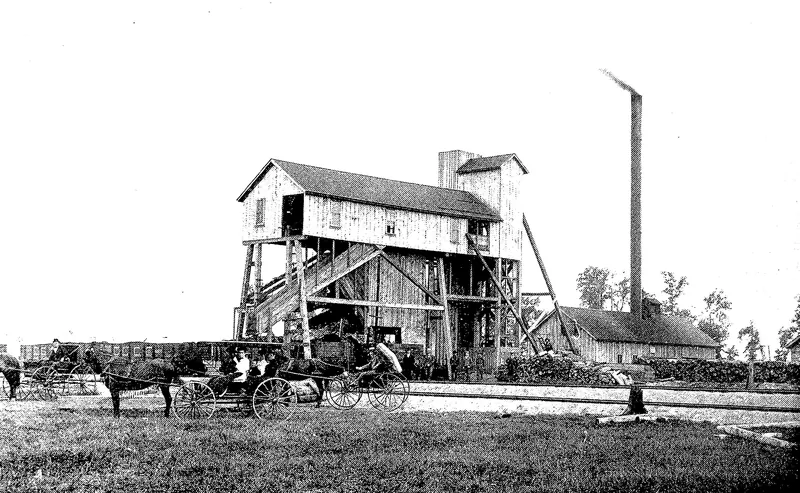
For decades Bay City drilled salt wells straight through a coal seam and left it alone. Then, in the middle 1890s, a few West Side men began testing farmland in Monitor and Frankenlust townships, and within a few years the county had 14 mines, miners brought in from Ohio, Illinois and Pennsylvania, and a United Mine Workers district. This page follows the coal story as the 1905 History of Bay County, Michigan, and Representative Citizens told it, mine by mine and name by name.
Written from History of Bay County, Michigan, and Representative Citizens (1905). Everything below comes from that book, and where it gives an opinion, we say so. You can read the full book free on the Internet Archive.
Coal Under the Salt Wells
The 1905 history says a vein of coal was found in the county as early as 1861, while a salt well was being drilled. Nobody mined them, because pine was plentiful and Bay City burned its own forests. The author describes the salt-well drillers boring right through the coal without anyone troubling to drill for coal itself.
He plainly regretted it. He wrote that if the copper and iron men of the Upper Peninsula had known about coal lying only 150 feet below the surface, Bay City might have become the "Pittsburg of the Northwest." Instead the ore went down Lake Huron, past Saginaw Bay, to Ohio and Pennsylvania ports. That is town-history boosterism, but it shows the hopes pinned on coal.
Alexander Zagelmeyer and the First Shafts
The sketch of Alexander Zagelmeyer, whom the book calls the father of the coal industry in Bay County, gives the earliest dates. In August 1894 he took four prominent citizens to the Zill Brothers sawmill, five miles west of West Bay City in Monitor township, where coal had turned up when a well was drilled. They got a lease and on June 18, 1895, began sinking a shaft, finished that October. The sketch says the operators met with ridicule and sometimes persecution.
The Monitor Coal Company was incorporated in the spring of 1895 with $50,000 in stock: Alexander Zagelmeyer, president; George Penniman, vice president; E. L. Mather, secretary; Frank Zagelmeyer, treasurer; with Christ. Heinzmann on the board. The Bay Coal Mining Company followed on March 16, 1896, also at $50,000, with its mine across the road from the Monitor mine and a capacity of 400 tons a day. By 1905 the North American Chemical Company controlled it.
Here the book disagrees with itself. Its coal chapter says it was in 1897 that Zagelmeyer and a few others proved paying coal under the farms of Monitor and Frankenlust, that the first shaft that year was for the original Michigan coal mine, on a vein about four feet thick, and that the Monitor shaft came after. The Zagelmeyer sketch says the Monitor mine was the first in Bay County. A third account, in the sketch of the driller Mr. Arnold, says he struck coal on the Albert Pfundt place on September 18, 1896, and that the Michigan and Central shafts went up the next year. The book never reconciles these.
“Bay City for many years was dependent upon her forests for fuel…”
The Driller: Mr. Arnold's Finds
The excerpt names him only as Mr. Arnold. His wife Mary was a daughter of the Oeder family, German Lutherans who farmed in Bangor township before moving to Standish. The book credits Arnold with finding several of the county's best-known mines. At the Pfundt place he struck coal at 121 feet. On January 6, 1898, with Messrs. Maxon, Flower and Lewis Howe present, he hit coal at 124 feet on the Von Alstein place in Bangor township, the first test hole in that vicinity. A year later Messrs. Voss and Jackson put down a shaft three-quarters of a mile east, which became the Wenona mine.
On December 6, 1898, drilling on his own farm in the southern part of section 10, Monitor township, Arnold found the vein that runs southwest to Wolverine mine No. 2. On March 20, 1900, on the Everson farm, with his helper Henry Erbisch and Messrs. Everson, Johnson and Hunter looking on, he struck what the book calls one of the best-paying coal mines in Michigan, Wolverine No. 3. The Pere Marquette line to the Wolverine mines was built to carry their coal. Arnold leased some 3,000 acres from neighboring farmers, then on May 29, 1901, sold his leases and machinery to the Handy Brothers Mining Company, keeping only his drill.
The book says farmers at first sold their coal rights outright, but later signed long-term leases that paid a royalty on all coal mined. For a farm family in Monitor, Frankenlust, Bangor or Williams township, a coal lease is one more paper that may survive among its land records.
Mine by Mine, 1904 to 1905
Within a few years, the chapter says, Bay County had 14 coal mines. Handy Brothers opened the first in Bangor township and soon a second shaft nearby. E. B. Foss and George D. Jackson sank a shaft at O-at-ka Beach near the mouth of the Kawkawlin River, on what the book calls the finest vein in the county. With the bay a few hundred yards east, flooding was the great danger, and in April 1905 a rush of water shut it down. Arnold's sketch calls a Voss and Jackson shaft the Wenona mine; it may be the same partnership with the name spelled differently, but the book does not say so.
The Pittsburg mine was near Amelith. The Valley mine, Bay mine No. 2 and the Hecla mine were near Frankenlust, with the Central closer to the city. The Salzburg mine sat near the center of that West Side suburb, and the United City mine was inside the city on North Union street. Wolverine Nos. 2 and 3 were in Williams township, with the new Auburn mine nearby, on the Midland Branch of the Michigan Central. The newest was Foss's What-Cheer in Merritt township, 10 miles southeast of Bay City: a 196-foot shaft on a three-foot vein, with 20 miners and 10 day men.
The book gives crew counts. The Coryell mine had 180 miners under Charles Coryell, with Elias Mathews as superintendent. The Wenona had 150 miners, 80 day men, 10 trappers and 46 machine men in 1904, under E. B. Foss and superintendent James Gallagher. Wolverine No. 2 had 127 miners; Wolverine No. 3 had 126 under R. M. Randall and had just lost everything above ground to fire. The Michigan mine had 92 miners under Frank P. Young and Sam Wormeldorf. Zagelmeyer's Salzburg mine had 80; M. L. Davies's Bay mine, 78; George Waller's Central, 75; John Werner's Pittsburg, 61. The Hecla had been shut since October 1903 over its owners' legal troubles.
The United City mine reached coal on August 26, 1904, at 142 feet, on a vein nearly six feet thick, with John Walsh as manager and David Jones as superintendent. Walsh, born in Haldimand District, Ontario, in 1846, came to Bay City in 1866 and served a term as mayor of West Bay City. His sketch says the company was organized in August 1903 and ran one shaft employing about 40 men; the coal chapter counts 60 day men.
At the old Valley or Dutch Creek mine, Frank Zagelmeyer worked 29 miners and 10 clay diggers after finding good brick clay in the shaft. The Michigan Vitrified Brick Company, incorporated April 15, 1904, with $75,000 in stock, bought the Dutch Creek mine in Frankenlust township and dug fire clay, shale and the coal to burn it from the same mine.
“The great danger is the flooding of the mine, as the bay is but a few hundred yards to the east…”
Where the Miners Came From, and What They Earned
The book says expert miners were brought in from Ohio, Illinois and Pennsylvania for the first mines, and that by 1905 miners from Ohio, Illinois, Pennsylvania and Indiana were flocking to the county for better living and working conditions. It does not name the little mining camps or break the workforce down by nationality. The census shows the effect on Monitor township: 554 people in 1874, 931 in 1880, 1,784 in 1894, and 2,150 in 1900, a jump the book credits largely to the influx of coal miners. Monitor's first settlers, it says, came out of the German colony at Frankenlust.
The miners were organized as District No. 24 of the United Mine Workers. Operators had the Bay County Coal Operators' Exchange, with M. L. Davies, a Liverpool native, as vice president. The book, which leans toward the operators, says the district's two short strikes came from operators wanting the same protection as their competitors and miners determined to improve their living conditions. Statewide, a 1902 strike closed all the mines for many weeks. Michigan coal mines had worked an eight-hour day from the first.
The scale agreed in 1904, running to March 31, 1906, paid pick miners 91 cents a ton from a 30-inch vein and 96 cents from a 27-inch vein. Drivers, trip riders, timbermen and track-layers got $2.42 for an 8-hour day, motormen $2.65, greasers $1.18 and trappers $1.06. The average daily wage of all Michigan coal mine employees was $3.01 in 1904, a year of short work because the mines could not get railroad cars.
Accidents, Mules and the Mine Law
The book says Bay County had none of the deadly mine gas of other fields, but accidents were numerous, and it names four men killed. John Simmons, 35, single, died from falling rock at Wolverine No. 2 on December 29, 1903. Thomas Brown, 25, single, was killed by a premature explosion at the Wenona mine on January 16, 1904. Fred Serva, 28, married, was killed the same way at Wolverine No. 2 on May 14, 1904. William Western, 42, married, died under falling slate at Wolverine No. 3 on October 26, 1904. About a dozen more were injured.
When the Wenona mine put in electric hauling, the author joked that the boys would miss the mule's antics but breathe easier, since more than one driver and miner had been killed by a kick. The mines ran under Act No. 57 of 1899, which created a state mine inspector at $1,500 a year, required escape shafts at least eight feet square, limited cages to 10 men, and let employees name the weighman. State mine inspector Andrew Stevens reported ventilators at all the mines.
Big Companies and the Freight Problem
Bay County mined 248,645 tons in 1902, worth $410,615, with 660 miners averaging 149 days. In 1903 it mined 325,021 tons, worth $607,091, with 714 miners and 206 working days. The book says Michigan ranked 22d among coal states in 1904, with no rating eight years before, and that the county's known coal ran 20 miles from its western border east to Munger and 12 miles from Amelith to the Kawkawlin River.
Two industrial owners shaped the field. The North American Chemical Company, which came from Liverpool, England, in 1898, owned the Bay coal mine in Frankenlust township and paid $275,800 in wages there from 1899 to November 30, 1904. The Hecla Portland Cement & Coal Company, capitalized at $5,000,000 with Detroit brewer Julius Stroh as main stockholder, had Hecla mine No. 4 producing in Frankenlust and undeveloped fields near Kawkawlin, west of the city and east of Auburn when stockholder litigation tied it up in 1904.
The book's main complaint was freight. It says Ohio mines could deliver coal to Detroit more cheaply than Michigan mines. Foss was already arranging a railroad through the Thumb to Port Huron for What-Cheer coal. The author named Chicago, which consumed 11,000,000 tons of coal in 1904, as a natural market, and closed with a 1905 prediction that three to six feet of coal underfoot had solved the county's fuel problem for all time.
Finding your ancestor in Bay County
- Census records (free through 1950) list each person's occupation and town, so a mining family shows up decade by decade.
- Death records: search our Michigan database by surname.
- The county histories themselves: the biographical sections of History of Bay County, Michigan, and Representative Citizens hold hundreds of family sketches.
- Newspapers on the Library of Congress's Chronicling America carried obituaries, accidents, and local news.
Tell us one grandparent's name. We'll take a free first look at the records and email you back.
Ask about my family →Frequently asked questions
When did coal mining begin in Bay County, Michigan?
The 1905 history gives two answers. The Zagelmeyer sketch says the Monitor mine shaft, west of West Bay City in Monitor township, was begun June 18, 1895, and calls it the first in the county. The coal chapter says the first shaft was the Michigan mine in 1897.
Where did Bay County's coal miners come from?
The book says expert miners were brought from Ohio, Illinois and Pennsylvania for the first mines, and that by 1905 miners from Ohio, Illinois, Pennsylvania and Indiana were flocking to the county. It does not give their nationalities. Monitor township grew to 2,150 people by 1900, largely from the influx of miners.
Which Bay County coal miners were killed in 1903 and 1904?
The book names four: John Simmons, 35, at Wolverine No. 2 on December 29, 1903; Thomas Brown, 25, at the Wenona mine on January 16, 1904; Fred Serva, 28, at Wolverine No. 2 on May 14, 1904; and William Western, 42, at Wolverine No. 3 on October 26, 1904.
Did Bay County miners have a union?
Yes. The 1905 history says the county's miners were well organized as District No. 24 of the United Mine Workers, and that the district had two short strikes. Operators belonged to the Bay County Coal Operators' Exchange. The 1904 wage scale ran to March 31, 1906.
Photographs on this page are in the public domain. About the images and their sources.