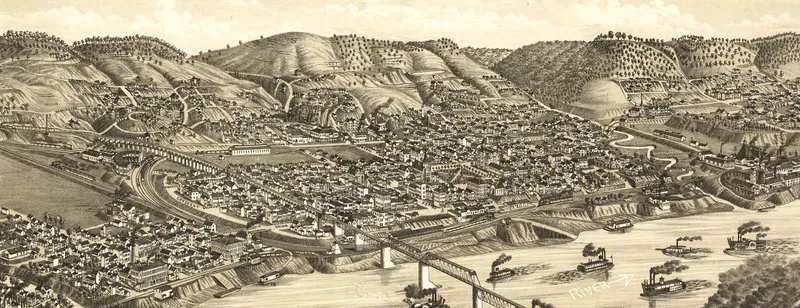
Belmont County sits on the Pittsburg coal seam, and by the time its Centennial History was written in 1902, the mines along just two railroads employed nearly 3,000 miners. This page follows the book's account from Capt. John Fink's first coal boats at McMechen's Creek in 1832 to the coal land buying of the new century, with the families, companies, and mine names that researchers are most likely to meet in the records.
Written from Centennial History of Belmont County, Ohio, and Representative Citizens (1903). Everything below comes from that book, and where it gives an opinion, we say so. You can read the full book free on the Internet Archive.
The Pittsburg Seam Under Every Township
The history quotes Thomas Emerson, a geologist late of Belmont County, who wrote that the Pittsburg seam of coal underlies the entire county and was mined at outcrops in 10 of its 16 townships. The seam rises toward the northwest, reaching the surface along creek valleys in Flushing, Kirkwood and Union townships, and it could be worked along Wheeling Creek for 19 miles from the river, through Wheeling, Colerain, Richland and Pease townships. Downriver the dip carries it below river level at Bellaire. Its usual thickness, Emerson wrote, was six or seven feet; an outcrop on Isaiah Lee's land in section 31 of Union township reached 10 feet.
Thinner seams above it mattered to particular neighborhoods. Coal number eight C, which the book ranks third in importance, went by local names: the Horeb coal in Wayne township, the Glencoe coal on McMechen's Creek, and the Tunnel seam at Flushing. Coal number 10, called the Badgersburg coal in Belmont County and the Cumberland coal in Guernsey and Noble counties, ranked second only to the Pittsburg seam. Coal number 12 was mined extensively and, the book says, was valued most by the farmers of the ridge sections.
Captain Fink and the Flatboats
According to the history, coal was mined only for household use up to 1830 and had little value for shipping. In 1832 Capt. John Fink, an old steamboat man who knew the demand for coal in Southern cities, began building coal boats for the New Orleans market and opened mines near the mouth of McMechen's Creek. The book names him the pioneer of coal shipping in Belmont County.
Coal was shoveled into carts, shoveled again into flatboats, and floated to New Orleans on the rise of the river to heat sugar refineries. There deckhands carried it off in a barrel hung from a pole across two men's shoulders. Until the railroads opened, the history says, mining for shipment stayed on the river front. Mead township's river hills also sent coal south by flatboat, and in 1865 to 1866 five companies there, among them the Pipe Creek Coal & Iron Company, the Empire Coal Company and the Wegee mines, produced 700,000 bushels a year.
“In 1832 Capt. John Fink, an old steamboat man who was familiar with the demands of the trade for coal in Southern cities…”
The Heatheringtons, Miners from the North of England
The best documented mining family in the book is the Heatherington family of Bellaire. A sketch of Joseph W. Heatherington says his grandfather John came from Durham County, England, to Philadelphia in 1829, the rest of the family arrived there on July 10, 1830, and they came to Wheeling in 1832, mining lead for a time before moving on to Galena, Illinois. John was an expert at locating coal mines, known in England as a "blossom finder," and the sketch says all of the family were coal miners except Edward, a tailor.
Jacob Heatherington, born in England in 1814, had worked as a "trapper" in the mines of northern England before emigrating. The resources chapter says the Heatheringtons rented a coal bank from Captain Fink in 1837, bought eight acres, and supplied passing steamers and Bellaire homes and factories with thousands of bushels a day. Jacob opened Belmont No. 1, later run by his son Albert, and Belmont No. 2, the "River" mine, which Winfield Scott Heatherington and Miss Lyde Heatherington operated for 20 years before its sale to the Empire Coal Company in 1899. Jacob's brother Ralph, born July 13, 1817, worked for Captain Fink in 1833 (the scan reads "Link"), returned to Bellaire from Illinois in 1846, and opened and managed mines for others, among them the old Sullivan and the Barnard mine.
Jacob's black mule, "Jack," worked 44 years, was buried in a shady corner of the estate, and had his likeness carved on the keystone over the front door of the family mansion in South Bellaire. The book gives two costs for that house: $35,000 in the resources chapter and $30,000 in the family sketch.
Schick and Koehnline: German Families in the Coal Trade
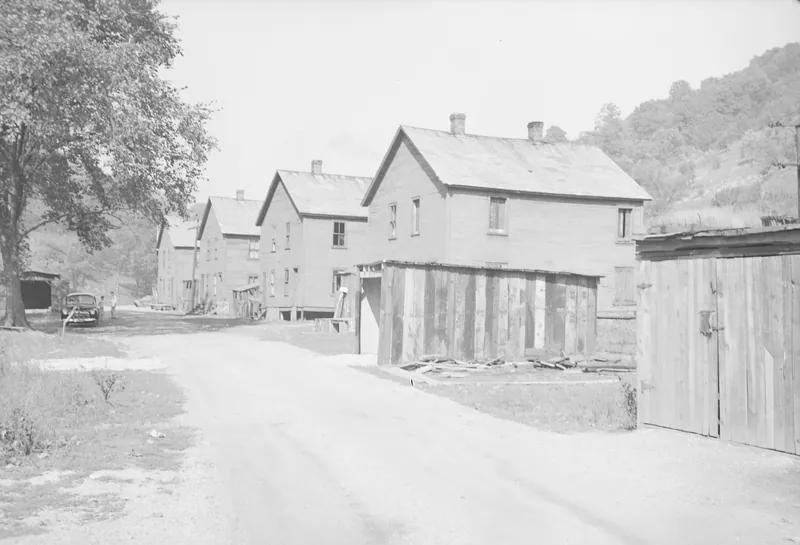
Martin Schick came to the United States from Germany in 1847, lived 12 years in Baltimore, then settled in Bellaire by way of Wheeling. He served as immigrant agent for the B. & O. and owned a farm west of Bellaire on which, the book says, the miners' shanties had since been built. His son John, born in Germany in 1845, formed a coal partnership with his brother August in 1877. Their mine, a mile and a half west of Bellaire on the B. & O., had supplied the railroad with coal since before the Civil War and had earlier been worked by Jacob Heatherington and his brother. In 1902 the next generation, John A. and M. J. Schick, ran it with about 83 men, raising 5,000 to 8,000 bushels a day.
At Bridgeport, John M. Koehnline, born in Wurtemberg in 1816, came to the United States in 1838 after four months on a sailing vessel. He opened the mine between Aetna and Bridgeport during the Civil War, moved to Bridgeport in 1863, and shipped coal as far south as New Orleans before his death in 1875. His son John J. boated coal to Cincinnati and Louisville and, the sketch says, floated the first coal to Louisville after the war. In 1890 he moved his coal business up the river opposite the Wheeling steel bridge; his sons later ran that mine, called the largest retail mine in the city, with upward of 18 men. The scanned text spells the surname several ways, so search variants.
“All of the Heatherington family were coal miners but Edward, who followed tailoring…”
Railroads, Gravity Loading, and the Mines of 1902
The railroads carried mining inland. The Central Ohio, later the western division of the Baltimore & Ohio, was completed from Cambridge to Bellaire in 1854, and the Cleveland, Tuscarawas Valley & Wheeling, later the Cleveland, Lorain & Wheeling, was built from Dennison to Bridgeport in 1876 along the line of Wheeling Creek. By 1902 the history counts upwards of 50 square miles of the six-foot vein being mined along the B. & O. and over 100 miles of the Pittsburg vein along the Cleveland, Lorain & Wheeling, in both cases loaded into cars by gravitation. These mines employed nearly 3,000 miners, paid a total of $170,000 a month.
The commercial mines named for 1902 were the Crescent, Boggs', Maple Hill, Taggart, Flushing and Wheeling Creek mines; the Echo, Black Diamond and Ohio and West Virginia mines on a branch of the B. & O.; the Standard and Glen mines; the Captina mine near Armstrong's Mills; the Gaylord mines near Don; the Wegee mines near Ambler; and in Bellaire the Scheck mines, the Pittsburg & Ohio Coal Company and Belmont No. 2. The history judged Belmont coal without a superior for locomotives: the B. & O. burned 850 tons a day, the Cleveland, Lorain & Wheeling 975, and the Wheeling & Lake Erie 1,200, while the Troll mines shipped hundreds of cars a week to Canada.
Pipe Creek, Captina, and the Coal Land Rush
After 1900 large buyers took up undeveloped coal land, paying over two million dollars in aggregate by the book's count. The biggest on its list were the Empire Coal Company with 32,000 acres, the International Coal Company with 24,500, the Sun Oil & Coal Company with 24,000, C. Troll's Sons with 13,600, and the Youghiogheny & Ohio Coal Company with 11,000. The Pultney township chapter says the Empire company, owner of the 30,000-acre tract south and west of Bellaire, planned three new mines as large as the three it already had, probably below Wegee.
In Washington township the Welsh mines at Armstrong's Mills had run 20 to 22 years, fueling the Bellaire, Zanesville & Cincinnati Railway and the towns along it; 31 hands mined 2,000 to 2,500 bushels a day from the No. 8 or Pittsburg vein. That chapter says Messrs. Welsh and Armstrong, representing the International Coal Company, bought 60,000 acres at $8 to $20 an acre, a figure that does not match the county list. In Mead township, a sale of the Pipe Creek mines of Johnson Brothers of Pittsburg, with over 2,000 acres fronting the Ohio, was expected in 1902, with George Hernickle credited with engineering it. The slope mine then employed about 100 men, and the buyers planned to spend over $20,000 on machinery and multiply the workforce, which the book says would require new houses and a new town.
For family historians, the sketches point to two early streams into Bellaire's mines: English miners such as the Heatheringtons of Durham County, and German families such as the Schicks and Koehnlines.
Finding your ancestor in Belmont County
- Census records (free through 1950) list each person's occupation and town, so a mining family shows up decade by decade.
- Death records: search our Ohio database by surname.
- The county histories themselves: the biographical sections of Centennial History of Belmont County, Ohio, and Representative Citizens hold hundreds of family sketches.
- Newspapers on the Library of Congress's Chronicling America carried obituaries, accidents, and local news.
Tell us one grandparent's name. We'll take a free first look at the records and email you back.
Ask about my family →Frequently asked questions
Who was the first coal shipper in Belmont County, Ohio?
The centennial history names Capt. John Fink, an old steamboat man, as the pioneer coal shipper. In 1832 he began building coal boats for the New Orleans market and opened mines near the mouth of McMechen's Creek. The coal was floated south on the rise of the river to fuel sugar refineries.
Where did early Belmont County coal miners come from?
The book's family sketches describe English and German mining families. The Heatheringtons came from Durham County, England, arriving in Philadelphia in 1829 and 1830. Martin Schick came from Germany in 1847, and John M. Koehnline, born in Wurtemberg, arrived in 1838 and later mined at Bridgeport.
Which coal mines were operating in Belmont County in 1902?
The history lists the Crescent, Boggs', Maple Hill, Taggart, Flushing, Wheeling Creek, Echo, Black Diamond, Ohio and West Virginia, Standard, Glen, Captina, Gaylord and Wegee mines, plus the Scheck mines, the Pittsburg & Ohio Coal Company and Belmont No. 2 in Bellaire.
How many coal miners worked in Belmont County around 1902?
The book says mines along the Baltimore & Ohio and the Cleveland, Lorain & Wheeling employed nearly 3,000 miners, paid a total of $170,000 a month. That count left out the Captina field and the coal mined for the mills and factories along the river front.
Photographs on this page are in the public domain. About the images and their sources.