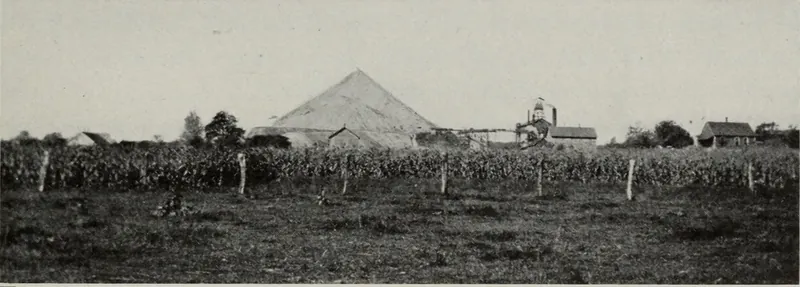
The 1885 History of Bureau County, Illinois treats coal as one of the county's important resources. The northern edge of the Illinois coal field ran through the county, and the book follows the mines from the Sheffield incline and Mineral Township's shafts to the deep shafts near Peru and Hollowayville. Its mining pages name companies, small operators, a superintendent, wages and tonnage, and they trace Bourbonnais, a mining village whose post office had closed before the book was printed.
Written from History of Bureau County, Illinois (1885). Everything below comes from that book, and where it gives an opinion, we say so. You can read the full book free on the Internet Archive.
Where the Coal Lay
The book's geology chapter says the northern boundary line of the Illinois coal field passes through the north part of Bureau County. Everything south of that line, which the book reckons at about two-thirds of the county, is underlain by the lower coal measures. Because the county sat on the northern limits of the field, the 1885 history warns, the deposits were "somewhat irregular and detached."
Miners worked several numbered seams. The No. 6 seam ran at Sheffield and was, in the book's words, geologically identified with the seam at Kewanee. Near Princeton a thinner No. 7 seam, about two and a half feet thick and of inferior quality, lay above No. 6. In the southeast corner of the county, toward Peru, the coal was the deeper No. 2 vein, the same formation worked at Peru and La Salle. The book closed its survey with confidence: there was little doubt, it said, that more coal would be found, especially in the southwest part of the county.
Sheffield: A Town Laid Out by a Coal Company
The 1885 history calls Sheffield "a miner's town in a rich agricultural country." It was laid out in 1852 by the Sheffield Mining & Transportation Company. Company and town were named for Joseph E. Sheffield of New Haven, Connecticut, one of the original owners of a 1,000-acre tract the company bought from John O. Reed. The book names the other chief men of the original company as Ebenezer Cook, Henry Farnam and Charles Atkinson, and it says plainly that the original scheme was to develop the coal on their land. They paid $10,000 for the land alone.
The company built the Sheffield Hotel and opened its first shaft in Mineral Township, near the village of that name. It also put up an early frame building with lumber hauled by wagon from Chicago. In 1852 E. Smith opened a store. The railroad put up an elevator in 1855, and A. G. Scott built another in 1860. Alex Ruthven was the company's first secretary. H. C. Porter succeeded him and left in 1875, remembered, the book says, as one of the most public spirited men the place ever had. The book's verdict on the company is that it did a great work in developing the county's coal interests and building one of its most thriving towns.
Biographical sketches fill in the Sheffield business circle. Albert W. Boyden, born in Beverly, Massachusetts, on May 24, 1833, came west in September 1853 and moved to Sheffield in the fall of 1858. After Porter died in October 1875, Boyden became Secretary and Treasurer of the Sheffield Mining Company. Watson F. Lawton settled in 1854 in what the book calls the then new village of Sheffield. In the book's population table, Sheffield Village counts 905 people, part of Concord Township's 2,686.
“It is a miner's town in a rich agricultural country. It was laid out by the Sheffield Mining & Transportation Company, in 1852.”
Inside the Sheffield Mine
The book ranks the Sheffield mine as "one of the oldest and most prosperous mining enterprises in the State." Its mines opened more than thirty years before the book was written, about the time the Chicago & Rock Island Railroad was built, and Sheffield remained an important coaling point on that line. Men here did not ride a deep shaft. The seam was reached by an inclined plane carried down about forty feet below the surface to the No. 6 coal, which averaged four and a half feet thick, and the book reports no trouble from water. By the time the book was written, the main entries had advanced a great distance from the original dump.
Steady demand for locomotive coal, the book explains, kept output fairly uniform for many years and gradually built a permanent and prosperous community of miners, many of whom owned comfortable homes. It gives the average price of mining as $1 a ton, varying with the seasons or with contracts. On labor, the 1885 history says disaffection among the men was unusual and that few efforts at strikes had occurred in years. That is the book's own view; it quotes no miners.
Mineral Township's Seven Shafts
Mineral Township, where the Sheffield company sank its first shaft, had seven working coal shafts when the book was written. The township chapter lists the owners as W. H. Forrest, John Yanvelizer, Peter Duncan, James Sprague, Hauxwell & Loyd, Victor & Fleming, and the Sheffield Mining & Transportation Company. Hickory and Coal Creeks run parallel through the township. Spellings drift between chapters: the inspector's table prints Forest and Vanvelzer, a useful warning for anyone searching indexes.
The township was organized at a town meeting on April 2, 1850. Early settlers included Thomas Grattige, a native of England and a large farmer who came in 1838, and the English Hall family, who came in 1840. Mineral village was surveyed and platted in 1857 by William Riley, who was also the first postmaster in Mineral. Its first prosperity soon declined, and by 1859 the only businesses were the blacksmith shops of Edward Hooley and West Moeks and the shoe shop of Gleason & Cooper. Prospects revived in 1865, and an elevator built in 1868 added to local business for a time. The population table counts 997 people in Mineral Township, village included.
“The seam is reached by an inclined plane, carried down to the level of the coal, about forty feet below the level of the surface.”
Bourbonnais and the Lovejoy Post Office
The book's clearest portrait of a mining village that rose and faded is Bourbonnais. John H. Robinson began sinking a shaft on his land, and soon afterward the village of Bourbonnais was platted. A switch was built the following year, and the village had a post office known as Lovejoy.
Robinson worked with partners, first Binks & Bradbury of Kewanee and afterward Binks & Higman, and later sold out to Charles Barney, who leased the coal interest to others except in the last two years, when he ran the business himself. The book is blunt that Robinson was a farmer and not a miner and did not run the mines successfully, while some of the other parties were experienced miners and made money. Six shafts were opened in the vicinity in all. Higman & Akar opened two, one on John Owen's land and one on Elbridge Stevens' farm, and ran them four years. They went down about seventy-five feet to the second vein, about five feet thick, and their chief trouble was the great abundance of water.
The post office was discontinued about 1876. The village store was started by S. Parks and Robinson, passed to Charles Shepard for two or three years, then to Binks, Higman & Co., and in 1874 to J. H. Morgan & Co., which closed it in 1877. Mining at Bourbonnais was discontinued in the fall of 1881. For a family historian, Bourbonnais and a Lovejoy postmark are names that can turn up on records from these years.
Princeton, Tiskilwa, Hollowayville and the Deep Shafts
Not every mine sat on a railroad. The most noticeable mines away from rail connections, the 1885 history says, were those near Princeton, which supplied that town chiefly. There the lower No. 6 seam was a bright, hard coal four and a half to five feet thick, about 150 feet below the surface, and the mines were free from water. The book adds that the coal was free enough of sulphuret of iron to be used in making gas at Princeton. Coal weighing was already a town office there: after the first town council was voted in on April 6, 1857, C. B. Clark and Douglas were named coal weighers.
Around Tiskilwa, outcrops in the ravines and along the bluffs of Bureau Creek had long been the local source of supply for the village and the country around it. The deep mining lay at the county's edges. Near Peru, in the southeast corner, a shaft went down about 300 feet to the No. 2 vein, about three feet thick and of superior quality. The Hollowayville Mine reached the same seam at 385 feet, and James Holloway appears as postmaster of Hollowayville in the book's early post office lists. In the southwest corner near Kewanee, a shaft went 186 feet to the seam worked at Kewanee and Sheffield.
The Inspector's Count: Operators, Tonnage and Wages
The book reprints a table from Thomas Elliott, Inspector of Mines, headed as a report on Bureau County mines for 1882. Its column of owners and operators is badly scrambled in the scan, but the names that read clearly include the Sheffield Mining & Transportation Co., James Sprague (printed Spracue), James M. Wood, A. Lyford, Peter Duncan, W. H. Forest, John Vanvelzer, A. B. Ashley as superintendent, Fletcher Bros., Elizabeth Foster, A. W. Walton, Joseph Vanes, John Nichols and Seaton Bros. Post office addresses in the table include Sheffield, Buda, Mineral, Kewanee in Henry County, Princeton, La Salle, Peru and Hollowayville. The table shows mines hoisting by steam and others by horse gin.
In the text, the book gives the county's output for 1881, a year earlier than the table's heading, as 61,454 tons, mined in spite of a very unfavorable season. It was worth an average of $2.03 a ton at the mines, or $124,751 in all, and about $75,000 of that went out in wages to about 225 men.
Mining also fed local industry. At Buda, the Ford & Mason Company, chartered in 1883 with a paid up capital of $24,000, made railway and mining supplies, architectural iron and castings, and employed an average of forty to fifty men.
The 1885 history does not say where Bureau County's miners came from. Its county-wide count of foreign-born residents lists 1,798 from the German Empire, 1,048 from Ireland, 750 from England, 320 from Denmark and 200 from Canada, in a county whose 1880 population was 33,189. For mining families, the best leads in the book are the operator names above, the Sheffield company officers, and the township chapters for Mineral and Concord.
Finding your ancestor in Bureau County
- Census records (free through 1950) list each person's occupation and town, so a mining family shows up decade by decade.
- Death records: search our Illinois database by surname.
- The county histories themselves: the biographical sections of History of Bureau County, Illinois hold hundreds of family sketches.
- Newspapers on the Library of Congress's Chronicling America carried obituaries, accidents, and local news.
Tell us one grandparent's name. We'll take a free first look at the records and email you back.
Ask about my family →Frequently asked questions
When did coal mining start at Sheffield, Illinois?
The 1885 History of Bureau County says the Sheffield mines opened more than thirty years before the book, about the time the Chicago & Rock Island Railroad was built. The Sheffield Mining & Transportation Company laid out the town in 1852 and opened its first shaft in Mineral Township, near the village of that name.
Which coal operators does the 1885 Bureau County history name?
Mineral Township's seven shafts belonged to W. H. Forrest, John Yanvelizer, Peter Duncan, James Sprague, Hauxwell & Loyd, Victor & Fleming and the Sheffield Mining & Transportation Company. Thomas Elliott's inspector's table adds names such as James M. Wood, A. Lyford, Fletcher Bros., Elizabeth Foster, A. W. Walton, Joseph Vanes, John Nichols and Seaton Bros.
What happened to the mining village of Bourbonnais?
John H. Robinson sank a shaft on his land and the village was platted soon after, with a post office called Lovejoy. Six shafts were opened nearby, about seventy-five feet deep and troubled by water. The post office closed about 1876, the store closed in 1877, and mining stopped in the fall of 1881.
How much coal did Bureau County produce in the early 1880s?
The book gives the 1881 output as 61,454 tons, worth an average of $2.03 a ton at the mines, or $124,751 in total. About $75,000 was paid in wages to about 225 men. The table it prints from Inspector Thomas Elliott is headed 1882, so the two years do not match.
Photographs on this page are in the public domain. About the images and their sources.