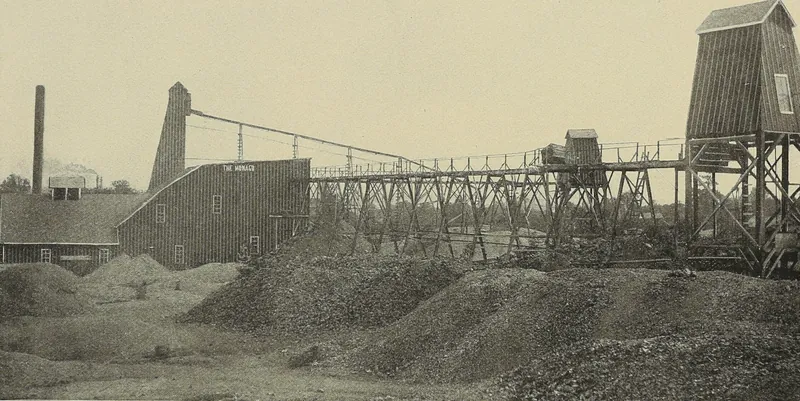
In the spring of 1877 two men swimming in Short Creek brought up a chunk of lead, and that same year the Scammon brothers opened the county's first coal shaft. By the time the 1904 History of Cherokee County, Kansas, and Representative Citizens was compiled, coal camps covered the north-central townships and the Galena district held all of the lead and zinc mining in Kansas. This page follows the book's account of the mines, the towns and the people who worked them.
Written from History of Cherokee County, Kansas, and Representative Citizens (1904). Everything below comes from that book, and where it gives an opinion, we say so. You can read the full book free on the Internet Archive.
Coal under Cherokee, Mineral and Ross townships
The 1904 history ranked coal mining as the county's second greatest industry, but said it took more capital and employed more men than any other. The whole north-central part of the county, it explained, sat on a two-and-a-half-foot seam of coal about fifty feet down and a four-foot seam at about one hundred and fifty feet. The book reported that Cherokee County mined more than one-third of all the coal produced in Kansas, second only to Crawford County.
Mining centered on three districts: Weir City in Cherokee township, Scammon in Mineral township, and Mineral City in Ross township, the newest of the three. Up to 1900 the county had 46 shafts in operation, and by the time of writing the author counted about 60. In Ross township alone, where there had been a single shaft nine years earlier, 28 were working. The book described the three townships as a network of railroad tracks, with switch engines working in all directions at all hours.
Scammon and the first shaft, 1877
The first coal shaft in the county was opened at Scammon in 1877 by the Scammon brothers, for whom the town was named, and the book says it was the first in Kansas south of the Leavenworth district. E. C. Scammon held the quarter section just north of the later townsite, Samuel F. Scammon claimed land northwest of that, and James Coman, who came to the county in 1868, took the quarter west of town. The book credits Coman with discovering the coal. E. A., S. F. and E. C. Scammon put the shaft down on E. C. Scammon's land near what became Mackie's Junction, about a mile north of the later city.
Only a few men were employed at first. The Kansas City, Fort Scott & Gulf Railroad had been finished through the county in the spring of 1871, yet as late as 1883 the land around Scammon was still farms with a single plain store. By then three shafts were running under Keith and Mitchell, who had bought out the Scammon brothers. The Scammon Town Company was incorporated March 15, 1884, with E. C. Scammon as president and D. Mackie as secretary. Scammon became a city of the third class on July 5, 1888, with P. M. Humphrey as its first mayor.
“Even as late as 1880, Weir City was a mere mining camp containing only about 350 people.”
Weir City and the Central Coal & Coke Company
Weir City grew on land entered by T. M. Weir, born in Washington County, Pennsylvania, on March 2, 1814. He came to the county in 1871, laid out the original plat on 40 acres of his quarter section, and began opening coal mines at once. The first operators included Fred Blattner, the Oswego Coal Company and Bovard & Dixon. Growth was slow at first: Weir City had only about 350 people in 1880, but the 1900 census counted 3,091. The book says the famous Cherokee steam coal was first mined in the original district between Weir City and Scammon.
The largest operator was the Central Coal & Coke Company. Its roots went back to 1871, when Richard H. Keith opened a retail coal yard in Kansas City. After several partnerships, including Keith & Perry from 1881, the firm took the Central Coal & Coke name in 1893. In April 1902 it raised its capital to $7,000,000 and bought the mines of the Kansas & Texas Coal Company. The book credited it with 45 mines, about 9,000 men and an average payroll of $10,000 a day. In the Cherokee district it had 13 mines producing 9,000 tons each working day, with the Weir City mines under Hugh Reid and C. N. Sweeney as district manager.
Mineral City and the price of coal land
The book tells Mineral City's land story through two brothers. About twelve years before the book, Johnson Patterson, living near where the Mineral City station later stood, offered his quarter section at $20 an acre, and two years later he happily sold it for $25. His brother Leslie Patterson, who had taken the quarter just north as a claim, kept his. He later leased it for mining only, was earning $300 an acre in royalty, and had sold $14,000 worth of town lots. At one time within the previous twenty years, the book says, he had offered to take less than $1,000 for land it valued at $75,000 in 1904. A Leslie Patterson also appears in the book's list of Union veterans, a private in Company E, 102d Illinois Infantry, with a Mineral post office.
Mineral City proper had about 1,200 people, and nearly every family owned its home; the book put the whole mining community at about 3,000. Coal shipments ran about 2,500 car-loads a month for four months of the year and about 1,800 a month the rest. The author complained that prices to local coal buyers had risen nearly 100 percent in 15 years, for no reason, in his view, except the operators' profit.
“They bantered each other as to which could bring up the heaviest stone from the bottom of the stream.”
Lead in Short Creek: Galena and Empire City
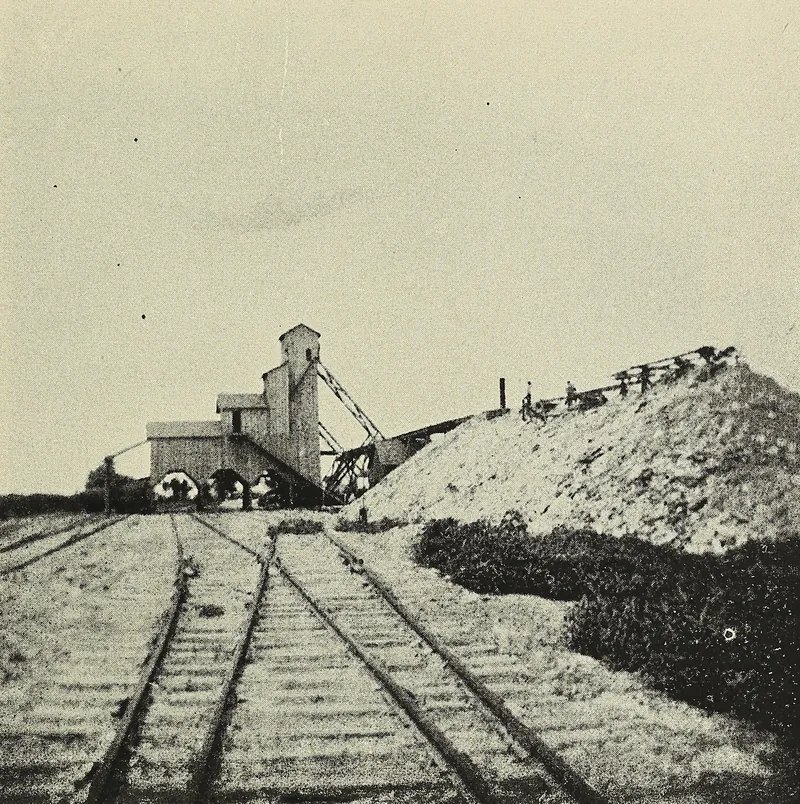
Lead and zinc were found in April 1877 in the bed of Short Creek. The book prints a letter dated June 26, 1904, from Charles E. Topping of Empire City, who arrived in June 1877 and later became a partner of John McAllen, one of the discoverers. As Topping told it, McAllen and John Shoe had been driven out of Joplin as vagrants and were walking to the home of Shoe's mother on Spring River, near the Ryan ford. They stopped to swim at a deep hole in Short Creek, dared each other to bring up the heaviest stone, and one of them surfaced with a chunk of lead. On land owned by the Nichols brothers, who supplied tools and board for half the take, their shaft became known as the "Discovery Shaft." They soon sold out; Topping wrote that McAllen had only about $75 of his share left when he last saw him.
The West Joplin Mining Company bought out the Nichols brothers, laid the land off in mining lots and platted the town of Empire on the north, while Galena was laid off to the south. Lead buyers in Galena paid more than the company did, so the company built a stockade fence between the towns. Early one morning in the fall of 1877 a crowd chopped it down and burned it, and one workman was shot in the leg. A court later declared the stockade unlawful. Empire City incorporated in the summer of 1877 with S. L. Cheney as its first mayor, but Galena, named for the mineral so abundant there, won the rivalry, and the field came to be called the "Galena District."
Ore, tailings and the people of the Galena district
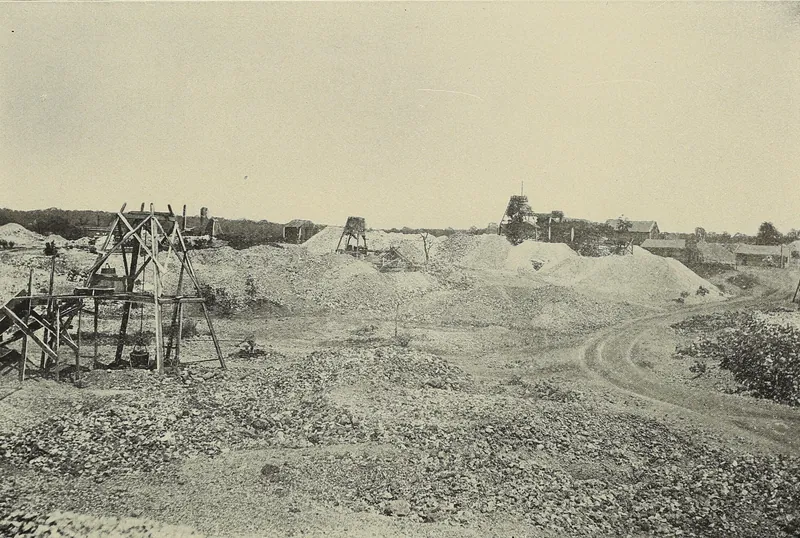
Drawing on Erasmus Haworth's state bulletin, the book reported that from 1886 through 1901 the Galena district produced 633,683.63 tons of zinc ore sold for $15,144,640.70 and 105,178.46 tons of lead ore sold for $4,542,260.25, or $19,686,900.95 in all. Zinc output peaked in 1898, lead in 1897. Unlike coal, these ores lay in scattered pockets, so a man could sink a shaft beside a neighbor's rich strike and not even get a "shine." Rock went through crushers and water "jigs," and newer "sludge mills" reworked the "tailings." Nearly all the ore was shipped out of the county to be smelted.
The book is frank that Galena was transient: it judged that not one newcomer in twenty stayed, and it wrote dismissively of the drifters, though it said those who stayed included more well-to-do people than most towns its size. It reprints a list of Galena men from a county history published 21 years earlier, among them Spencer Cooper of The Cooper Mining & Crushing Works, John F. Cody of The Cody Crushing Company and Harry Tamblyn, secretary of the Cornwall Mining Company. It also prints the operators named by the Galena Times of July 28, 1904. Mining-era land deals were recorded with the register of deeds at Columbus, including a January 11, 1904 sale of more than 1,000 Empire City town lots for $60,000. The book's list of Union veterans also gives post offices at Galena, Empire City, Weir, Scammon and Mineral.
Finding your ancestor in Cherokee County
- Census records (free through 1950) list each person's occupation and town, so a mining family shows up decade by decade.
- Death records: search our Kansas database by surname.
- The county histories themselves: the biographical sections of History of Cherokee County, Kansas, and Representative Citizens hold hundreds of family sketches.
- Newspapers on the Library of Congress's Chronicling America carried obituaries, accidents, and local news.
Tell us one grandparent's name. We'll take a free first look at the records and email you back.
Ask about my family →Frequently asked questions
Who discovered lead at Galena, Kansas?
According to a 1904 letter from Charles E. Topping printed in the county history, John Shoe and John McAllen found a chunk of lead while swimming in Short Creek in April 1877. They sank the "Discovery Shaft" on land owned by the Nichols brothers, then sold out soon after.
Where was the first coal shaft in Cherokee County?
The book says the first shaft was opened at Scammon in 1877 by the Scammon brothers, on E. C. Scammon's land near what became Mackie's Junction, about a mile north of the later city. It calls it the first coal shaft in Kansas south of the Leavenworth district, and credits James Coman with discovering the coal.
How much lead and zinc did the Galena district produce?
Using Erasmus Haworth's bulletin, the 1904 history reported that from 1886 through 1901 the district produced 633,683.63 tons of zinc ore worth $15,144,640.70 and 105,178.46 tons of lead ore worth $4,542,260.25, for a combined $19,686,900.95. The book stressed that only a small part of that was clear profit.
Where were Cherokee County mining land deals recorded?
The book says the records of the big real estate transactions tied to mining could be found in the office of the register of deeds at Columbus. Examples it gives include James Murphy's 1904 sale of Empire City lots and W. S. Norton's sale of coal lands to The Fidelity Land & Improvement Company.
Photographs on this page are in the public domain. About the images and their sources.