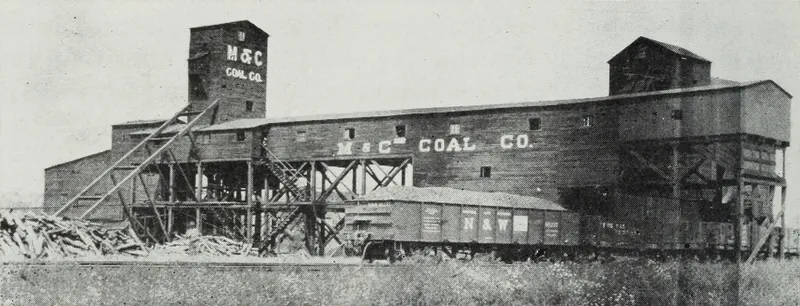
Coal in Christian County, as the 1880 county history tells it, was more promise than payroll. The book describes a coal formation under the whole county, a handful of thin outcrops, a hillside drift south of Pana, and one deep shaft at Edinburg that took years to sink. If your ancestors lived near Coal creek or around Edinburg, this is the story the county's first history recorded about the ground beneath them.
Written from History of Christian County, Illinois (1880). Everything below comes from that book, and where it gives an opinion, we say so. You can read the full book free on the Internet Archive.
What the 1880 history found underground
The geology chapter of the 1880 history was not written locally. The publishers credit A. H. Worthen, editor of the State Geological Report,. That report describes the county's Coal Measures as about 230 feet thick, with two coal seams in view, only one of which is of workable thickness.
According to the book, these measures lie under the whole county, but you could only see them in a few places. There were no outcrops in the southwest or the northeast quarter. Exposures were limited to a small district south of Pana, to Locust Fork, to the South Fork for ten miles upstream from the west county line, to the North Fork for three miles from the west line, and to one more spot between the forks. Everywhere else, deep drift deposits covered the rock.
On the North Fork, a low bluff of drift clay held bituminous shale and a little coal. A sandstone on the South Fork, five miles below Taylorville, carried Calamites and other coal plants. A quarter mile above Greenwood's mill, in section 29, township 14 north, range 3 west, the survey recorded a thin seam it numbered Coal No. 12.
Stone Coal Precinct: Pana's first name
The clearest mark coal left on the county's early record is a name. Pana township was first called Stone Coal Precinct. It belonged to Shelby County until Christian County was organized in 1839, and the county commissioners' court formed the precinct on June 5, 1845. The book says the precinct took its name from Coal creek, a small stream along whose banks stone coal outcropped in limited quantities.
The name lasted about eleven years. On September 2, 1856, it was changed to Pana Township on the petition of Mason French and thirty other legal voters, which Milan S. Beckwith presented to the county court. Beckwith had already been appointed first postmaster of the "Stone Coal" post office, established in 1854 and kept at first in his store shanty close to the Central railroad below Pana, before it was moved into Pana.
Two early settlers tie the old name to real families. Joseph Edwards, a native of Ireland, settled on Coal creek on March 26, 1845. The book calls him one of the noted eighteen voters of Stone Coal Precinct; his house served as the precinct's voting place for years, and he was a justice of the peace. He died in October 1855, aged sixty-eight. William Pryce, born in England on February 28, 1817, came in 1845, taught the first school in that part of the county, and served as deputy tax collector. The whole tax collected in the precinct that year came to $7.00.
One discrepancy for researchers: the Pana chapter says nineteen votes were cast at the first election, at Andrew Hanson's house on August 2, 1845, counting five Bell's Grove voters attached to the precinct.
“Joseph Edwards, a native of Ireland, settled on Coal creek in this county March 26, 1845.”
White's bank and the drifts on Coal creek
The only coal workings the book places near Pana were small ones. In its economic geology section it says that south of Pana, coal had been taken out at several places along the head waters of Coal creek. The one it names is White's bank, on section 34, township 11 north, range 1 east.
At White's bank the seam was about twenty-two inches thick and, in the book's words, of good quality. It was not reached by a shaft. Miners got at it by drifting into the hillside, at about thirty feet above the level of the creek. The geology chapter adds that the rocks at White's bank were the highest in the county's sequence, and that from Pana there was a regular southerly dip of thirty feet to the mile, running four miles south.
The book does not give the first name of the White who owned or worked the bank, how much coal came out, or who dug it. The surviving excerpt breaks off in the middle of the White's bank description, so anyone tracing a White family on Coal creek should go to the full volume.
Dr. Greenwood's shaft at Edinburg
The most detailed coal story in the 1880 history is the shaft at Edinburg. On August 22, 1873, Dr. Basil Greenwood and John McKeman (the spelling in the scanned text) signed a contract to sink a shaft for coal on land owned by William W. Halford. The site was in what was then Blueville, later Edinburg. The shaft measured six feet by twelve feet in the clear, with a partition down the middle that made it two six-foot shafts.
At about 70 feet McKeman became dissatisfied and sold out to Greenwood, who kept going. The work was done with one horse and three to five men, and the shaft took over four years to sink. The book prints a long table of the layers passed through, from drift clay down through sandstones, quicksand, fire clay, limestones and several thin coal streaks. The table closes by giving the exact depth as 315 feet; the depth and cost figures printed earlier in the passage are too damaged in the scan to read with confidence.
Greenwood did not find the coal he wanted. He let the shaft sit for nearly three years and fill with water. In the spring of 1879 he brought in an engine, hoisted out the water, and drilled nearly seventy feet deeper, but found nothing worth sinking for. So he put his hands to work on the last 18 inch vein. That coal, the book says, proved to be a very good article, and with fire clay lying directly beneath it, the shaft could be worked profitably.
The publishers note that they got the facts of this account from Dr. Greenwood himself. Their verdict on the county as a whole is blunt: this was the only mine in the county where coal had been raised to any extent, though large sums of money had been spent prospecting for it.
“The shaft was sunk with one horse, and from three to five men, and was over four years being sunk…”
Railroads, towns and what the book leaves out
By 1880 the coal places in the book were already tied together by rail. Edinburg grew on Daniel De Camp's "Blue Point" farm and stage stand, which he bought in February 1851; the book says the town of Edinburg was located on his land. Edinburg sat on the Springfield division of the Ohio and Mississippi, which ran from the northwest corner of the county through Taylorville to Pana. The first train reached Taylorville on October 28, 1869. At Pana, three railroads intersected: the Illinois Central, the O. & M., and the I. & St. L. The Pana chapter says the township's population rose quickly with the coming of railroads in 1854.
The 1880 history names no coal company, no superintendent, no list of miners, and no wages, strikes or accidents, and it says nothing about where coal workers came from. The people it connects to coal are the men behind the Edinburg shaft (Greenwood, McKeman and Halford) and early Stone Coal Precinct settlers such as Edwards, Pryce and Beckwith. One Pana biography does describe mining, but far from home: William H. Newcomb went west, became a miner in Colorado for a year, then worked in Montana Territory before returning to Pana in 1866. If your ancestor dug coal in Christian County, his trail most likely lies in records made after this 1880 book.
Finding your ancestor in Christian County
- Census records (free through 1950) list each person's occupation and town, so a mining family shows up decade by decade.
- Death records: search our Illinois database by surname.
- The county histories themselves: the biographical sections of History of Christian County, Illinois hold hundreds of family sketches.
- Newspapers on the Library of Congress's Chronicling America carried obituaries, accidents, and local news.
Tell us one grandparent's name. We'll take a free first look at the records and email you back.
Ask about my family →Frequently asked questions
Why was Pana township once called Stone Coal Precinct?
The 1880 history says the precinct, formed June 5, 1845, took its name from Coal creek, a small stream where stone coal outcropped along the banks in limited quantities. The name was changed to Pana Township on September 2, 1856, after a petition by Mason French and thirty other legal voters.
Where was the first real coal mine in Christian County?
The book points to Dr. Basil Greenwood's shaft at Edinburg, begun under an August 22, 1873 contract on William W. Halford's land. It calls this the only mine in the county where coal had been raised to any extent, though large sums had been spent prospecting elsewhere.
How thick was the coal near Pana?
At White's bank, on section 34, township 11 north, range 1 east, south of Pana, the 1880 history describes a seam about twenty-two inches thick and of good quality. It was worked by drifting into the hillside about thirty feet above Coal creek rather than by a shaft.
Does the 1880 history name Christian County coal miners?
No list of miners appears in the excerpt. It names landowners and promoters such as Basil Greenwood, John McKeman and William W. Halford at Edinburg, and early Stone Coal Precinct settlers like Joseph Edwards and William Pryce. It records no wages, strikes, accidents or miners' origins.
Photographs on this page are in the public domain. About the images and their sources.