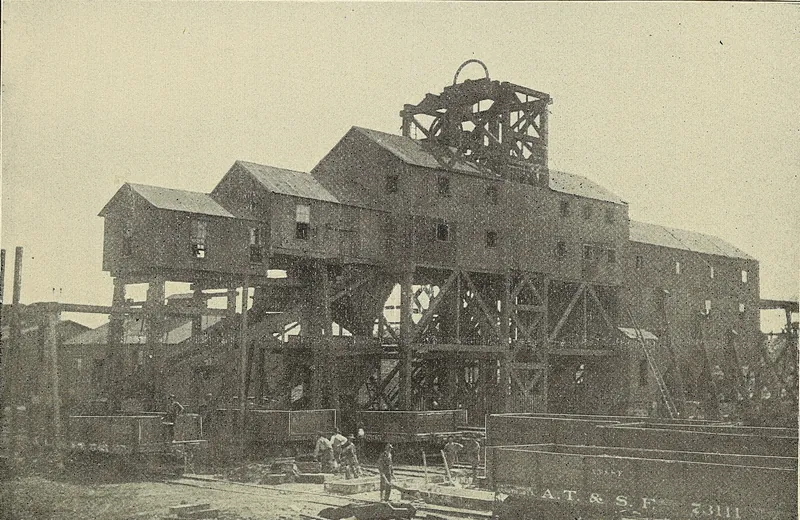
In 1905 the Twentieth Century History and Biographical Record of Crawford County, Kansas gave a full chapter to coal, written by Fred Henney, mining editor of the Pittsburg Headlight. He opened by saying the county's mining history "is really the history of Pittsburg." This page follows his account, the book's town sketches and its biographies, from teamsters digging outcrops before the Civil War to sixty-two shafts and nearly 7,000 men in 1903.
Written from A Twentieth Century History and Biographical Record of Crawford County, Kansas (1905). Everything below comes from that book, and where it gives an opinion, we say so. You can read the full book free on the Internet Archive.
Outcrops and teamsters before the shafts
Henney writes that before the Civil War, teamsters dug it from strip and slope workings in the southeast of the county and hauled it across the prairie to Fort Scott or Carthage, Missouri, where settlers traded it for groceries. During the war, coal for the army at Fort Scott came mostly from banks along Drywood and Bone creeks on the county's northern edge.
A. J. Georgia, who settled on the future Pittsburg townsite in 1867, said settlers had been hauling outcrop coal to Carthage for years, among them Frank Dosser, one of the first county commissioners, Marion Medlin and a man named Daniels. When the Missouri River, Fort Scott & Gulf built through the county, its agent reported that the coal lay only on the surface and mining would never pay, so the company sold land for less than $5 an acre that its successors were later glad to buy back at $75 and $100.
The biographies add their own pioneers. J. E. Harmon came in 1869, settled where Litchfield later stood, and, the book says, mined the first coal there, on a custom basis for some nine years. Joseph E. Bevins, born near Perry City, Illinois, to English parents, came in 1870 and first mined at Fort Scott. In 1874 he began stripping coal where the Litchfield bridge later crossed the east prong of Cow creek, selling it to farmers for a cent and a half a bushel.
Carbon creek, Edwin and Litchfield
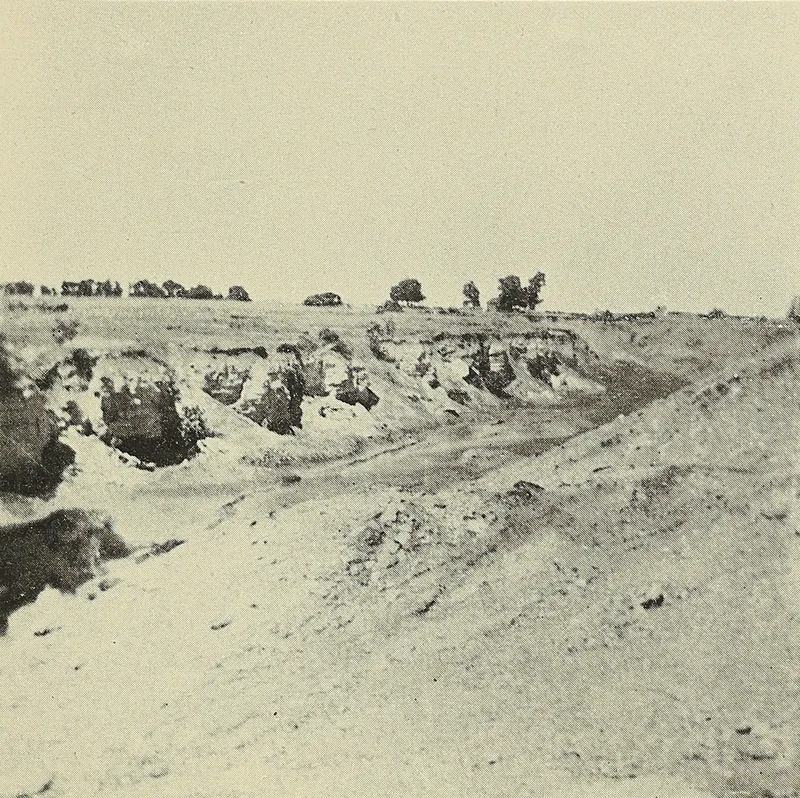
The branch of Cow creek along the south edge of Litchfield was named Carbon creek for its coal, and Henney calls it the county's first mining camp, with strip pits and slopes run along the veins. By 1877 perhaps one hundred miners worked there. Early operators included Piper & Sawyer, whose P. H. Sawyer was the first to run a drift, Tom Fields of Joplin, a Girard man named Anderson, and an Irishman named Dugan, who opened a slope about 1876.
Steam came next, and the book tells it two ways. Henney says railroad contractor Jack Armel leased Jeff Bedford's ground and sent to Ohio for James A. and Charles Patmor, who brought a steam shovel outfit and stripped north of Edwin; Charles Patmor also opened the first coal pits at Midway. The biography of John N. Hodges, Armell's partner on the Joplin and Girard Railroad, credits Hodges with bringing the shovel from Ohio and stripping at Carbon in the fall and winter of 1876 to 1877. It did the work of thirty or forty teams, the first machinery in the Pittsburg district.
The camp was first called Edwin, for Col. Edwin Brown, and got a postoffice in 1879 with Bedford as postmaster. Another Kansas postoffice already had that name, so it became Carbon, then Litchfield, because Carbon conflicted with Carbondale. For a while it was the more important camp, with work all along the creek while Pittsburg had one shaft. By 1905, the town sketches say, the moving away of the mines and the company store had nearly depopulated it.
“The mining history of Crawford county is really the history of Pittsburg…”
Joplin money and the Coyle shaft
"It was Joplin men who started the coal mining industry" here, Henney writes: the zinc and lead boom around Joplin needed fuel. Moffatt and Sergeant of Joplin financed Colonel Edwin E. Brown's railroad from Girard to the zinc mines and bought the Pittsburg townsite. They leased ground to Peter and Matt Coyle of Joplin, who began a shaft in the spring of 1877. Pittsburg then was a crossroads store at what became Fourth and Broadway and about half a dozen houses.
James Vincent, an early pit boss at the Coyle shaft, said it was the first. Probate Judge T. R. Jones said the gin shaft he sank at Litchfield for George W. Anderson of Joplin, started July 24, 1877, came earlier. All agreed the Coyle shaft was the first steam shaft. A man named Carson was its first pit boss. Vincent came over from the Piper & Sawyer slope in August 1877 and re-timbered the shaft, which had caved in twice.
What made Pittsburg permanent, in Henney's telling, was zinc. Robert "Bobbie" Lanyon of Mineral Point, Wisconsin, inspected the Coyle coal and built a block of zinc smelters, fed by coal hauled in wagons. Slack coal had been worthless, and the Coyles had paid men to haul it away. In the winter of 1903 to 1904 slack sold at the mines for $1.75 a ton, and the camp had grown into a city of 16,000.
Company houses, company stores and the Frisco
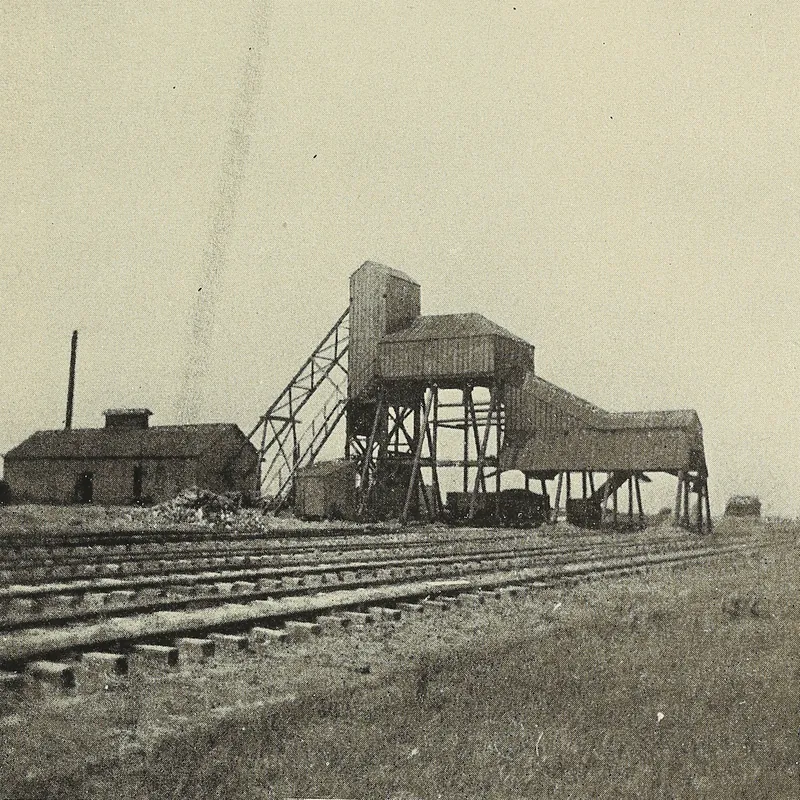
After Peter Coyle died, Matt sold the business to the Oswego Coal Company, headed by B. F. Hobart with C. M. Condon, which sank No. 2 in the spring of 1880. That winter Bill Weaver built twenty-eight company houses at Carbon, the first there, and the county's first company store opened with T. P. Waskey as manager, "if the writer's information is correct."
In 1882 the St. Louis & San Francisco took over the Moffatt & Sergeant road and the Oswego property and formed the Rogers Coal Company, named for General Superintendent Rogers. Henney says independents paid exorbitant Frisco freight rates and nearly stopped work. "Cottonwood" Davis, Major Rombauer and Charles Patmor formed the Pittsburg Coal Company and sank shaft "A" under John R. Braidwood, with John Kilholland as pit boss; short of cars, Davis led the push to get the Gulf road built down from Minden. The Rogers company sank Nos. 5, 6 and 7 at Weir and its ninth mine at Litchfield in 1884.
In 1885, after the legislature barred railroads from owning coal lands, the Rogers company became the Kansas & Texas Coal Company, to evade the law "it is claimed." It sank Nos. 12 and 13 in Pittsburg in 1885, No. 15 in 1886 and No. 20 in 1888, all later abandoned and built over with homes. David Ramsey was local superintendent in its best decade. A prolonged strike weakened it, and the Central Coal & Coke Company absorbed it about three years before the book, operating eleven mines in the county.
“He began working in the coal mines when he was nine years old…”
Boom camps: Midway, Fleming, Yale, Frontenac, Chicopee
Henney dates the boom to 1885 and 1886, when ten or twelve new coal concerns started. In May 1885 Colonel Brown, W. H. and James Chick of Kansas City and J. T. Morrison formed the Pittsburg & Midway Coal Company, stripping at an old stage stop called "Holes-in-the-Prairie," renamed Midway because it lay midway between Fort Scott and Baxter Springs.
The Gould railroad interests brought the Western Coal & Mining Company, which sank No. 1 at Minden in 1885 under Ira Fleming, for whom the camp of Fleming south of Pittsburg was named. In 1887 No. 3 went down at Fleming and No. 4 at Yale, a new camp north of Litchfield named, Henney says, "for some unknown reason" after the eastern college. Josiah Lane of Rich Hill followed Fleming, then James Gardner in 1891. The company had sunk eleven shafts in the county; its No. 12 was at Folsom in Cherokee County.
In 1886 Topeka capitalists tied to the Southern Kansas railroad, later the Santa Fe, formed the Cherokee & Pittsburg Coal & Mining Company, sank No. 1 and founded Frontenac, with Robert Craig as superintendent. A second camp, Chicopee, grew south of Pittsburg around No. 4. Pittsburg merchants paid the company $7,000 to keep company stores out of both camps, until its successor, the Mount Carmel Coal Company of C. J. Devlin, a former bookkeeper from Spring Valley, Illinois, opened stores. Mount Carmel opened nine mines, six at Frontenac and three at Chicopee.
The book disagrees with itself on Frontenac's size: two thousand people in the town sketch, about three thousand in the mining chapter. Its shafts were one hundred and twenty feet deep, in forty inches of coal. Chicopee had about one thousand people, most of foreign birth, Italians predominating. In 1892 Frank Wear and Archie Kirkwood bought the Anderson shaft below Pittsburg, started it August 1, and named the camp Kirkwood; the Wear Coal Company went on to open twelve shafts around Pittsburg.
Not every camp lasted. About 1886 a man named Johnston from Topeka sank the Lone Oak shaft northwest of Pittsburg. Its coal was fine, but pillars left too small made it "squeeze." Later operators included Matthew and Andrew Hamilton, whom Frisco litigation nearly cost their farms. The first mine explosion in the county happened at Lone Oak, catching four miners and killing two or three. Only a black spot where nothing grew marked the old dump.
Mulberry, Englevale, Cherokee and the smaller camps
Mulberry took its name from a grove of wild mulberry trees on the old military road. Mines opened nearby about 1871, and the book calls it an extensive shipping point. David Arnott ran the Dickey & Mullholland shaft near Mulberry. Englevale, laid out in the fall of 1890 on land of David Dick and Jerry Ingals, had a shaft employing about one hundred men in coal thirty to forty-two inches thick.
Fuller, Yale and Nelson were mining towns of about five hundred people each, the people "nearly all engaged in mining." At Cherokee, O. A. Rees leased the Cherokee Coal and Mining Company No. 1, taking two to three thousand tons a month from a three and a half foot vein with fifty to a hundred men. Weir, which the book places in Cherokee County, was home to William Hamilton's Hamilton Coal Company.
The miners, their origins and their strikes
Henry Wilson of Northumberland, England, began in the mines at nine and reached America in 1879; after running Santa Fe mines at Frontenac he organized the La Belle Coal and Mining Company a mile west of town, with about fifty-five men and his sons as weighmaster, engineer and pit boss. Archibald B. Kirkwood of Lonaconing, Maryland, son of a Glasgow-born father, started at thirteen keeping trap door and driving mules, and became general manager of the Wear company, with about eleven hundred men in the Pittsburg district.
The book also records the 1893 strike. Thomas McGregor started the Miner's Echo during it, and the Pittsburg Daily World opposed it so harshly that miners hanged its editor in effigy two or three times. W. H. Ryan of Girard wrote the law making the mine inspector elective, placing the office "in the hands of the miners themselves." The newspaper chapter notes a large German population and a brief 1903 paper, the Afro-American, for Pittsburg's Black residents. By Henney's count, that year forty-four concerns ran sixty-two shafts, employed nearly 7,000 men and mined more than four-fifths of all Kansas coal.
Finding your ancestor in Crawford County
- Census records (free through 1950) list each person's occupation and town, so a mining family shows up decade by decade.
- Death records: search our Kansas database by surname.
- The county histories themselves: the biographical sections of A Twentieth Century History and Biographical Record of Crawford County, Kansas hold hundreds of family sketches.
- Newspapers on the Library of Congress's Chronicling America carried obituaries, accidents, and local news.
Tell us one grandparent's name. We'll take a free first look at the records and email you back.
Ask about my family →Frequently asked questions
When was the first coal shaft sunk in Crawford County, Kansas?
The 1905 history says Peter and Matt Coyle began a shaft in Pittsburg in the spring of 1877, and all pioneers agreed it was the first steam shaft. Judge T. R. Jones claimed his gin shaft at Litchfield for George W. Anderson, begun July 24, 1877, was sunk earlier. Strip and slope mining went back to before the Civil War.
What were Litchfield's earlier names?
The camp on Carbon creek was first named Edwin, for Col. Edwin Brown, and got a postoffice in 1879. It became Carbon because another Kansas postoffice was named Edwin, then Litchfield because Carbon conflicted with Carbondale. The 1905 history says the moving away of the mines and company store had nearly depopulated it.
Which companies opened Frontenac and Chicopee?
The Cherokee & Pittsburg Coal & Mining Company, formed by Topeka capitalists tied to the Southern Kansas railroad, founded both camps. Its successor, the Mount Carmel Coal Company headed by C. J. Devlin, had opened nine mines there by 1905, six at Frontenac and three at Chicopee. The book says Chicopee's people were mostly foreign born, Italians predominating.
How big was Crawford County coal mining in 1903?
Fred Henney's chapter counts forty-four mining concerns operating sixty-two shafts in 1903. They employed nearly 7,000 men and produced over four million tons, which he says was more than four-fifths of the entire output of the state of Kansas.
Photographs on this page are in the public domain. About the images and their sources.