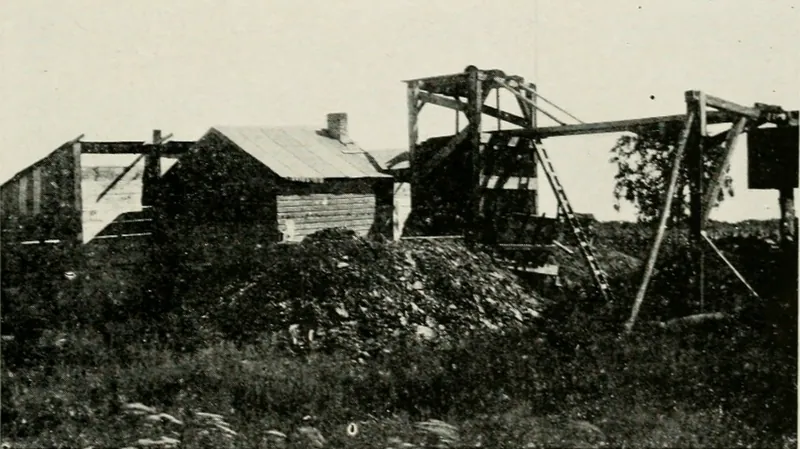
The 1882 History of Grundy County, Illinois describes a county sitting on coal. Its geology chapter says the seam underlay fully three fourths of the county. The book follows that coal from the first coal bank dug near Morris by Samuel Wood and Daniel Williams, through a ten-year shaft at Gardner, to the big company shafts around Braceville, Coal City and the Diamond, and it names the operators, bosses, accident victims and Scottish, Welsh and English families who did the digging.
Written from History of Grundy County, Illinois (1882). Everything below comes from that book, and where it gives an opinion, we say so. You can read the full book free on the Internet Archive.
A seam under three fourths of the county
The geology chapter of the 1882 history says coal underlay fully three fourths of Grundy County, with the seam averaging about three feet thick except on the borders of the field. The heaviest working was right around Morris, where upwards of one hundred openings had been made, most of them abandoned by the time the book was written. Most were shafts thirty to sixty feet deep, plus several large strippings, some exposing thirty inches of coal and others on the edge of the outcrop no more than eighteen.
Farther south the coal lay deeper. The chapter lists a shaft at Braceville ninety-eight feet deep, another in section 26 of the same township at 110 feet, and one at Gardner 160 feet deep. Miners everywhere fought "faults" and "rolls" that broke up the seam, and all coal mined in the county carried some pyrite. One shaft east of the Jugtown pottery near Goose Lake hit coal at forty feet, gave about 300 bushels, and then the coal stopped abruptly on every side.
The 1882 history judged the product of the main seam a fine steam and grate coal and said much of it went to the Chicago market, only sixty-two miles away. The chapter also calls the fossil-filled iron nodules of Mazon Creek one of the richest deposits of Carboniferous Articulates ever discovered, if not the richest.
Morris: the first coal bank and the Scottish colliers
Samuel Wood, born in England on January 4, 1824, mined for two years at Peoria before he settled at Morris in the spring of 1854. There he and Daniel Williams opened what the book calls the first coal bank ever started in the vicinity of Morris. For the next ten years Wood farmed in summer and mined in winter.
Scottish families dominate the Morris mining sketches. Henry Burrell was born in Edinburgh on September 30, 1843. His father, Archie Burrell, died of cholera in Chicago, and in the fall of 1854 his mother brought her three sons to Morris. The boys worked for their uncle, Alexander Telfer, a coal merchant, then went into the mines to support their mother. In 1866 Henry formed H. Burrell & Co.; his mines lay a mile and a half northeast of Morris, between the railroad and the canal. His brother Alexander, a collier born in Edinburgh in 1850, belonged to Gould, Buchanan & Burrell, which had two shafts near the Chicago & Rock Island Railroad inside the city limits.
A second Alexander Telfer, a miner born at Musselburg, Scotland, on November 1, 1826, worked the Pennsylvania Coal Company mines at Pittston until January 1855, then came to Morris and worked three years in the mines of Oliver and Alexander Telfer, the latter his cousin. In 1858 he opened his own mine, and from 1865 he made brick alongside his coal business with Henry Burrell. Francis Hall, born in Scotland in 1830, was in the Morris coal trade until 1868 and in 1861 sank the first shaft on the Conklin road. Note that the book names more than one Alexander Telfer in the Morris coal trade.
“Raised and educated in Scotland, and came to the United States in 1869…”
Gardner: a ten-year shaft and a broken rope
Gardner people raised money by subscription to pay for drill tests. James Congdon and Wm. H. Odell then leased the north part of the village plat from H. A. Gardner, J. C. Spencer, T. C. Meyer, C. H. Goold and others. Under the lease they could take coal free for the first seven years and would then pay a royalty of six cents per ton. The town raised $2,000 more by subscription to get them started. The first hole caved in at sixty feet and was abandoned, and Congdon sold out to Odell before coal was reached.
Odell sold to Wm. A. Steel and Thomas Kerr, and Steel sold half his interest to D. G. Wells. On January 22, 1867, the three sold to Aaron K. Stiles for $25,000. Stiles sold to the Gardner Coal Company on April 17, 1872, and the C., W. & V. Company ran it until the summer of 1874, when it closed. The book says experts called the coal fully equal to any in the State and that the shaft lasted ten years. Stiles also made brick from the fire clay, the source of most of Gardner's brick buildings. The town chapter puts the coal 180 feet down; the geology chapter lists a Gardner shaft of 160 feet without saying if it is the same one.
The town chapter records one accident in detail. E. L. Sutton, Alex. McKinzie, Wm. Harwood and Harry Watts had just stepped onto the cage when the rope broke, and all four fell to the bottom, two hundred feet below. Harwood died of internal injuries that night. Watts, whose spine was injured, lived twenty days. Sutton, with a badly fractured leg, and McKinzie, with a dislocated ankle, both recovered but were left slightly lame.
Other attempts failed. In 1865 the "Joint Stock Coal Mining Company of Gardner" began a shaft southwest of town on the Chicago & Alton line and gave up after striking a powerful vein of water at forty or fifty feet. Taylor Williams of Sterling sank a shaft a mile east of town and found no coal, so the buildings were moved to near the center of section ten, where a new shaft was going down and five drill tests had shown coal two feet eight inches to six feet thick at 156 to 200 feet. His superintendent from 1881 was J. W. Lewis, born in Pennsylvania to parents who were natives of Wales; the book praises him as kind to his men and careful.
Braceville: water in every shaft
The Braceville township chapter, written by J. H. Battle, says the sandy eastern part of the township, fit for little more than grazing, was richly underlaid with coal reaching into Will and Kankakee counties, and that a number of brisk mining villages had sprung up within some six miles of each other. The first attempt was a co-operative shaft some miners opened on land belonging to N. Cotton. Water nearly sank it until a Mr. Mehan pushed it down to the coal, and a Mr. Boyer bought it. Four or five years later a Mr. Augustine sank a shaft on his own land, but the business stayed starved for capital until outside money, which the book calls "foreign capital," took it up. By 1882 the leading owners were the Wilmington Coal Mining & Manufacturing Company and the Chicago, Milwaukee & St. Paul Railroad Company.
A December 1881 Chicago Tribune sketch quoted in the chapter gives Braceville, on the Chicago and Alton railroad, about 1,000 people. The St. Paul company had bought the old Bruce mine and was taking 275 to 300 tons a day from it. Its No. 2 shaft had twenty-five rooms, but only six were being worked, and of seventy-five miners only eighteen could work because of water. The No. 3 shaft, 117 feet deep, was drowned out when a pump failed, and the water rose to within thirty-five feet of the surface.
Water set the pay. The Tribune writer gave the standard price for mining as $1.05 per ton in winter and 95 cents in summer. At Godley, a little east of Braceville, where Baird and a partner ran a mine, operators had to pay $1.25 to $1.30, and in spots in the deep old Bruce shaft the price went as high as $1.50.
The book gives sketches of several Braceville mining men. Richard Ramsey, born in England in 1842, began laboring in coal mines at eleven, came to America with his mother, mined at Pekin, became general pit boss at Braidwood in 1873, and in 1881 was made superintendent of the Braceville mines, with about a thousand men and three shafts. H. C. Richey kept books for the Braceville Coal Company from 1871 and later served as superintendent of the Braceville Coal Mines until the company sold out. John Mathias, born in Wales in 1839, began mining at thirteen and settled at Braceville when only three houses stood on the village site; he married Elizabeth Williams, also a native of Wales.
“…a number of brisk mining villages have sprung up within some six miles of each other…”
Coal City, the Diamond and the Wilmington company
The Braceville chapter places the larger coal interests at Coal City and the Diamond, in the northeast corner of the township. From the middle of the township, the writer says, the columns of smoke on the eastern horizon looked like a fleet of steamers passing on a lake.
The superintendent of the Wilmington Coal Mining & Manufacturing Company, with his post office at Diamond, was David Mackie. Born in Ayrshire, Scotland, on January 1, 1837, he had worked in mines since he was nine and was an assistant superintendent by twenty-two. He came to the United States in 1869 and in October of that year reached Braidwood in Will County, where he dumped mud from the No. 1 shaft for Bennett & Turner, then ran the engine and became mining boss before rising to superintendent. In 1882 he had about 400 men under him, with a pay-roll of $17,931 for the month ending October 31, 1882, an average capacity of about 500 tons a day, and 1,040 acres of company coal land in Felix and Braceville townships.
The Tribune writer also went down the Fairbanks mine in Essex township, Kankakee County, four miles southeast of Gardner. Its shaft was ninety-five feet deep, built in twenty-eight days, and able to hoist 1,000 tons a day. Miners cut the coal with picks, with no gunpowder. The Wilmington Coal-fields Company owned some 2,600 acres in Grundy and Kankakee counties, and surveyors were laying out a fifteen-mile railroad from Buckingham to Braidwood. The Tribune called the coal free of sulphur and iron; the book's own geology chapter says all coal mined in the county carried more or less pyrite.
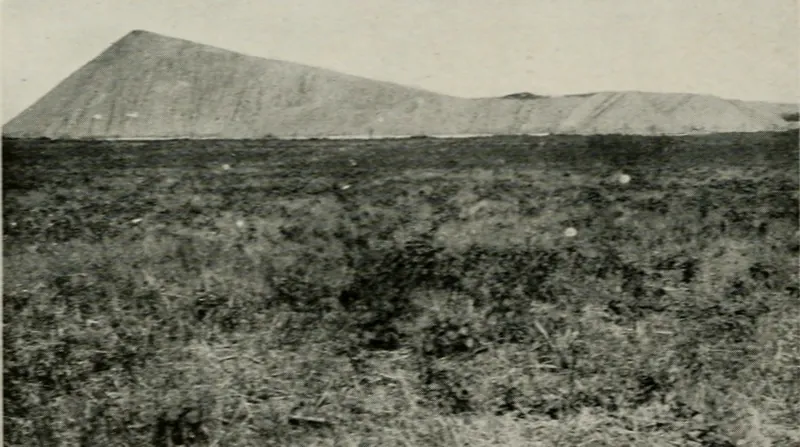
Tracing a mining family in the 1882 history
The book's mining sketches point to Scotland (Edinburgh, Musselburg, Ayrshire), Wales and England as the main homelands, and many of the men came by way of other coalfields: Pittston in Pennsylvania, Youngstown in Ohio, and Peoria and Pekin in Illinois. A. F. Watson, a coal miner's son from Northumberland, England, mined there before settling in Grundy County in 1853. Braidwood, just across the line in Will County, drew Grundy men back and forth; the banker John Cunnea farmed there for seventeen years before moving to Morris.
The sketches also name places to look for records. Mining men in the sketches belonged to Braceville Lodge No. 679 of the I. O. O. F., to the Knights of Pythias at Braceville, and to the Masonic lodges at Gardner and Braidwood. C. M. King founded the Gardner News in 1881 and in 1882 started the Braceville Miner, a Republican paper printed in the News office. Most of the mining men who got their own sketches were operators, bosses and superintendents, so ordinary miners mostly turn up in accounts like the Gardner cage accident.
Finding your ancestor in Grundy County
- Census records (free through 1950) list each person's occupation and town, so a mining family shows up decade by decade.
- Death records: search our Illinois database by surname.
- The county histories themselves: the biographical sections of History of Grundy County, Illinois hold hundreds of family sketches.
- Newspapers on the Library of Congress's Chronicling America carried obituaries, accidents, and local news.
Tell us one grandparent's name. We'll take a free first look at the records and email you back.
Ask about my family →Frequently asked questions
Where was coal first mined around Morris, Illinois?
The 1882 history says Samuel Wood, an English-born miner who had worked at Peoria, settled at Morris in the spring of 1854 and with Daniel Williams opened the first coal bank ever started in the vicinity of Morris. By 1882 upwards of one hundred openings had been made near the city, most of them abandoned.
What happened at the Gardner coal shaft?
Congdon and Odell leased the north part of the village plat for mining, and the shaft passed through several owners before the C., W. & V. Company closed it in the summer of 1874, after ten years. When a cage rope broke, four men fell; Wm. Harwood died that night and Harry Watts lived twenty days.
Why were wages higher at some Braceville-area mines?
Water. A Chicago Tribune sketch quoted in the book gives the standard price as $1.05 per ton in winter and 95 cents in summer, but at Godley operators paid $1.25 to $1.30, and parts of the old Bruce shaft cost up to $1.50 per ton, all on account of water.
Who ran the mines at Diamond and Braceville in 1882?
David Mackie, a Scottish miner from Ayrshire with his post office at Diamond, was superintendent of the Wilmington Coal Mining & Manufacturing Company, with about 400 men. Richard Ramsey, born in England, was superintendent of the Braceville mines from 1881, with about a thousand men and three shafts.
Photographs on this page are in the public domain. About the images and their sources.