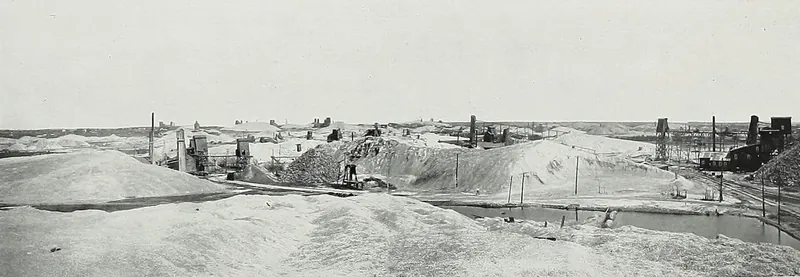
The 1883 History of Jasper County, Missouri gave a full chapter to mining. In about thirty-five years the ore along the small creeks feeding Turkey Creek turned farms and creek bottoms into Joplin, Oronogo, Webb City and Carterville. This page follows the book's account of the first diggings, the camps that became towns, the companies that leased ground to miners, and the families who came to work it.
Written from The History of Jasper County, Missouri (1883). Everything below comes from that book, and where it gives an opinion, we say so. You can read the full book free on the Internet Archive.
The first diggings, 1848 to 1851
The book dates the first real mining in the Southwest to 1848, setting aside the little that Spaniards and Native people may have done earlier. A man living about two miles northwest of Joplin found a chunk of mineral near his house and told his neighbor, William Tingle. Tingle took his pick and shovel to the spot and soon threw out nearly one hundred pounds of lead ore. Tingle and a Mr. Fitzgerald of Carthage then built an air furnace for the first smelting. The site, on Turkey Creek, came to be called the Leadville diggings.
Colonel Young, an early mine superintendent whom the book quotes at length, carried the story further back. In his telling, Indians and trappers found surface lead and melted it for bullets in chip fires, and a Mr. Duncan was the first man to buy pre-emption rights for mining, in 1836 and 1840. He said Old Uncle Johnny Fitzgerald smelted at the Tingle & McKee mines, the first worked for a market.
Lead turned up near Oronogo in the spring of 1851, found by Judge McKee on ground just south of where the railroad depot later stood. The book says even the grass roots were tangled with pieces of lead. The Mineral Township chapter adds that McKee sold the secret of his find for a house frame to Duncan & Cabaniss, owners of a sawmill on Spring River, who set off for the government land office at Springfield and entered the land.
Minersville becomes Oronogo
The camp was first called Minersville. Stephen O. Paine laid out the original plat, dated October 20, 1856, with 35 lots facing Main and South streets. Additions followed in October 1867, May 1872 and June 1874. The book explains the new name with a trading-post story. When trappers, Indians and miners asked for credit, they were pointed to a sign reading cash only or ore, and the reply became Or-o-no-go: your ore or no go.
Little came of the Oronogo mines until the Granby Mining and Smelting Company took hold. Colonel Young arrived as its superintendent in 1865, when every newcomer carried a carbine or revolver. He found an old smelter called the Scotch Heap, worked by a blind mule, that recovered thirty-five per cent from the ore. A steam blast soon raised that to sixty-six per cent. Miners came in by the hundred, Young said, from Iowa, Wisconsin and Missouri.
When the mining fever ran high, Minersville held from 1,000 to 2,500 people. By 1883 the book counted 300 to 500. That year brought a worse blow: a cyclone completely destroyed the town in May 1883.
“With a little digging lead was obtained; even the roots of the grass being tangled with the pieces…”
Joplin and Murphysburg, 1871 to 1872
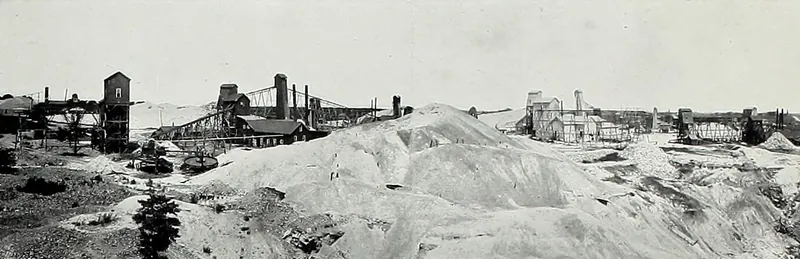
Among the men who did well at Oronogo, Young named John Sergeant and Moffett, who moved in 1871 and 1872 to the diggings that became Joplin, also called the Moon Range. Young said Joplin was named for a trapper, and that John H. Taylor bought forty acres there for $1 an acre and called it Kansas City Bottom.
By the time Joplin was laid out, the camp held nearly four hundred people, most living in tents. John C. Cox, an old settler who owned much of the land, laid out Joplin; the county records are dated July 28, 1871. Davis & Murphy bought land on the west side of the creek and laid out Murphysburg, whose plat was recorded September 4, 1871. By fall the rival towns had about five hundred residents and roughly two hundred houses each, mostly of rough native lumber. All winter the five furnaces of Moffet & Sergeant and Davis & Murphy ran at full capacity.
With no town officers, the book says, rough characters ran wild. On the evening of February 27, citizens of both towns met to stop the drunkenness, careless shooting and rowdyism, and they began a petition to the county court to incorporate the two towns as one. Peter Schnur, who came from Carthage, issued the first Mining News on March 7, 1872. The Joplin Mining and Smelting Company, incorporated December 20, 1871, was the oldest of the Joplin companies, with John H. Taylor its first president.
Webb City, Carterville and the outlying diggings
John C. Webb found lead in 1873 while ploughing corn. He dug that fall, but water slowed him until a large steam pump went in the next year. By 1883 the Webb City mines had built a town of more than 2,000 people. For 1882 the Carterville tract reported 2,371,802 pounds of lead ore from fifteen shafts, plus zinc, worth $279,207.82 in all and shipped in 931 cars. Zinc ore brought about twenty dollars a ton at the mines. The book called Carterville and the Blende City mines the richest zinc mines in the world.
Smaller diggings ringed Joplin. Davis & Murphy opened the Stephens diggings about 1872, taking out perhaps 600,000 pounds of lead ore; the zinc blende went unused for lack of smelting facilities. Byers & Murphy opened Tanyard Hollow in 1877, and the Jackson diggings opened in the fall of 1882. At the Burch mines, found by Covington Burch while plowing in 1872, some 7,000,000 pounds of lead came out before they were abandoned. Burch laid out Burch City in April 1877 with 108 lots, but newer mines to the west drew away its buildings and its largely mining population.
The book also records the miners' own words. Galena, the source of nine-tenths of the region's lead, was simply "mineral"; cerussite was "dry-bone"; zinc blende was "black jack." The deepest shaft in southwest Missouri, in Kansas City Bottom, went down two hundred and twenty feet and eight inches.
“The population of the camp had already been swelled to nearly four hundred, most of whom were living in tents…”
Companies, leases and smelters
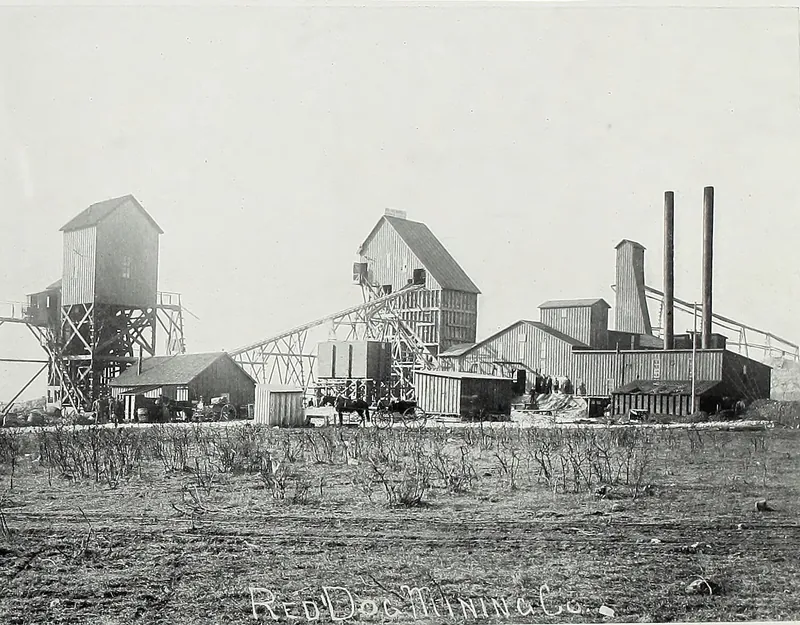
Much of the mineral ground was leased to miners in lots. The West Joplin Lead and Zinc Company, organized in the fall of 1875 with Thomas E. Tootle of St. Joseph as president and Patrick Murphy as superintendent, held upwards of 3,000 acres divided into lots and leased to miners. At its Sherwood diggings, 120 acres were cut into lots 200 feet square. The Granby company grew from a firm Peter E. Blow and F. B. Kennett formed in 1857; after Kennett retired in 1865 it was organized at St. Louis, with James B. Eads among the stockholders, and by 1883 owned upwards of 19,000 acres in Missouri and Arkansas.
In 1881 the district mined 43,000,000 pounds of lead ore, yielding about 15,000 tons of pig lead sold as Soft Missouri Lead. Zinc ore in 1882 was estimated at 1,500 tons a week. The Lone Elm Mining and Smelting Company, organized February 22, 1877, smelted 20,445,177 pounds of lead ore in 1882 and shipped 565 cars of pig lead and 161 of white lead.
The white lead came from smelter fumes, caught by a process invented by Professor E. O. Bartlett of Philadelphia, who came west in 1876. Moffet & Sergeant bought the exclusive United States right in 1878. On April 3, 1880, the White Lead Works burned while about two hundred and twenty hands were at work, with a loss estimated at $300,000. The book noted the loss fell hard on workers who lived on daily wages. Earlier, in the fall of 1878, falling lead prices had closed many furnaces, and the Short Creek strikes pulled miners toward new camps at Galena and Empire just over the Kansas line.
Finding mining families in the book
The biographical sketches show how mining families moved. Peter Holman, born in Cornwall, England, in 1832, mined at Dubuque, Iowa, and in Franklin County, Missouri, before bringing his family to Joplin in the fall of 1871 and going back to mining. His son W. G. Holman worked in the mines for about two years from around age sixteen before opening a grocery. Edward P. Swift, born in Ohio, reached Joplin in the fall of 1873 and mined for a time. Charles F. Taylor came in 1871 and went straight into mining.
The book also gives recorded dates for town additions, such as Porter's second addition to Joplin (June 22, 1877), and names each digging's owners, which can help place a family on the land.
People from this history in our records
These Jasper County residents have biographies on our site from the county histories, and each one mentions the mines. Their sketches name parents, spouses, and where the family came from.
- David N. Friend
- T. W. Hill
- James M. Smith
- Joseph H. Myers
- E. Lee Schooler (b. 1860)
- James Myers
- John Henry Taylor (b. 1837)
- Monroe Clark (b. 1832)
- Stephen A. Smith
- Charles F. Taylor (b. 1842)
- Henry D. Smith (b. 1831)
- N. U. Wilson
- William M. Williams (b. 1859)
- Joseph C. Miller (b. 1828)
- William E. Hall (b. 1845)
- John C. Webb (b. 1826)
- R. C. Friend
- John W. Spencer
- Stephen Smith (b. 1839)
- Albert B. Smith (b. 1849)
- Albert C. Webb (b. 1877)
- F. Luther Burch (b. 1858)
- Joe S. Wilson (b. 1846)
- John W. Burch (b. 1841)
Finding your ancestor in Jasper County
- Census records (free through 1950) list each person's occupation and town, so a mining family shows up decade by decade.
- Death records: search our Missouri database by surname.
- The county histories themselves: the biographical sections of The History of Jasper County, Missouri hold hundreds of family sketches.
- Newspapers on the Library of Congress's Chronicling America carried obituaries, accidents, and local news.
Tell us one grandparent's name. We'll take a free first look at the records and email you back.
Ask about my family →Frequently asked questions
When did lead mining begin in Jasper County, Missouri?
The 1883 county history dates the first actual mining to 1848, when William Tingle dug nearly one hundred pounds of lead ore near a neighbor's house about two miles northwest of present Joplin. Tingle and a Mr. Fitzgerald of Carthage built the first smelting furnace at what became the Leadville diggings.
How did Oronogo, Missouri, get its name?
Oronogo was first called Minersville, platted in 1856. The 1883 history says traders pointed miners, trappers and Indians who wanted credit to a sign for cash or ore, and the answer became Or-o-no-go, meaning your ore or no go.
Who founded Joplin, Missouri?
John C. Cox, an old settler who owned much of the land, laid out Joplin; the county records are dated July 28, 1871. Davis & Murphy laid out the rival town of Murphysburg across the creek, recorded September 4, 1871. Colonel Young's account says Joplin was named for a trapper.
What did Jasper County miners call the different ores?
According to the 1883 history, miners called galena, or lead sulphide, simply "mineral." Cerussite, a lead carbonate, was "dry-bone," and zinc blende was "black jack." Galena supplied nine-tenths of the lead produced in southwest Missouri.
Photographs on this page are in the public domain. About the images and their sources.