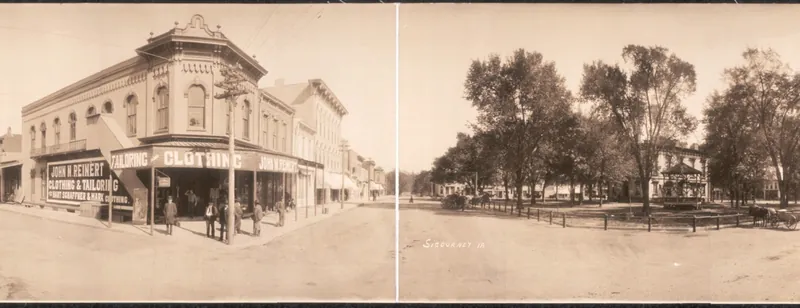
Keokuk County sat on the eastern edge of Iowa's coal field, and in both of its county histories the coal story means one town above all: What Cheer, in Washington township. The 1880 History of Keokuk County caught the mines on the eve of the railroad, with nine coal banks and a seven-mile haul to the nearest station. The 1903 Genealogical and Biographical History looks back through the lives of the men who sank the shafts, ran the machinery and worked the field until the coal ran out.
Written from 2 county histories, all free to read on the Internet Archive: The History of Keokuk County, Iowa (1880); A Genealogical and Biographical History of Keokuk County, Iowa (1903). Everything below comes from those books, and where they give an opinion, we say so.
Coal Township, on the edge of the field
The 1880 history opens its coal story with a general chapter on Iowa geology. It places Keokuk County with Lee, Des Moines, Henry, Jefferson, Washington and Mahaska counties where the formation beneath the coal-bearing strata forms a narrow border at the edge of the coal field. It puts the whole state field at no less than 20,000 square miles, mined in about thirty counties, and notes that little Iowa coal had yet been raised from deeper than one hundred feet. Its list of the most important coal counties, from Appanoose and Mahaska to Wapello and Webster, does not include Keokuk.
Coal was in the county's vocabulary early all the same. Washington township, which first took in a large part of what became Warren township, was originally called Coal township. The county commissioners fixed Coal township's boundaries at their January 1846 meeting, and in 1847 the name was changed to Washington. The township had 215 people in 1850, 580 in 1856 and 1,246 at the 1875 census. Its oldest town, Springfield, was laid out in 1845 on sections 28 and 33. The 1880 history says that while the township's soil compared well with others, it was chiefly noted for its coal.
Petersburg becomes What Cheer
The center of the coal field was What Cheer, on section 10. It was laid out in October 1865 and, the 1880 history says, had been known as Petersburg until recently, when the name was changed by authority of court. The book does not say why the new name was picked. By 1880 the town had Daniel Dodge's steam flouring mill, the general stores of Harland & Davis (where the post office was kept) and J. H. Leathers, and two leading hotels, the What Cheer House and the Summit House.
The 1880 history counted nine principal coal banks around the town, employing some three hundred hands in all. The principal operators it named were William Clubb, Gillette & France, and Rhodes & Bedford. The largest mine, covering a half section of land, belonged to the Railroad Mining Company, but it had hardly been worked, because the company was waiting for the track to be laid to What Cheer. Its vein was six feet thick and lay about seventy-five feet below the surface.
Most of the coal mined in the county, the book says, came from the mines around What Cheer, and although they sat seven miles from the nearest railroad station, about 20,000 tons had been mined the past year. With a direct rail connection, it predicted, What Cheer would prove to be one of the most important mining regions in the state. That is the 1880 book's forecast, and county histories of the period were seldom shy about boosting their towns.
“What Cheer is the somewhat odd name of a pretty little town situated in Keokuk county, Iowa.”
William Clubb, William France and the 1880 shafts
The township directory at the back of the 1880 book fills in two of the operators. William Clubb, listed as a farmer and proprietor of coal banks on section 16, was born January 4, 1831, in Morgan County, Indiana, and came to Keokuk County in 1848. His coal land was an eighty-acre tract with a six-foot vein. He married Rebecca Whiteman, also of Indiana, on March 25, 1855. The directory names nine living children, from Arthur P. to Harry, and says the couple belonged to the Christian Church.
William France appears as a partner in the firm of France, Rhodes & Bedford, coal proprietors, on section 10. The history's own text pairs him with a Gillette and lists Rhodes & Bedford as a separate firm, and the book does not explain the difference. France first settled in Massachusetts for five years, moved to Illinois in 1857 and came to Keokuk County in 1865. He spent a year in the army in the gunboat service, and in 1855 he married Elizabeth Farra, a native of England. He owned fifty-eight acres of coal land, with his shaft a quarter mile northeast of What Cheer. The shaft went down seventy-five feet to a six-foot vein, and the directory gives the mines a capacity of 1,000 bushels a day. A Josiah Rhodes is listed as a farmer on the same section 10; whether he was the Rhodes of the firm, the book does not say.
The railroad years: Shaft A and the long wall
The 1903 history picks up after the rails arrived. Samuel Gillfoy, a retired mine operator living in What Cheer, was born in Baltimore on January 4, 1828. In Illinois he had been general manager of the Kingston coal mine, which the 1903 book calls the largest in that state at the time, and its superintendent for ten years, before mining on his own account at Mapleton. In 1879 he came to Keokuk County at the solicitation of the Burlington, Cedar Rapids & Northern Railroad Company. At What Cheer he opened a mine called Shaft A and later became general manager of all the principal mines of the place, running them until the coal was exhausted, which the book says took about nine years.
Gillfoy was also general agent for the lot association that owned a large part of the town site, and kept that post until most of the lots were sold. He then opened another mine as general manager for C. D. Ives, resigned after nine months and retired. He sat on the What Cheer school board for twelve years, and he and his wife had twelve children. The 1903 book, which praises nearly everyone it profiles, files him among the self-made men of the county.
Another What Cheer company brought in a specialist from Scotland. James Wyllie went to work in the collieries at twelve, married Jane Jennison Simpson in Scotland in 1873, and came to America in 1881. The 1903 book says the first news he heard on landing in New York was the assassination of President Garfield. After about three years mining in Illinois he was hired by the Granger Mining Company of What Cheer to plan and establish the long wall system of coal mining, a job he finished in about six months. The company kept him for about four years. He then rented a farm near What Cheer in Prairie township, later farmed in Van Buren township, and in 1896 became superintendent of the county poor farm.
By 1903 the book described What Cheer as a town on a branch of the Burlington, Cedar Rapids & Northern, twenty miles northeast of Oskaloosa, and the center of an important mining industry. It also called What Cheer a somewhat odd name for a town.
“…the first news that he learned on his arrival in New York was of the assassination of President Garfield…”
Prairie township, Thornburg and the North Star mine
Mining also reached into Prairie township. F. J. and M. C. Ogden left Blooming Grove in Franklin County, Indiana, and arrived in July 1867, settling in Prairie township when it was a thinly settled community thirty miles from any railroad. Their youngest son, Irvin, was born soon after. From seventeen he spent four years dividing his time between the farm and what the 1903 book calls the bituminous coal mines, then recently discovered. After his father's death he bought an interest in the North Star mine on the old homestead, sold it the next year, and spent six more years in the coal mines as engineer, weighman or whatever else was needed.
When the North Star Mining Company, with added capital, opened up on a large scale, Ogden sold his royalties to it. With the money he bought a half interest in the What Cheer Patriot, starting publication with A. H. Holland as partner in 1895. The Patriot had been established in 1880 and by 1903 came out twice a week. Ogden bought out his partner in March 1901 and about the same time was appointed postmaster.
The 1880 book shows Thornburg at its very start. J. W. Johnson, born in Stark County, Ohio, in 1841, bought a farm on section 23 of Prairie township in 1867. He was one of the active workers in securing the railroad and one of the proprietors of the town of Thornburg, laid out on his land, which the book expected to be one of the best towns on the line. It says nothing of coal at Thornburg itself, but the Prairie township directory already lists many households with a Thornburg post office and others at Coal Creek. One of them was Thomas Molyneux of section 10, born June 21, 1831, in Lancashire, England, who worked in the coal business there until he was twenty, emigrated in 1851 and came to Iowa in 1862 with his brother John.
Keswick barely appears in these books. Its one mention comes in the 1903 sketch of Dr. Lawrence, a physician at What Cheer, whose son Hode B., then clerking in What Cheer, married Amy Irwin of Keswick. Neither book, in the passages used here, describes mining there.
Van Buren township and a vanished town
Van Buren township, very broken country with plenty of stone and timber, had what the 1880 history called quite an important coal interest in its southern part. The mine then working was owned by a Mr. Bonnton (as the scanned text spells it) and operated by a Mr. Durham. It had opened three years earlier, employed fourteen hands, worked a vein five and one-half feet thick, and sold its coal readily because it was close to the Sigourney market.
The same township shows how quickly a place could disappear. Its only town, Keenersburg, on section four, was already gone by 1880, and the book says even its location would be difficult to trace.
Where the miners came from, and where to look for them
Neither book describes the mining workforce as a whole, and the passages used here give no wage rates, strikes or mine accidents. The biographies do show a pattern: men from the coal districts of England, Scotland and Ireland, often by way of Pennsylvania and Illinois. Besides Molyneux and Wyllie, James Shepherd of Prairie township, born in England in 1827, emigrated in 1848, landed at Philadelphia and tried coal mining before deciding it did not suit him. John J. Kelly, born in Ireland on November 24, 1826, left home at fifteen to work in the coal mines of England and came to America in 1846. He mined in Schuylkill County, Pennsylvania, later contracted coal mine and railroad work, spent the winter of 1863 coal mining in Illinois, and in April 1864 brought his family to a farm in Liberty township.
For family historians the 1880 directory is the best tool here. It gives each household's section and post office, so a family can be placed at What Cheer, Springfield, Thornburg, Coal Creek or Delta. The sketches also point to other records: Masonic lodges (Gillfoy was a Mason for half a century); the Friends' Society, to which several Prairie township farm families belonged; the What Cheer school board; and the Patriot, published from 1880. Both books tend to praise their subjects, so treat their judgments as the books' own and check the dates against the records.
People from this history in our records
These Keokuk County residents have biographies on our site from the county histories, and each one mentions the mines. Their sketches name parents, spouses, and where the family came from.
- Henry Snakenberg (b. 1840)
Finding your ancestor in Keokuk County
- Census records (free through 1950) list each person's occupation and town, so a mining family shows up decade by decade.
- Death records: search our Iowa database by surname.
- The county histories themselves: the biographical sections of The History of Keokuk County, Iowa and A Genealogical and Biographical History of Keokuk County, Iowa hold hundreds of family sketches.
- Newspapers on the Library of Congress's Chronicling America carried obituaries, accidents, and local news.
Tell us one grandparent's name. We'll take a free first look at the records and email you back.
Ask about my family →Frequently asked questions
Why was What Cheer once called Petersburg?
The 1880 History of Keokuk County says the town was known as Petersburg until shortly before the book was written, when the name was changed by authority of court. It was laid out in October 1865 on section 10 of Washington township. The excerpts do not say why the name What Cheer was chosen.
How much coal did What Cheer mine before the railroad arrived?
According to the 1880 history, about 20,000 tons were mined in the past year, even though the mines sat seven miles from the nearest railroad station. Nine principal coal banks employed some three hundred hands, and the Railroad Mining Company's large mine was waiting for the track to reach town.
Who brought the long wall system to What Cheer?
The 1903 history says the Granger Mining Company of What Cheer hired James Wyllie, a Scottish collier who had mined in Illinois for about three years, to plan and establish the long wall system. He finished in about six months, and the company kept him for about four years.
Who was Samuel Gillfoy?
A Baltimore-born mine operator who had managed the Kingston mine in Illinois. The 1903 history says he came to What Cheer in 1879 at the railroad company's request, opened Shaft A, became general manager of the town's principal mines until the coal was exhausted, and served twelve years on the school board.
Photographs on this page are in the public domain. About the images and their sources.