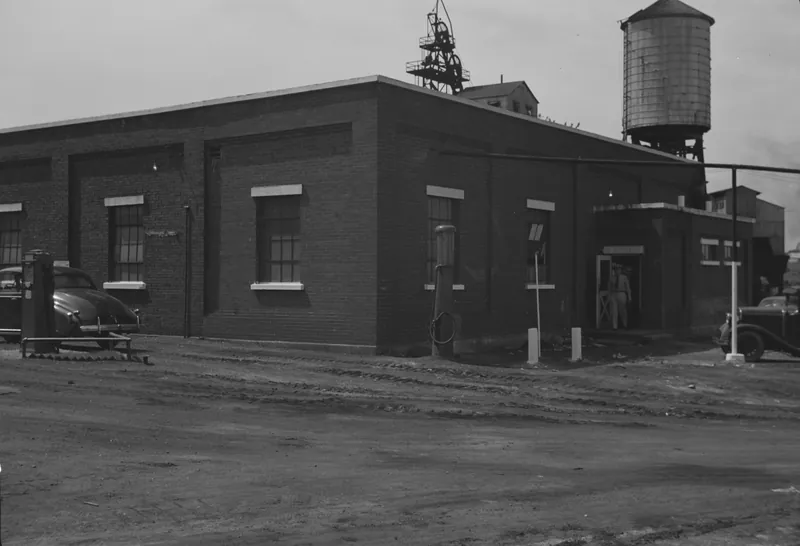
Two county histories carry the story of coal in this corner of southwestern Indiana. The 1886 History of Knox and Daviess County printed the State Geologist's seam-by-seam sections along with early accounts of Cannelburg, Montgomery and the Edwardsport mine. The 1915 History of Daviess County tells how a railroad grading crew struck coal at Washington in 1857 and what became of the mining towns afterward. Between them they name the companies, the shafts, and some of the men who worked them.
Written from 2 county histories, all free to read on the Internet Archive: History of Knox and Daviess County, Indiana (1886); History of Daviess County, Indiana (1915). Everything below comes from those books, and where they give an opinion, we say so.
Seams lettered like a ledger
The 1886 book's geology chapters were adapted from the report of the State Geologist, and they treat coal as a stack of lettered seams. Knox County, which the book puts at about 540 square miles, has strata that dip from east to west at an average of twenty-two feet to the mile, so the coal lies deeper toward the Wabash. Coal M averaged about three feet. It was fat and caking with considerable sulphur, yet the book called it excellent for grate use, and it underlay the county west of a line from Edwardsport to Freelandsville. Coal L averaged over three feet, burned to a white ash, and in the book's words compared well with the same coal at Washington. Coal K, the lowest seam to reach the surface in Knox, ran three to six and a half feet.
Across the line in Daviess County, the same book labels Coal L the "main Washington" seam. It averaged 5 feet at Washington, and samples from five banks averaged 59.1 per cent fixed carbon. The 1886 history judged it "the best caking coal yet mined in the Western coal field." The State Geologist estimated an average of eight feet of coal spread over the whole county, which the 1886 book gives as 271,000 acres; the 1915 history repeats the estimate but says two hundred and seventy thousand acres. The 1886 writer assured citizens they need not fear exhausting it, though he also admitted the shaft and bore records showed "a great want of persistency" in the seams from place to place.
Washington and the 1857 railroad cut
The 1915 history credits Washington's first spurt of growth to coal found on the eastern edge of Greenup, which it calls a deserted village. The bigger find came in 1857, when workmen on the grade of the Ohio & Mississippi railroad cut into a rich vein of bituminous coal at Washington, and it became clear the county seat sat on top of it. Mines opened at once. Miners came "from near and far," in the book's phrase, and many brought families. Because the wages paid well, the 1915 writer says, they prospered, built homes, and often stayed on as permanent citizens.
The railroad had the coal tested for steam, and before long its wood-burning locomotives were converted to coal burners. The 1886 geology points to an even older working: a mine on the old canal bank, on Section 6, Town 2, Range 7, which the book calls one of the earliest worked in the county. By 1915 the Daviess history could say that many millions of tons of coal had been mined in the county.
“It has a population of 350, a good school, and is steadily growing…”
Cannelburg and the Buckeye Cannel Coal Company
Cannelburg was a company town from the start. The 1886 history says the Buckeye Cannel Coal Company, made up of A. J. Shotwell, L. C. Harris and Anthony Moots, laid it out on September 26, 1872, in ten blocks divided into 102 lots, and a 44-lot addition followed in 1884. The mine itself was opened in 1870 by Shotwell and Clapp & Bailey and sold in 1881 to Washington and Cincinnati capitalists. Cannel coal and ordinary bituminous came out of the same vein, the cannel lying on top, in a seam two and a half to five feet thick. The 1886 writer said the cannel had no superior in the State.
In 1886 the company worked 125 men and mined seventy to ninety cars of coal a week, each car averaging about fifteen tons. Austin F. Cabel of Washington was secretary. The town had 350 people and a good school, and of the two mines near Cannelburg, one was being worked on the co-operative plan by the Knights of Labor.
The 1915 history adds what happened next. The company owned most of the property in town and kept its only store. In the winter of 1881 to 1882 a smallpox epidemic caused a large number of deaths. Later the mines produced less coal and employed far fewer men, which the book says had a marked effect on the town, and it gave the population as three hundred. Most residents were Catholic and worshipped at All Saints' church, and a new consolidated high school went up in 1914. The post office had begun as Black Oak Ridge on May 4, 1858, with Alva Clark as postmaster, and was renamed Cannelburg on April 10, 1873.
Montgomery and the Barr Township mines
Montgomery, seven miles east of Washington in Barr Township, dates from 1854, when James C. Montgomery built a house that also served as a small store for the men building the Ohio & Mississippi. When the line was finished through in 1857 the place had about twenty people in four houses. The 1915 book says Valentine B. Montgomery laid out the town on his own land in 1865, and the 1886 book records its incorporation in March 1870.
The 1886 account of Montgomery was written by Charles G. Sefrit of Washington. He gave the town over 500 people, much of the growth coming in the previous six months, after the Wilson Coal Company opened extensive mines on land adjoining the town, and he predicted it would become one of the most important coal mining towns on the Ohio & Mississippi. The 1915 census figures tell a different story: 415 people in 1890, 616 in 1900 and 511 in 1910. The later book blamed the drop on the transitory character of many residents employed in the nearby mines, and noted that St. Peter's Catholic school had closed because so many families moved away. The two books disagree on when Montgomery's first public schools opened under trustee Lloyd Clark: the 1886 history says 1869, the 1915 history says 1860.
At Montgomery the geology gave Coal K about two feet thick under a foot of limestone. The 1915 history describes Barr Township, at seventy-two sections the largest in the county, as underlaid with an inexhaustible bed of the finest coal. Counting Cannelburg and Montgomery, the township had 3,335 people in 1910. Most of its first settlers, the book says, came from Kentucky.
“Our subject was six years old when he came to America, and worked in coal mines until twenty years old…”
Edwardsport, Bicknell and Job Freeman
The Knox County mining man the 1886 book documents most fully is Job Freeman. He was born in England on October 4, 1844, to Joseph and Susan (Manley) Freeman. Joseph was a coal miner who came to the United States in 1840 and settled in Ohio, and when he died in 1856 he was living near Briar Hill in Mahoning County. Job came to America at six and worked in coal mines until he was twenty. In May 1864 he enlisted for 100 days in Company D, 151st Ohio Volunteer Infantry. In the fall of 1865 he went to Washington, Daviess County, and went back to mining. On March 8, 1868, he married Martha Jane Tranter, daughter of William and Margaret Tranter.
The family moved to Edwardsport in 1872, where Freeman was made inside foreman of the Shepard & Haslet mine. In 1877 he bought an equal share and the firm became the Edwardsport Coal Company, at times employing 130 men and mining an average of about 40,000 tons a year. In 1884 the partners bought the Bicknell coal mines and took the name Indian Creek Coal Company. Freeman was a Mason and an Odd Fellow.
The geology explains why Edwardsport drew operators. The combined thickness of all the coals near the town came to nearly 12 feet. Three shafts a mile or more northwest found Coal L from 3 feet 2 inches to 5 feet 8 inches thick, and the book gives Coal K nearby as 6 feet. At Bicknell itself the book records only a seam 2 feet thick, found 82 feet below the surface.
Small banks around Wheatland, Vincennes and the Daviess hills
Much Knox County coal was dug from small banks and shallow seams. Coal M was worked by stripping near Wheatland, where it ran one to two and a half feet, and at the old Weaver bank north of town it was 3 feet 4 inches of fat caking coal that the book describes as full of gas and bitumen. The Kelty & Swick bank also appears in the sections. Of the old Williams shaft the book judged that a little more sinking would probably have reached workable seams. Around Vincennes the good coal lay deep: a 54-foot shaft a mile south of town found only 1 foot of coal, at Bunker Hill the valuable Coals M, L and K lay 250 to 500 feet below the thin rash coals the shaft passed through, and at Emison they were 200 to 250 feet down. Thin rash coal in the south of the county was used by residents and by blacksmiths.
In Daviess County, Coal K was mined near Alfordsville on Sections 34, 33 and 26, good apart from considerable sulphur. Coal from four mines near Glendale averaged 55.1 per cent fixed carbon. At Epsom, Coal A was a caking coal a foot and a half thick, and the book says Coal A had been worked in numerous places in Towns 4 and 5, Ranges 5 and 6. The 1915 history describes Raglesville, with something less than two hundred inhabitants, as having a coal mine near town whose coal, it was claimed, was as good as any produced in the county. The village was laid out under the name Sanford on June 21, 1837.
Finding mining families in these books
Freeman's sketch shows how much a single biography in the 1886 volume can hold: birthplace, parents, the Ohio mining town where his father died, his regiment, and his wife's parents. The 1915 history's post office lists give names and dates, with Cannelburg's running from John Sullivan on September 18, 1873. Church names point toward parish records, All Saints' at Cannelburg and St. Peter's at Montgomery, and the Knights of Labor co-operative mine at Cannelburg is a lead for anyone whose ancestor was a union miner. Montgomery's shrinking 1910 count is a reminder that mining families moved often, so a household found there in one census may be gone by the next.
Finding your ancestor in Knox and Daviess County
- Census records (free through 1950) list each person's occupation and town, so a mining family shows up decade by decade.
- Death records: search our Indiana database by surname.
- The county histories themselves: the biographical sections of History of Knox and Daviess County, Indiana and History of Daviess County, Indiana hold hundreds of family sketches.
- Newspapers on the Library of Congress's Chronicling America carried obituaries, accidents, and local news.
Tell us one grandparent's name. We'll take a free first look at the records and email you back.
Ask about my family →Frequently asked questions
When was coal discovered at Washington, Indiana?
The 1915 History of Daviess County says workmen grading the Ohio & Mississippi railroad cut into a rich vein of bituminous coal at Washington in 1857. Mines opened right away, miners arrived from near and far, and the railroad tested the coal and converted its wood-burning locomotives to coal burners.
Who founded Cannelburg, Indiana?
The 1886 history says the Buckeye Cannel Coal Company, made up of A. J. Shotwell, L. C. Harris and Anthony Moots, laid out Cannelburg on September 26, 1872, in ten blocks of 102 lots. The town grew up around the company's cannel coal mine, which had opened in 1870.
What was the Indian Creek Coal Company?
According to the 1886 history, it was the name the Edwardsport Coal Company took after its owners, including English-born miner Job Freeman, bought the Bicknell coal mines in 1884. At Edwardsport the firm at times employed 130 men and mined about 40,000 tons a year.
Why did Montgomery's population fall by 1910?
The 1915 history counts 616 people in Montgomery in 1900 and 511 in 1910, and blames the decrease on the transitory character of many residents who worked in the nearby coal mines. St. Peter's Catholic school there closed because many families moved away.
Photographs on this page are in the public domain. About the images and their sources.