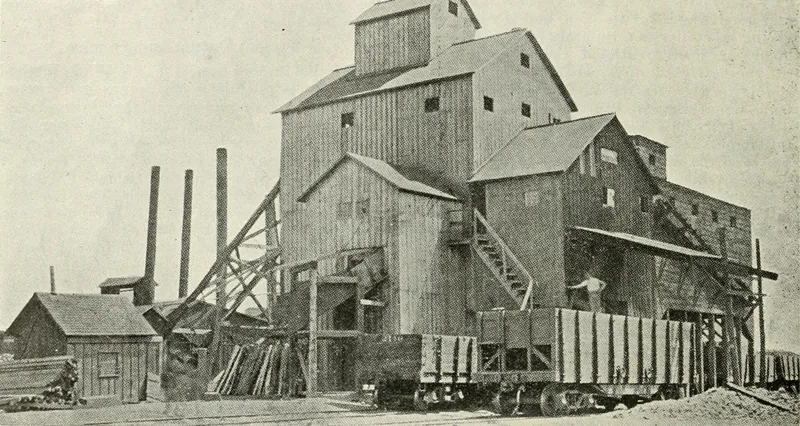
Coal shaped two corners of La Salle County. The 1877 Past and Present of La Salle County put the county's output at about 900,000 tons a year, nearly all of it from Streator and from La Salle and Peru. U. J. Hoffman's 1906 History of La Salle County called Streator and La Salle great mining centers that gave work to thousands of men. Here is what the two books record about the beds, the shafts, the operators and the miners.
Written from 2 county histories, all free to read on the Internet Archive: The Past and Present of La Salle County, Illinois (1877); History of La Salle County, Illinois (1906). Everything below comes from those books, and where they give an opinion, we say so.
Ten Veins Under the Prairie
Hoffman's 1906 history counted ten veins of coal in the county, with the warning that they were not everywhere present. In some places a vein thinned to a few inches, and in others it disappeared entirely. He explained the exposed rock as the work of a great fold running from the mouth of Deer Park Glen to beyond Millington, which tipped the lowest layers up toward the surface along the Illinois River.
The 1877 history sorted the workable coal into three beds named for the county. The Lower La Salle, called the 4 foot bed, was the most extensive, underlying perhaps 400 square miles, though the book said it would not average over 3 feet. The Middle La Salle, the 5 foot bed, lay east of the Vermillion at Marseilles and south of the river at Streator, on not over 100 square miles. The Upper La Salle was confined to the country around La Salle and Peru, probably no more than 40 square miles. By the book's arithmetic, one acre of 5 foot coal held about 8,000 tons.
Its estimate of yearly production ran 400,000 tons for Streator; 390,000 tons for La Salle, Peru and neighborhood; 10,000 for Seneca; 7,500 for Marseilles; 7,000 for Ottawa; and 5,000 for Utica. The book totaled these at 900,000 tons, although the listed pieces add to about 820,000. It noted that at Ottawa and Utica the coal was quarried rather than mined, with the earth stripped away before the coal was taken out, and it guessed the county itself burned probably less than 400,000 tons a year.
The Shafts of 1877
The 1877 book appended a list of the principal mines. The OCR of that list is rough, but the readable names include the Peru shaft, the Kentucky shaft, a works of the Chicago and Vermillion Coal Co., a carbon shaft at Streator, numbered shafts south and southeast of Streator, the Kenosha shaft about a mile south of La Salle, the Sharp shaft two miles northeast of La Salle, the Plumb shaft, nicknamed the Peanut, south of Streator, a drift worked by Patterson & Co. southwest of Streator, a shaft of the Pekin & Southwestern northeast of Streator, and shafts at Marseilles and Seneca.
Miners had their own words for what they found underground. At the Plumb or Peanut shaft, and reportedly throughout the Coal Run mines, the coal lay in rolls like windrows of hay, thinning to as little as 2 feet. The miners called these rolls horsebacks, spaced 50 to 60 feet apart, and called the glazed coal on their sides slicken sides. West of the Vermillion at Streator the coal lay in broken, detached masses surrounded by shale or gravel that were hard to work, and along the Vermillion the beds stood at angles of 30 and 40 degrees. The book also warned that the roof over some beds was very poor, requiring great care to prevent serious accidents.
“From 1866 to 1870 coal was hauled great distances from Streator in wagons. Farmers employed their teams during the whole winter.”
From Hard Scrabble to Streator
In 1866 Col. Ralph Plumb came from the east as the representative of capitalists interested in coal mining. A company was organized with Dr. Streator as its president, and the little village of Hard Scrabble took the name Streator.
For the first years the coal had no railroad. From 1866 to 1870 it was hauled great distances in wagons, farmers hired out their teams for the whole winter, and trains of wagons left Streator daily in every direction. A line from Streator to Wenona was built in 1869 and 1870 and became part of the Alton. The Fox River branch of the Chicago, Burlington & Quincy, built in 1870, gave access to the Streator coal fields, and in 1871 a road to Fairbury was built that became part of the Wabash. With those outlets, Hoffman wrote, many large companies began to mine coal, glass factories located in the town, and in a few years Streator was the largest city in the county.
One old settler's memory survives in the 1906 biographies. James H. Pickens, whose family arrived in 1840 and lived about six miles east of the future city, recalled trips to what became Streator for coal when only one building stood on the site.
English Miners Who Sank the Shafts
Two of the 1906 sketches follow working miners from England into Streator. William Howe, born in Somersetshire on January 31, 1839, left home at fourteen and worked in the coal and iron mines of South Wales until he was twenty-one. In America he fired a flour mill boiler at Mendota, then mined at Kewanee and at points in Illinois, Pennsylvania, Virginia and Maryland. In the spring of 1871 he came to Streator and helped open the No. 1 coal shaft, and that fall he began prospecting for coal for the Vermillion Coal Company. In 1876 he joined John Hillier and James Jones in the Cornell Coal Company in Livingston County, ran it alone after his partners withdrew, and returned to Streator in 1878. He later sank and operated three shafts: the Prairie Creek, the Howe and the Howe Coal Company shaft.
Researchers should note a snag in Howe's sketch: it says he arrived in Streator in 1871 but also that he spent thirteen years with the Vermillion Coal Company, from 1869 until 1882. Other records will be needed to settle the dates. His wife, Eliza Richards, was born in England on August 9, 1849, and married him at Morris, Illinois, on February 1, 1868. Her parents, Thomas and Mary (Giddins) Richards, came over in the 1850s, lived in Pennsylvania, then Morris, then Braidwood, where Thomas died. The Howes had six children, two of whom, Willie and Clara Pearl, died young. Howe belonged to Edina lodge, No. 391, I. O. O. F., of Streator.
George H. Atherton was born at Pemberton, near Wigan, England, on May 29, 1829. He married Sarah Simpkin in the old parish church at Wigan on September 4, 1853, and crossed to America in July 1862. He settled first at Lowell in La Salle County, where he had a local coal shaft for seven years, sank a shaft at Minonk on September 15, 1867, and came to Streator in 1871, where he had charge of the mines until March 1880. He went on to open shafts at Stanton, Wenona and in Ohio, returned in 1888 to run the No. 1 shaft for a year, and retired to Streator. Sarah Atherton died on June 15, 1903.
“Leaving home he went to South Wales, where he worked in the coal and iron mines until he was twenty-one years of age.”
William S. Cherry and Local Union No. 800
A long 1906 sketch covers William S. Cherry, son of William and Henrietta (Sloan) Cherry, natives of Ireland. In 1856 he went with an older brother to Schuylkill County, Pennsylvania, to mine anthracite, then served seven years as a navy engineer. He came to Streator in 1871 as mine superintendent for the Chicago, Wilmington & Vermillion Coal Company, rose to general mine superintendent, spent 1889 to 1892 with the Grand River Coal & Coke Company in Colorado, and returned to the same post until he resigned in 1904.
The book says Cherry found the Streator mines worked with little system, with coal taken where it was easiest and the rest of the vein left to waste. It credits him with bringing in the mining machine, steam and electric haulage, improved hoists, scientific ventilation and drainage, and with organizing the Miners' Institute, through which many Streator miners earned state certificates and became mine inspectors and superintendents.
The sketch quotes a man who began as a miner and became an operator, crediting Cherry with Streator's immunity from strikes for many years and with relatively good conditions of work and wages. It also prints the resolution of Local Union No. 800, U. M. W. A., passed when he retired, praising him as a superintendent whose word the members never hesitated to accept. These are tributes chosen by a book that honored its subjects, but they show that Streator miners were organized in a United Mine Workers local by 1904, a lead for anyone tracing a miner's union ties.
La Salle, Peru and the 1894 Riot
The La Salle field has its own founder in the 1906 book. The father of W. W. Taylor, addressed as Col. Dick Taylor in a Lincoln letter the book prints, had mined lead at Galena. About 1855 he learned that outcroppings of coal had been found on the Little Vermillion at La Salle and sank a shaft under the name of the Northern Illinois Coal & Iron Company. That shaft was known by 1906 as the La Salle shaft and was still in operation, and the other shafts opened later ran under the first company name until 1872.
His son W. W. Taylor spent most of his life in the coal trade and was sheriff of La Salle County from 1890 to 1894. In 1894, when a riot occurred at the coal mines at La Salle, he went down to settle it and was shot four times and beaten nearly to death. The militia was called out from Ottawa, and Taylor went back to the mines wrapped in blankets. The book tells the story entirely from the sheriff's side, calling the other party strikers and lawbreakers, and gives no account of the miners' grievances. In 1903 Taylor became general superintendent of mines for the Spring Valley Coal Company and then general manager and superintendent of mines for the Chicago, Milwaukee & St. Paul Railroad Company.
Finding Miners in the 1877 Directory
The most useful pages for family historians may be the township directory in the 1877 book, which lists residents by name and occupation. The Peru Township list is thick with men marked simply coal miner, with surnames such as Burke, Cosgrove, Dwyer, Gallagher, Kerp, Kramer and Hoffmarknichter. It also names the structure of a working shaft. At the Union Shaft, Lawrence Christopher was superintendent and Edward Christopher a coal shaft boss, while Mike, Thomas and Thomas Christopher Jr. were coal miners, and Mike Costelloe, L. Lathrop and Wm. McDonald are listed as miners there. Elsewhere in the list are Jno. Colburg, weighmaster in a coal shaft; H. N. Hackmann, boss in a coal shaft; Anton Loefler, engineer in a coal shaft; and R. Merrick, proprietor of a coal shaft. The same pages list men at the zinc works and the plow factory, so one Peru family might have sons in several trades.
Around Streator, the Eagle Township list gives coal miners with a Streator post office, among them James Carrington, Fred and T. Courtnay, B. and T. Flanigan, Louis Folger, Joseph Short, Wm. Smith, H. Worthington, and George and Henry Sornberger on Section 26, along with Wm. Courtnay, listed as a coal-operator. Fuller entries in these directories give a birthplace and the year the person came to the county, which can point a search back to Ireland, Germany, England or an eastern state.
Finding your ancestor in La Salle County
- Census records (free through 1950) list each person's occupation and town, so a mining family shows up decade by decade.
- Death records: search our Illinois database by surname.
- The county histories themselves: the biographical sections of The Past and Present of La Salle County, Illinois and History of La Salle County, Illinois hold hundreds of family sketches.
- Newspapers on the Library of Congress's Chronicling America carried obituaries, accidents, and local news.
Tell us one grandparent's name. We'll take a free first look at the records and email you back.
Ask about my family →Frequently asked questions
When did coal mining start at Streator?
Hoffman's 1906 history says Col. Ralph Plumb came in 1866 representing capitalists interested in coal mining, a company was organized with Dr. Streator as president, and the village of Hard Scrabble was renamed Streator. Coal went out by wagon from 1866 to 1870, until railroads to Wenona, Fairbury and the Fox River branch gave it an outlet.
What coal companies are named in the La Salle County histories?
The books name the Chicago, Wilmington & Vermillion Coal Company and the Vermillion Coal Company at Streator, the Cornell Coal Company in Livingston County, the Howe Coal Company, the Northern Illinois Coal & Iron Company at La Salle, the Spring Valley Coal Company, and the Chicago and Vermillion Coal Co. in the 1877 mine list.
What happened at the La Salle mines in 1894?
According to the 1906 sketch of W. W. Taylor, then sheriff, a riot occurred at the coal mines at La Salle in 1894. Taylor went to settle it, was shot four times and badly beaten, and the militia was called out from Ottawa. The book tells only the sheriff's side and does not describe the miners' grievances.
How can I find a coal miner ancestor in La Salle County?
Start with the 1877 township directory in The Past and Present of La Salle County, which marks many Peru and Eagle Township men as coal miners and names shaft bosses, weighmasters and engineers. The 1906 history also mentions Local Union No. 800 of the United Mine Workers at Streator and the Miners' Institute.
Photographs on this page are in the public domain. About the images and their sources.