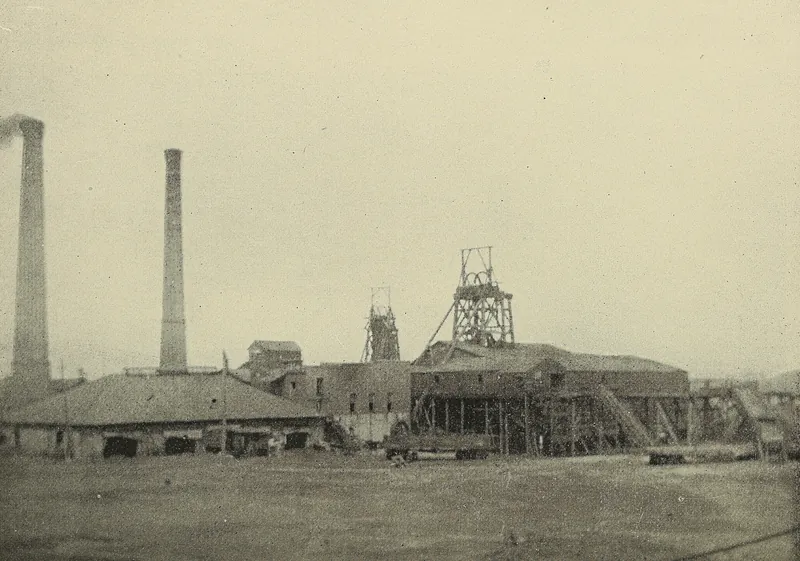
Leavenworth went looking for deep coal from 1851 to 1870 before it found any worth digging. The 1906 Early History of Leavenworth City and County, written by one of the last two surviving members of the original town company, gives the story one short chapter: creek-bank drifts, a geologist's hunch, a drill turned by an old horse, and finally a shaft 713 feet deep. By the book's count, the mines around the city were employing 1,000 to 1,200 men.
Written from Early History of Leavenworth City and County (1906). Everything below comes from that book, and where it gives an opinion, we say so. You can read the full book free on the Internet Archive.
Before the Town: Drift Mines on Salt Creek and Stranger Creek
According to the 1906 history, coal was being dug near Leavenworth before the city existed. For several years before settlement, the U.S. government mined coal in Salt Creek Valley by drifting along the banks of the creek. The coal fed the blacksmith and wagon repair shops at Fort Leavenworth, and the book says the supply was limited to a few hundred tons.
The first civilian miner the book names is Charles Peet, whom it calls "the veteran coal miner." In 1855 Peet was living on Stranger Creek west of town, where he opened a mine and for a number of years delivered coal to Leavenworth's citizens. His was also a drift mine, and when the coal became more expensive to get out, it was abandoned. Peet stayed in town. When the book was written he still lived in the city on Fourth Street, which makes him the one working miner in the chapter that a family researcher can place at a street address.
Major Hawes and a Drill Turned by a Horse
The idea of deep coal under the city came from Maj. F. Hawes, who the book says was working for the state of Missouri as assistant state geologist. In 1851, after a careful survey of the Missouri River near the future town, he concluded that coal lay under Leavenworth in paying quantities. A later geological survey of the county led him to predict it would be found at about 700 feet.
Hawes's confidence outlasted several failures. In 1863 he organized a company with Thomas Ewing Jr., Ed W. Russell, John McCarty and others, and the group got the government's permission to sink a mine on twenty acres of the Fort Reservation, north of and adjoining the city. Hawes wanted to start a shaft at once. His partners thought it safer to drill first, to be certain the coal was there and learn how deep a shaft would have to go. The drill, the book says, was "of primitive construction," with an old horse standing in for a steam engine. Within a few weeks the company's money was gone.
In 1865 the promoters brought in more backers and started again, but the war drained the funds a second time. The book counts six attempts in all and calls the full story too long to narrate. In 1868 the property passed to Lucien Scott, president of the First National Bank, and the work was revived with the money and experienced managers it had lacked. Scott came from a Leavenworth banking family: the book says the First National was owned and controlled by Lyman Scott Sr. and his sons Lucien and Lyman Jr. A list of federal acts reprinted elsewhere in the book includes one approved July 20, 1868, authorizing the sale of twenty acres of the Fort Leavenworth Military Reservation to the Leavenworth Coal Company.
“Work was commenced with a drill of primitive construction, and with an old horse as the steam engine or driving power.”
First Coal, 1870: The Shaft North of the City
In 1870 the first coal from a Leavenworth mine was put on the market. The vein was reached at 713 feet, close to Hawes's 700-foot estimate, and was 21 inches thick. The 1906 history calls it bituminous coal of "very superior quality," easily worked and "the best mined in the West," which is the author's judgment of a hometown product.
The shaft was eventually sunk to 1,100 feet. At 998 feet it passed through a second vein 26 inches thick, and at 1,030 feet a third vein 28 inches thick. Even so, the book says only the first vein was being worked, in this mine and in every other mine in and around the city. When it turns to the Lansing mine, the book refers to this first shaft as the North Leavenworth mine.
The State Penitentiary Mine at Lansing
The book lists the penitentiary mine at Lansing, about three miles south of the city, as the second mine opened. It was owned by the state of Kansas. The legislature appropriated $25,000 in 1879 to pay for sinking a shaft, and on January 15, 1881, coal was struck at 713 feet, the same depth as in the North Leavenworth mine.
The labor came from the prison. The book says 350 to 400 convicts were employed digging coal, that more than 10,000 bushels were being mined each day, and that over 20,000,000 bushels had come out since 1881. None of it was sold on the open market: the coal was solely for the state and went mainly to state institutions in cities and towns across Kansas. The 1906 history calls the mine a profitable investment for the state, worth nearly or quite half a million dollars. Beyond their number, it says nothing about the men who did the digging.
Lansing appears in the book's family notes as well. A. T. Kyle, one of the original town company, came back to Kansas after the war and settled at Lansing, where he and his wife kept a boarding house for the officers of the penitentiary for a number of years.
“In 1870 the first coal from a Leavenworth mine was put upon the market.”
Riverside and Home: Two More Shafts in the City
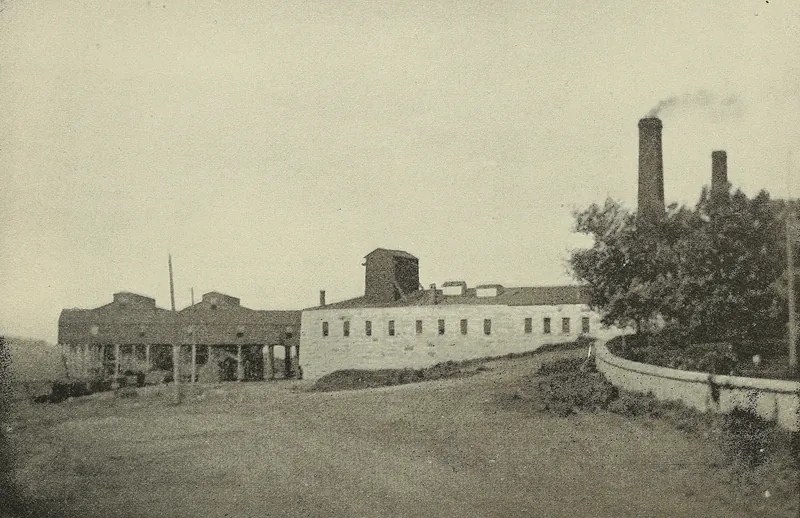
The Riverside mine, which the book calls the second coal mine opened in the city itself, sat in the southeast corner of Leavenworth near the Missouri River. Work on the shaft began January 17, 1886, and coal was struck on September 17 of the same year, eight months to the day. The book says the mine was a success from the first, and most of its coal was shipped away by railroad.
The third mine sunk in the city was the Home Coal Mine, between Second Street and the Missouri River near the old ferry landing. Instead of a single backer, a number of local citizens formed a stock company and raised the money to sink the shaft and equip the mine. By 1906 the three city mines were owned by one company under one general management, an arrangement the book credits with making them a profitable investment. It does not name that company.
The Carr Mine at Richardson, and the Men Who Worked the Shafts
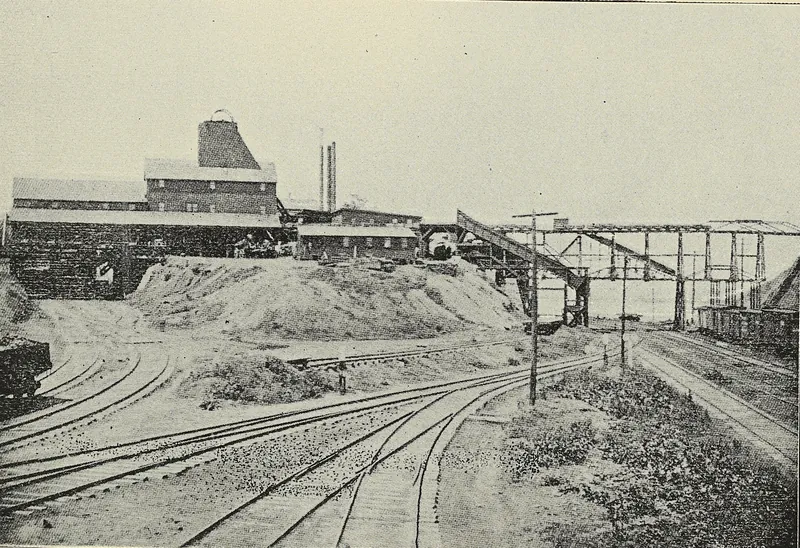
The newest mine in the chapter is the Carr Coal Mine at the town of Richardson, on the Atchison, Topeka & Santa Fe Railroad about two miles south of the city. The book says it was sunk "about two years ago," so shortly before the 1906 publication, and that it was principally owned by Leavenworth capitalists.
The book says "these four mines," which reads as the three city shafts plus the Carr mine, gave steady work the year round to 1,000 to 1,200 men "at good wages," with more miners taken on in winter when the demand for coal was greater. The convicts at Lansing appear to be a separate count. Coal also shows up in the book's street directions: it locates the city's first bank building in the alley behind Martin Donovan's coal and transfer office, on the northwest corner of Main and Cherokee streets.
For family researchers, the chapter's gaps matter as much as its facts. It names geologists, investors, a banker and one early miner, but none of the hundreds of men who worked the city shafts, and it says nothing about where they came from or whether they ever went on strike. What it does give is a firm timeline: drift mining before 1855, the long drilling effort of the 1860s, first coal in 1870, Lansing in 1881, Riverside in 1886 and the Carr mine shortly before 1906. Those dates are the anchors for placing a Leavenworth or Lansing coal miner in time.
Finding your ancestor in Leavenworth County
- Census records (free through 1950) list each person's occupation and town, so a mining family shows up decade by decade.
- Death records: search our Kansas database by surname.
- The county histories themselves: the biographical sections of Early History of Leavenworth City and County hold hundreds of family sketches.
- Newspapers on the Library of Congress's Chronicling America carried obituaries, accidents, and local news.
Tell us one grandparent's name. We'll take a free first look at the records and email you back.
Ask about my family →Frequently asked questions
When was coal first mined at Leavenworth, Kansas?
The 1906 history says the first coal from a Leavenworth mine went on the market in 1870, from a shaft on twenty acres of the Fort Reservation north of the city. The vein lay at 713 feet and was 21 inches thick. Earlier, the government and Charles Peet had worked drift mines on Salt Creek and Stranger Creek.
Who worked in the Lansing penitentiary coal mine?
Convicts. The book says 350 to 400 convicts were employed digging coal in the state-owned mine at Lansing, which struck coal on January 15, 1881. Its output, over 10,000 bushels a day, was solely for the state and went mainly to state institutions. The book does not name any of the men.
How many coal miners worked around Leavenworth in the early 1900s?
The 1906 history says four mines gave steady employment the year round to 1,000 to 1,200 men at good wages, with more miners employed in winter when demand for coal was greater. It gives no names, nationalities or wage rates for those workers.
Where were the Leavenworth County coal mines?
The first shaft was on the Fort Reservation, north of and adjoining the city. Riverside was in the southeast corner of the city near the Missouri River, and the Home mine was near the old ferry landing. The penitentiary mine was at Lansing, about three miles south, and the Carr mine at Richardson, about two miles south.
Photographs on this page are in the public domain. About the images and their sources.