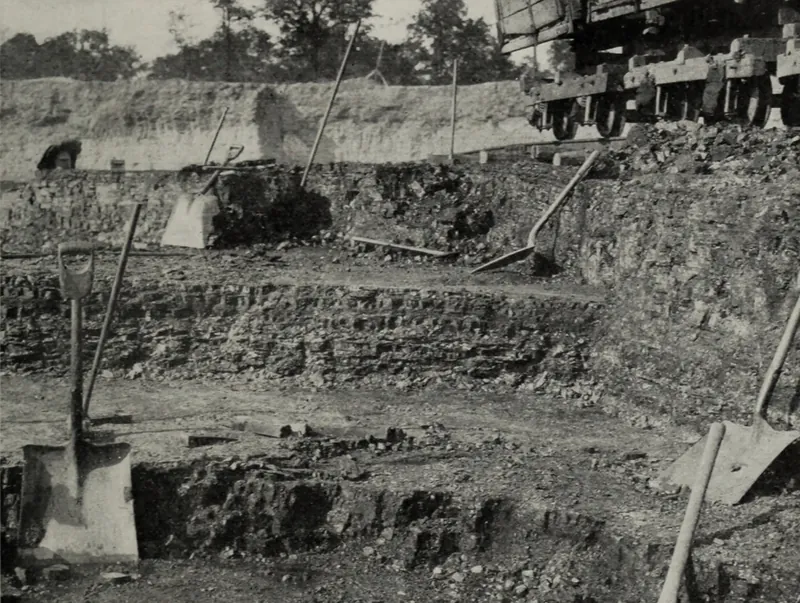
The 1878 History of Livingston County, Illinois carries a long roll of the county's tax-payers, printed township by township with each person's trade and post office. Read for the words "miner" and "coal shaft," that roll becomes a map of where the county's coal men lived in 1878: in Fairbury village, on the Indian Grove shafts around it, at the Coalville post office in Reading Township, and along the Streator edge of Newtown Township.
Written from The History of Livingston County, Illinois (1878). Everything below comes from that book, and where it gives an opinion, we say so. You can read the full book free on the Internet Archive.
How the 1878 tax-payer roll works
The roll runs under the page head "Tax-Payers of Livingston County." Pontiac's entries fall around page 828, and the village and township lists follow in the pages after it. Each entry gives the surname first, then initials or a given name, then an occupation. Rural entries add a post office, so a line reads like Easton, Thos., miner ; P. O. Fairbury. Farmers are often shortened to "far."
For coal research the useful words are miner, coal miner, coal shaft and coal dealer. Across the Fairbury, Indian Grove, Reading, Newtown and Pontiac lists, more than a hundred entries carry one of the miner labels. The roll gives no ages, no birthplaces and no mine names, and because it is a list of tax-payers it should not be read as a complete count of everyone who worked underground. The scanned text also garbles some letters, so any name below is worth checking against the page image before you search other records for it.
Fairbury village: 22 miners and Robert Knight's shaft
The Fairbury village list, which starts on page 829, records 22 men whose occupation is simply "miner." Among them are Jacob Adis and William Adams near the top of the alphabet, David Holden and Robert Holden, Thomas Heatherington, Robert Jones, Matthew Johnson, Hugh Wilson and Alexander Wilson, John Watson and Joseph Wamsely. Thomas Gibb, also a village miner, shares a surname with the shaft-owning Gibbs of Indian Grove Township.
One village tax-payer is identified with the business end of the trade: Robert Knight, entered as "prop, coal shaft," the proprietor of a shaft. The book does not say where his shaft stood or how deep it went.
The same list shows the town the miners lived in. Fairbury had a Catholic priest, Rev. J. A. Fanning, a Baptist minister, Rev. C. D. Merritt, and a Methodist Episcopal minister, Rev. John Wilkinson, which points to three sets of church records worth checking for baptisms, marriages and burials. Railroad men lived alongside the miners too, including a road master on the T., P. & W. line and a ticket agent for the C. & P.
Indian Grove Township: the shafts around Fairbury
Indian Grove Township's list, beginning on page 832, is mostly farmers, and nearly every entry takes mail at Fairbury. It holds four of the five coal-shaft entries found in the roll. J. Gibb is entered as "propr. coal shaft," J. Gibb, Jr. with "coal shaft," and M. Hotchkiss and J. Kirkwood each with "coal shaft" as well. John Gibb, Sr. is listed as a miner, so the Gibb name appears at both ends of the work, as owner and as digger, though the book never spells out how the Gibbs were related.
At least 14 Indian Grove men are entered as miners in the pages examined for this guide, which stop partway through the W's. Several surnames come in groups: R. Easton, Jr., Thomas Easton and Robert Easton; Allen Ireland and William Ireland; Patrick Sullivan and Jeremiah Sullivan. John Daily, John Fleming, Jeremiah Griffin, John Jackson, P. F. Moran and James Smail round out the miners. Two engineers, William Burges and Basile Devos, also had Fairbury addresses; the list does not say where they worked. A minister, Rev. T. Hemstead, is listed in the township as well.
Reading Township and the Coalville post office
The Reading Township list, starting on page 845, shows a second cluster of miners. Fifteen men are entered as miners or coal miners, and every one of them took mail at P. O. Coalville. They include D. Allen, T. Edwards, W. Flanagan, Evan James, William Knaak, C. C. Long and Albert Long, John Larkins, John Moore, John Redfern, W. M. Spicer and John T. Williams.
Coalville had its own postmaster, T. H. Mallory, and a few farmers used the same post office, among them T. Baldwin, Catherine Barton and Peter Ketner. The book treats Coalville only as a post office address and does not describe the place itself, so its size and layout cannot be read from these pages. Other Reading Township farmers took mail at Reading, Ancona, Long Point, Munster, Collins or Streator, and L. N. Arnold served as both postmaster and station agent at Reading.
Newtown Township and the Streator miners
The largest group of miners in the pages examined appears under Newtown Township, which begins on page 847. More than fifty men there are entered as coal miners, and nearly all give Streator as their address. These are Livingston County tax-payers, listed in Livingston County's book, even though they used the Streator name. One exception is Henry Kepple, entered as a coal miner at Collins.
The list also names a company officer: W. S. Cherry, "Secretary Coal Co., Streator." The book does not give the company's name. Same-surname groups show up here as they do around Fairbury: Alexander and William Hanlon, Alexander and Robert Jefferson, John and Joseph Kelly, and three Martins, D., Henry and James L. Other Newtown coal miners include George Atherton, William Biddle, John Forsythe, Arthur Hawkesley, John Pickering and Samson Rogers.
As in every list, no birthplaces are given. Some surnames, printed in the scan as Simko and Sabol, are exactly the kind that a later census or naturalization record can confirm or correct. A few Streator tradesmen appear among the Livingston tax-payers too, such as the merchant Nathan Bailey, the butcher Christian Echard and the blacksmith Joseph Dixon, along with a Streator physician, R. Evans, in the Reading list.
Pontiac, Dwight, Odell and the farm townships
Pontiac shows coal mostly as a trade. The Pontiac list, the one that includes the county sheriff and the city marshal, names W. W. Post as a coal dealer and a single coal miner, Thomas C. Robinson. In Pontiac Township a drayman is entered as "drayman and coal dealer," though his surname is blurred in the scan.
Outside those pockets the roll reads as farm country. In the pages of the Dwight Township list examined for this guide, and in the lists of farmers taking mail at Odell and Cayuga, the entries are farmers and tradesmen, with no one entered as a miner. Cayuga's postmaster was Peter Eppler. Taken together, the 1878 roll puts nearly all of the county's listed miners in two places: the Fairbury and Indian Grove area, and Reading and Newtown townships, whose miners used the Coalville and Streator post offices.
Using the roll to find a coal-mining ancestor
If an ancestor mined in Livingston County around 1878, start with the post office. A Fairbury address points to the village and Indian Grove lists, Coalville to Reading Township, and Streator or Collins to Newtown Township. Then read the whole township list, not just your surname. Relatives can sit a few lines apart, and same-surname groups such as the Eastons, Irelands, Hanlons and Martins are worth testing against census households.
Next, use the people the roll names around the miners. The roll names the postmasters at Coalville (T. H. Mallory), Collins (Martin A. Newman) and Smithdale (Z. R. Jones, also the railroad agent there), and those post office names are worth watching for in other records from the period. The Fairbury clergy point to church registers. And the shaft owners, Knight, the Gibbs, Hotchkiss and Kirkwood, are the names to look for in local newspapers and land records for the mines themselves, since this part of the book does not describe them.
Finding your ancestor in Livingston County
- Census records (free through 1950) list each person's occupation and town, so a mining family shows up decade by decade.
- Death records: search our Illinois database by surname.
- The county histories themselves: the biographical sections of The History of Livingston County, Illinois hold hundreds of family sketches.
- Newspapers on the Library of Congress's Chronicling America carried obituaries, accidents, and local news.
Tell us one grandparent's name. We'll take a free first look at the records and email you back.
Ask about my family →Frequently asked questions
Were there coal mines at Fairbury, Illinois, in 1878?
The 1878 Livingston County history's tax-payer roll lists Robert Knight of Fairbury village as proprietor of a coal shaft, and J. Gibb, J. Gibb, Jr., M. Hotchkiss and J. Kirkwood with coal shafts in Indian Grove Township, all with Fairbury mail. The village list alone names 22 miners.
Where was Coalville in Livingston County?
The 1878 history shows Coalville only as a post office. Fifteen Reading Township miners received mail at P. O. Coalville, where T. H. Mallory was postmaster, along with a few farmers. The book does not describe the settlement itself, so its exact location and size are not given in these pages.
Are Streator coal miners listed in the Livingston County history?
Yes. The Newtown Township tax-payer list names more than fifty men entered as coal miners with Streator addresses, plus Henry Kepple at Collins and W. S. Cherry, listed as secretary of a coal company at Streator. They appear in the Livingston County roll, under Newtown Township.
Does the 1878 roll say where the miners were born?
No. Each entry gives only a name, an occupation and, for rural residents, a post office. There are no ages, birthplaces or mine names, so origins have to come from other records such as censuses, church registers or naturalization papers, using the township and post office as a starting point.
Photographs on this page are in the public domain. About the images and their sources.