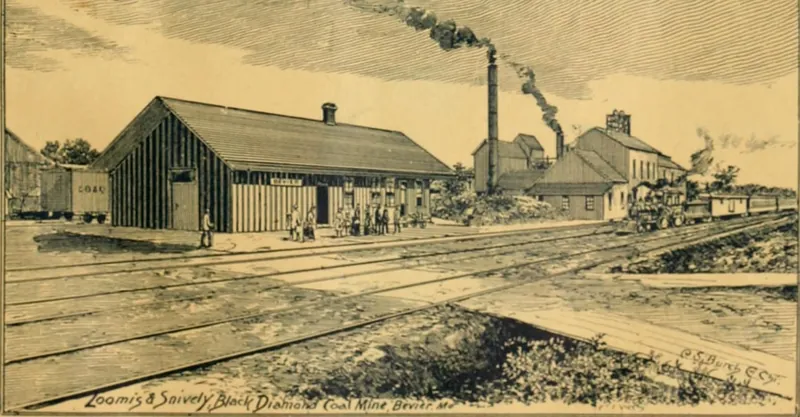
Macon County's coal story starts with a farmhand digging for water. By the time the General History of Macon County, Missouri appeared in 1910, the book could call Bevier the most important coal producer in the state, a field opened largely by Welsh and English miners, later joined by Black and Swedish miners at Bevier and Bohemian and Austrian miners at Lingo. This page follows the book's account of the mines, camps, companies and families, from a log-walled shaft to the corporate mines of 1908.
Written from General History of Macon County, Missouri (1910). Everything below comes from that book, and where it gives an opinion, we say so. You can read the full book free on the Internet Archive.
A Well That Struck Coal, 1860
The 1910 history credits the discovery to a man named Rector, a hand on the Hughes farm near Bevier who earned $13 a month. Sent to sink a well, he got down about twelve feet, hit two feet of slate and then a bed of coal later found to be a six-foot vein. Two railroad men, Thomas and Halleck, heard about it and opened a shaft on the spot, hiring Rector, his father and Cleve Stacy to wall it with hickory logs. They named the place New Castle, after Newcastle-upon-Tyne in England.
The pioneer company soon sold its rights to Mr. Hinton of Hannibal, who put in a horse-gin and hoisted two to three cars a day. The timing mattered: the Hannibal & St. Joseph locomotives still burned wood, and the railroad wanted coal. Rector mined all his working life and died at seventy. The book contrasts him with Thomas Wardell: the two started even, but Wardell died a wealthy operator while Rector died worth about what he had in 1860.
In an 1875 paper to the Macon Geological Society, reprinted in the book, Colonel A. L. Gilstrap described three workable veins east of the Chariton River: a top vein of four to five and a half feet worked at the Summit and Bevier mines, a 32-inch vein about thirty-five feet lower, and an eight-foot vein another forty feet down in the East Fork valley, which he rated best for coke and steam.
Hazleton, Oakwood, Centerville: The Named Mines of Early Bevier
The town came first. Lewis Gilstrap entered the land and sold to Mr. Bevier, whose son Col. E. S. Bevier, a railroad lawyer, gave the town its name. Duff & Co., a Boston firm, laid out the town in 1858, and the railroad came through in 1859.
Colonel Robeau, on the farm east of Hughes, hired David Reese to drive a tunnel near the railroad, which the book calls the district's first slope mine. He named it Hazleton. In 1861 Thomas Wardell, an Englishman then at Kewanee, Illinois, read about the Macon coal in a newspaper, took the next train, and leased Hazleton. East of Hazleton, John Cross and John Clifton sank the Oakwood shaft in 1862, and W. S. Watson, Wardell's brother-in-law from Knoxville, Iowa, sank Centerville on the George Parker farm. In 1862-3 the railroad sank a shaft near the depot and used the district's first steam hoist, loading eight to twelve cars a day.
A second passage numbers the mines and differs in places. It puts Hazleton (No. 6) on Lewis Robeau's land in 1861, abandoned for too much water, and dates Oakwood (No. 4) to the same year, a pocket soon worked out. No. 2 belonged to Hopkin Evans. No. 1, put down by the railroad under C. O. Godfrey with Wardell as superintendent, plus a company store, fixed the town on its present site. The merger is named differently too: the Centerville Coal & Mining Company in 1866-7 in one passage, the Central Coal & Mining Company in 1867 in the other.
Born in County Durham on July 4, 1835, and in America from 1844, Wardell went on to employ 600 men, with mines in Wyoming as well. He married Ann Surtees and died October 12, 1888, leaving four children: Thomas E., Elizabeth, Mary and Jane. His land south of Bevier passed to the Central Coal & Coke Company.
“The first settlers were Welsh and English, with a scattering of Irish and Scotch…”
Strikes, Strikebreakers and the Union, 1864 to 1899
In 1864 the companies raised the rate per bushel; the miners asked for another cent and got it. In 1865 the operators refused to recognize the union, and a strike failed. In 1867 a second strike brought out the women of the camp, who used tin pans and stale eggs against the replacement workers. On a rainy Saturday the sheriff and twenty-nine deputies rounded up the women, held them in Macon over Sunday and sent them home, and the strike broke.
After good years from 1867 to 1873, the companies tried to cut the mining rate from 6 cents to 5 cents a bushel. The strike dragged on for months, the union lost, and the Central Coal & Mining Company went bankrupt in what the book calls the darkest period in Bevier's history. Loomis & Snively bought what was left, except No. 2, which had gone to Mr. Atwill of St. Joseph.
In 1885 the companies decided to fight the union and brought in Black miners for the first time; after a long struggle, the book says, they became a permanent part of Bevier's population. In 1888 the companies brought Swedes from Chicago to break another strike. Riots followed, Front Street's business houses burned during the Swede strike, and once the state militia was called in, after Thomas Wardell was killed by attackers who were never identified. Two men were tried and acquitted. The book calls the killing the most unfortunate event in Bevier's history.
After the panic of 1893 the Loomis Coal Company, hurt by the cost of bringing in strikebreakers, went bankrupt. The book says the present union formed the next year; the Kansas & Texas Coal Company, which held out against recognition, sold out after spending $200,000 on the fight. Under the United Mine Workers of America and joint agreements, the book reports few disputes. One exception came in November 1899, when Edward Vail of Kansas & Texas telegraphed Sheriff A. J. Glenn that Black miners from mine 61 had been attacked by armed men west of Bevier and left badly wounded. The book says the Black miners, now armed, then fired from a railroad cut toward the Watson mines and union miners' homes. The book tells it from the townspeople's side, and the excerpt breaks off before the outcome.
Welsh Pits and Welsh Families at Bevier
The first settlers, the book says, were Welsh and English, with some Irish and Scotch. The First Congregational church was the first house of worship and the Welsh Congregational church came right after; a two-room schoolhouse opened in 1870. Bevier became a village on September 5, 1881, with Daniel Rowland as board chairman, and a city on March 16, 1889, electing Lewis Nowlan its first mayor. The book counts nine churches and a $30,000 central school, and puts the population between 2,000 and 3,000. The book credits the discovery and growth of the industry largely to men of Welsh birth or descent who had mined in Wales.
Former state inspector R. S. Thomas said a number of Missouri miners had started in Wales as trapper boys at 6 to 10. Uncle Johnnie Griffith began that way, carried to the pit on his father's back; he worked from age seven, last at mine 61, and made a full hand for three years past eighty before dying at eighty-four. Thomas listed working veterans aged sixty-five to eighty-six, among them Evan Maddy, Rowland Thomas, Jacob Ruch, Joseph Stott and David L. Davis. John T. Richards, born in Denbighshire, North Wales, on April 16, 1840, had worked since age eight. James E. Tanner went west with Wardell and Watson to open mines at Rock Springs and Carbon, Wyoming. The book adds that Missouri's mines did not generate gas, unlike the Welsh pits.
William Jones of Wales prospected for gold in Australia for three years, then coal at Johnstown, Pennsylvania, and in 1858 settled at Eureka, between Macon and Bevier; his son William T. Jones, born at Bevier on February 10, 1866, later lived at Callao. Thomas Francis, born in Glamorganshire on February 18, 1844, mined at Alton, Illinois, came to Bevier, prospected in Kansas for the company, became superintendent of the Central Coal Mining Company's local mines in 1879, and left in 1898 to be postmaster. Robert Edwards, Welsh-born, mined at Pomeroy, Ohio, until 1865; his son James G. Edwards was Bevier's second mayor. In 1893 Levi James, who farmed sixty-three acres in section nine with his wife Mary Evans, struck coal on his own land and worked a mine of about twenty-five tons a day until his death in 1901.
“From a town of 500 population, with churches, stores, schools and many dwelling houses, it dwindled to a hamlet.”
Lingo: Bohemian Longwall Miners West of New Cambria
Lingo, a few miles west of New Cambria on the Burlington, was founded in 1873 by Thomas and George Jobson. It was once Peabody's Woodyard, where the railroad bought engine wood, and was renamed for Judge Samuel Lingo. The Jobsons struck coal at 110 feet, bought 120 acres from the railroad at $6 an acre, and formed a company with $30,000 in stock. F. A. Quinn, William Blake, John Vanderpool, John Saunders and John Redman sank the shaft. Welsh miners from Bevier came first, but the coal suited only the longwall system used in Austria, so the Jobsons hired Bohemian and Austrian miners from Braidwood and Streator, Illinois, and sent to Austria for more.
Thomas Jobson owned the mines alone from 1884 to 1888 and said they made money. Later owners lost the railroad's business, and in the 1890s the Armours bought 600 acres including the whole town and painted every building bright yellow. After a sympathy strike, Armour closed the mines and switched to oil. Lingo fell from about 500 people to a hamlet. For a New Cambria company prospecting Perry Baldwin's land, well drillers hired to find coal salted a dry hole with coal and left with their $225; G. A. Yager of the Pioneer Gold Mining Company later reported ore there running $15 a ton.
Keota, Ardmore and the Corporate Field by 1908
The Central Coal & Coke Company built a road sixteen miles south to Ardmore, and the Missouri & Louisiana made Bevier its terminal. Keota was opened in 1900 by the Kansas & Texas Coal Company, later absorbed by Central Coal & Coke, which employed about 1,000 men; Keota had close to 500 people and a new $75,000 coal washer run by E. O. Jones.
The 1908 state report, when Richard S. Thomas of Bevier was chief inspector, lists Central Coal & Coke, capitalized at $7,000,000 under president C. S. Keith, with six mines: Nos. 61, 66, 24, 25, 28 and 10. The Northwestern Coal & Mining Company, with 850 acres and $150,000 in capital under John H. Bovard, worked No. 8, a mile south of Bevier, and No. 9. Smaller operators included the Gronoway mines at Macon and Isaacson & Underwood, three and a half miles west of Bevier. The Home Coal Company of Macon, led by Ben Davis, opened in November 1909 on a 22 to 25 inch longwall vein with sixty men, the first steam mine about Macon.
Inspector Charles Evans charged W. E. Murlin, Kansas & Texas superintendent, with ignoring the shot-firer law at mine 33 at Ardmore and mines 43 and 46. Murlin won before a justice in July 1895, but the Supreme Court, in Judge Gantt's opinion, sided with Evans, citing the 1888 Rich Hill disaster that killed twenty-three. Shot firers, paid $2.83 a day, then worked in every Macon County colliery. Output peaked in 1907 at 29,439 cars, or 1,032,143 tons.
Finding your ancestor in Macon County
- Census records (free through 1950) list each person's occupation and town, so a mining family shows up decade by decade.
- Death records: search our Missouri database by surname.
- The county histories themselves: the biographical sections of General History of Macon County, Missouri hold hundreds of family sketches.
- Newspapers on the Library of Congress's Chronicling America carried obituaries, accidents, and local news.
Tell us one grandparent's name. We'll take a free first look at the records and email you back.
Ask about my family →Frequently asked questions
Who discovered coal at Bevier, Missouri?
The 1910 county history credits a farmhand named Rector, who struck a six-foot vein in 1860 while digging a well on the Hughes farm. Railroad men Thomas and Halleck then sank a shaft there and called it New Castle, after Newcastle-upon-Tyne.
Where did Macon County's coal miners come from?
The book says Bevier's first settlers were Welsh and English, with some Irish and Scotch. Companies brought in Black miners in 1885 and Swedes from Chicago in 1888. At Lingo, the Jobsons hired Bohemian and Austrian longwall miners from Braidwood and Streator, Illinois, and from Austria.
What happened to the coal town of Lingo?
Founded in 1873 by Thomas and George Jobson, Lingo was later owned by the Armours, who painted every building yellow. After a sympathy strike, Armour shut the mines and switched to oil, and the book says Lingo shrank from about 500 people to a hamlet.
Which coal companies operated in Macon County around 1908?
The 1908 state report lists the Central Coal & Coke Company with six mines (61, 66, 24, 25, 28 and 10) and the Northwestern Coal & Mining Company with Nos. 8 and 9, plus smaller operators such as the Gronoway mines at Macon and Isaacson & Underwood.
Photographs on this page are in the public domain. About the images and their sources.