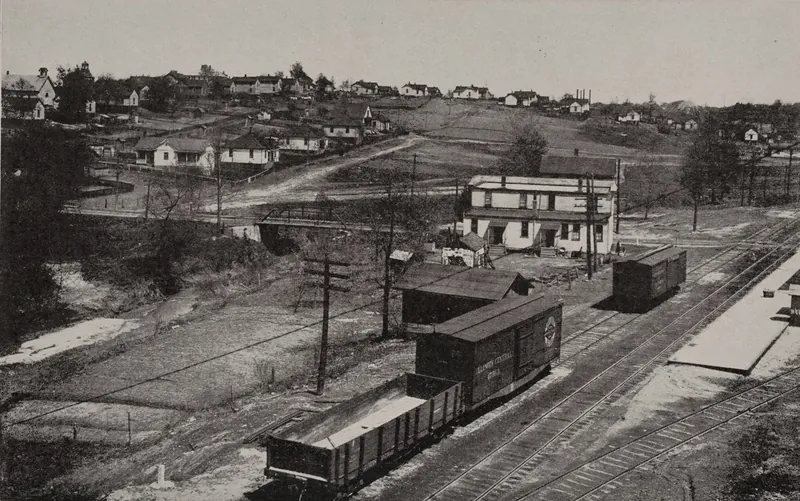
Madison County's coal story runs from a few drift mines on Mill Creek above Alton in 1840 to a county that, by the 1912 Centennial History's count, ranked fifth in Illinois for output in 1910. In between came the Vandalia line shafts at Collinsville, the Edwardsville mines of the Wolf Brothers and Frank Schramek, and railroad mining towns like Glen Carbon, Livingston and Williamson. This page draws on the 1882 History of Madison County and the 1912 Centennial History, volume 1.
Written from 2 county histories, all free to read on the Internet Archive: History of Madison County, Illinois (1882); Centennial History of Madison County, Illinois, and Its People, Vol. 1 (1912). Everything below comes from those books, and where they give an opinion, we say so.
Coal Branch and Buck Inn: the first diggings
The 1912 history prints a report on early mining from Walton Rutledge, state mine inspector for the Eighth district. In 1840 coal seam No. 1 was found outcropping on Mill Creek, half a mile north of Alton's city limits. N. Scharf, Joseph Hall and Richard Whyers opened drift mines there, and hauled the coal to the Alton levee for steamboats, the first coal mined in the county. Later Thomas Dunford and James Mitchell sank shafts on the hills, and John Applewhite, Thomas Hall, John Rutledge and others sank shafts at Greenwood, also called Buck Inn. These were the first mines of any extent in the county, and the district was known as Coal Branch.
Greenwood was platted by James C. Tibbett in 1853, across the township line from the Buck Inn, built in 1837. In December 1875 the plat and added ground were incorporated as North Alton, and in 1908 the village was annexed to Alton. The 1882 history rated the Buck Inn coal as excellent, better than the coal at Virden, but the 1912 history notes the vein was only 28 inches thick, and once thicker veins turned up in the central and eastern county the district declined. By 1910 only two small mines were working, run by Peter Syddal and Benjamin Eccles.
When the Chicago & Alton was finished from Joliet to Chicago in 1856-7, Superintendent McMullin asked the Alton agent, R. P. Tansey, for a carload of coal. It came from Dunford's mine, and the 1912 book says it was the first carload of coal ever received in Chicago over that road: ten tons.
In 1850 seam No. 6 was found on Wood River three miles north of Fosterburg, and mines were opened on Z. B. Job's land, called the "new diggings." They could not compete with the nearer Coal Branch mines and were abandoned. About 1852 the same seam was found two miles north of Bethalto, where a Boston company opened two slopes, laid out a town and built miners' houses. Those mines were abandoned during the Civil War, the 1912 book says, owing to a scarcity of miners and labor troubles.
Collinsville and the Vandalia line shafts
By 1882 the county history called coal mining and manufacturing the chief interests of Collinsville, ten miles east of St. Louis, with coal at 160 to 190 feet under a slate and limestone roof.
The two books name different pioneers. The 1882 history says the Collinsville Coal and Mining Company owned the first shaft sunk in Collinsville, put down by Peter Wonderly "about 20 years ago" and first worked by horse power. The 1912 history dates a shaft near the north edge of town to 1862, and says that when the Vandalia road was building through in 1863 the first mines on its line were sunk by John Maul and David Williams of Belleville, followed by William Fletcher, Dr. Lumaghi, Joseph Wickliffe, Andrew Delano and the Consolidated Coal Company of St. Louis.
In 1882 the Collinsville Coal and Mining Company, with George Savitz as president and J. H. Wickliffe, ran two shafts (the second sunk in 1873), 150 feet to a coal vein averaging seven and a half feet, with 100 men and a capacity of 11,000 bushels a day. The Lumaghi mine, opened in 1869 by Octavius Lumaghi, was 165 feet deep and employed about sixty men. The Cantine mine, sunk in 1873 by Morrison and Ambrosius, went 182 feet to the coal and had about 65 men, mining 100,000 bushels a month in 1881.
The book called the Abbey Coal and Mining Company the most extensive mining company on the Vandalia line, though its only Madison County mine was Abbey No. 3 near the depot, sunk by Reid and Strain in 1875 and leased to Abbey the next year. Abbey's other mines lay in St. Clair County, and in 1881 all of them together raised 13,400 car loads, about 5,000,000 bushels.
Northeast of town, the Confidence mine was sunk in spring 1870 by Seybt, Bandelier & Co. and leased that fall to the Bartlett Coal and Mining Co., which forfeited the lease in spring 1873. It ran its machinery on compressed air and employed 50 men, and the company had eighteen buildings, including boarding houses and dwellings on the bluffs east of the mine. Nearby, Heintzville was platted in fall 1880 by Walter Rutledge for J. L. Heintz, and by 1882 had twenty-two houses, twenty-six families and about 150 people, plus zinc works and a coal mine. Heintz had sunk the Heintz Bluff Mine in 1876; on July 1, 1881 he sold it to J. H. Wickliffe and stayed on as superintendent of its 65 men.
“Coal was mined and hauled to the levee in Alton for use of steamboats…”
Edwardsville's shafts
According to the 1912 history, about 1851 Richard Cartledge sank a shaft on seam No. 6 near the old distillery in the lower part of Edwardsville, the first coal mined there. Later shafts were sunk by Frank Shermack, John Gaffney, Wolf Brothers and Henry Voge. The 1882 history spells the first of those names Schramek.
In the 1882 book, Wolf Brothers' mine, half a mile southeast of the Court-House Square, was sunk in summer 1879 with a capital investment of $20,000. The book called its coal the finest quality found in that part of the state. At full capacity it raised 7,000 bushels a day with 150 men and paid $7,800 a month in wages.
The St. Louis and Edwardsville Coal Company, J. S. Trares president, worked a shaft on section 10 sunk by Tunstell & Holmes in 1868 or 1869 and later bought by John A. Prickett; the company leased it in fall 1881 for twenty years. Frank Schramek opened his mine on the Wabash at Union Street in spring 1879; in the busy season it employed twenty-five men, mined 200,000 bushels a year and shipped mainly to St. Louis.
Railroad mining towns: Worden, Troy, Glen Carbon and beyond
The 1912 history says a shaft was sunk at Troy in 1872, and in 1873 the Consolidated Coal Company sank two shafts at Worden, with later shafts at Worden, De Camp and near Staunton on what became the Wabash. The 1882 Omph-Ghent township directory names mine officials: Hardwig H. Lueker, born in Westphalia, Prussia, was a farmer, superintendent and stockholder of the Worden Mining Co., and J. H. McDonald, a physician born in Aberdeen, Scotland, was general manager of the McDonald Coal Co. By 1912 the Kerns-Donnewald mine was working at Worden.
Glen Carbon came with the railroad built in 1885 from Springfield to East St. Louis. A town site was located five miles south of Edwardsville, two shafts were sunk, and about 500 miners worked there, living in Edwardsville and Glen Carbon. The village was incorporated June 6, 1892. The Madison Coal Corporation ran mines No. 2 and No. 4 there: the 1910 coal report credited No. 2 with 195,218 tons for the previous year and 234 hands, and No. 4 with 187,983 tons and 250 hands. Glen Carbon had 1,348 people in 1900 and 1,220 in 1910.
The Litchfield & Madison railroad, built in 1886 and known as a "coal road," opened two large mines near the county line two miles from Staunton, and the village of Williamson was laid out there; about 600 miners lived in it. Williamson held the county's deepest workings, at three hundred feet. About 1900 a Chicago & Eastern Illinois spur brought a shaft and the village of Livingston, two miles east of Worden, home to about 500 miners; by 1912 its mine belonged to the New Staunton Coal Company of St. Louis.
In 1888 the Donk Brothers of St. Louis built the St. Louis, Troy & Eastern from Madison to Troy and sank mines at Maryville, Collinsville and Troy. The 1912 history calls the Donk company the largest in the county, with about 1,000 men in its three mines. Maryville, incorporated June 4, 1902, had 729 people in 1910, and the 1910 coal report gave its mine No. 2 an output of 373,900 tons for the previous year, with 467 hands and a product valued at $323,885.
“A shaft was sunk on this line and a village site located called Livingston. About 500 miners live there.”
Inside the mines by 1910
In Rutledge's report the seams run from the river bluffs to 400 feet deep in the east, all bituminous. Two-thirds of the coal was mined by machines. Mules gathered loaded cars at the working face and brought them to stations, where they were made up into trains for the hoisting shaft; some large mines kept upwards of forty mules and two electric motors. Where machines were used, one keg of powder brought down one hundred tons of coal; in hand mines, twenty-five tons.
The report judged the larger mines "very good and safe," but the numbers show the cost. In 1910 there were sixteen fatal accidents and eighty-four non-fatal ones that cost thirty days' work, and sixty per cent of accidents came from falling coal and slate. A new law effective July 1, 1911 required shafts and surface buildings to be fireproof. The 1912 history credits this cheap fuel with building up St. Louis and East St. Louis.
Output, seams and the books' disagreements
The 1882 history quotes the county mine inspector's report for the past year: 27 mines, all shafts, employing 1,000 men and boys, with a yearly product of 400,000 tons and $248,000 invested. The 1912 history's state table gives slightly different figures for 1882: 26 mines, 1,165 men and 578,000 tons.
The 1912 figures trace the growth. Output was 59,378 tons in 1864, the earliest report available, and 116,724 tons in 1870. By 1910 Madison ranked fifth of fifty-five coal counties with 3,719,155 tons, behind Williamson, Sangamon, St. Clair and Macoupin, and 4,322 people worked at the mines. In 1911 the county mined 3,766,002 tons, valued at $3,968,784 at the mines, and Rutledge counted twenty-nine mines, sixteen shipping and thirteen local. Over 1882 to 1911 the table totals 48,116,998 tons.
The books also number the main seam differently. The 1882 history believed the Belleville seam on the east side of the county was No. 5, the state's main workable seam; the 1912 history says the seam mined is No. 6.
Finding a Madison County coal miner in the records
Neither book says much about where ordinary miners came from, but the 1882 directories list birthplaces. The Fosterburg township list includes a Swiss-born coal miner, and Worden's mine officials came from Prussia and Scotland. E. J. Molloy, the county inspector whose 1882 report was the first the State Bureau of Labor Statistics received, appears in the 1882 North Alton directory as mine inspector, born in County Meath, Ireland.
For family research, the company and town names above are the best leads: Coal Branch and Buck Inn for the 1840s and 1850s, the Collinsville, Lumaghi, Cantine and Abbey mines for the 1870s and 1880s, and Glen Carbon, Worden, Livingston, Williamson and Maryville after 1885. The 1912 history drew its figures from the State Bureau of Labor Statistics' annual coal reports, and the 1882 history from the county mine inspector's report.
Finding your ancestor in Madison County
- Census records (free through 1950) list each person's occupation and town, so a mining family shows up decade by decade.
- Death records: search our Illinois database by surname.
- The county histories themselves: the biographical sections of History of Madison County, Illinois and Centennial History of Madison County, Illinois, and Its People, Vol. 1 hold hundreds of family sketches.
- Newspapers on the Library of Congress's Chronicling America carried obituaries, accidents, and local news.
Tell us one grandparent's name. We'll take a free first look at the records and email you back.
Ask about my family →Frequently asked questions
Where was the first coal mined in Madison County, Illinois?
The 1912 Centennial History says the first coal came in 1840 from drift mines opened by N. Scharf, Joseph Hall and Richard Whyers where seam No. 1 outcropped on Mill Creek, half a mile north of Alton. The coal went to the Alton levee for steamboats. Shafts at Greenwood, or Buck Inn, followed, and the district was called Coal Branch.
Which coal company was largest in Madison County by 1912?
The 1912 history names the Donk Brothers Company of St. Louis, which employed about 1,000 men in three mines on its St. Louis, Troy & Eastern railroad: No. 1 two miles north of Collinsville, No. 2 at Maryville and No. 3 at Troy.
When did coal mining start in Edwardsville?
The 1912 history says Richard Cartledge sank a shaft about 1851 near the old distillery in the lower part of town, the first coal mined at Edwardsville. The 1882 history describes later shafts, including Wolf Brothers' mine of 1879, Frank Schramek's mine of 1879 and the St. Louis and Edwardsville Coal Company's shaft.
How big was Glen Carbon as a mining town?
According to the 1912 history, Glen Carbon was laid out on the 1885 railroad from Springfield to East St. Louis, incorporated June 6, 1892, and had 1,348 people in 1900 and 1,220 in 1910. The Madison Coal Corporation ran mines No. 2 and No. 4 there, with 234 and 250 hands.
Photographs on this page are in the public domain. About the images and their sources.