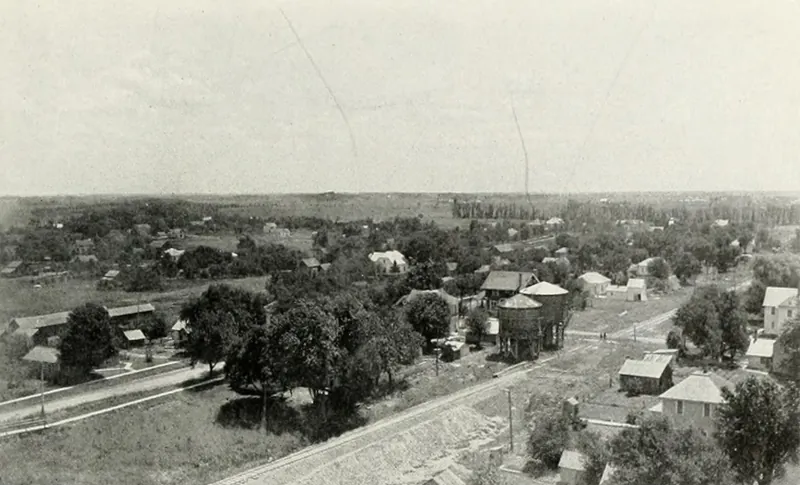
Madrid began as Swede Point, a Swedish settlement on the Dalander claim in Douglas Township, and it spent sixteen lean years watching railroads pass it by. In 1881 two lines came through at once, and the town began to build in brick. Elsewhere in Boone County, coal raised camps almost overnight: Angus in the southwest corner, Zenorville in Jackson Township, Moingona and Coal Valley in Marcy. This page follows Madrid and those camps from 1880 to 1914, as told in the two volumes of the 1914 History of Boone County.
Written from 2 county histories, all free to read on the Internet Archive: History of Boone County, Iowa, Vol. 1 (1914); History of Boone County, Iowa, Vol. 2 (1914). Everything below comes from those books, and where they give an opinion, we say so.
Swede Point becomes Madrid
Mrs. Anna Dalander and her sons and daughters settled in September 1846 on the claim where the town would stand. The 1914 history says no pioneer woman's name is more prominent in early Douglas Township, and it records her death on November 28, 1854, as the first among the Swedish people in Boone County. The sketch of her grandson, postmaster E. P. Dalander, says she secured the first deed to land in the county and that the deed was kept by the Madrid Historical Society.
The first two town plats were filed as Swede Point. After Mrs. Dalander died without a will, Charles W. Gaston, the county's first settler, became administrator of her estate, and with the third plat, surveyed in May 1855, he renamed the town Madrid. E. P. Dalander's explanation is that Gaston had fallen out with the Dalander sons and, to spite them, swapped the Swedish name for the capital a Spanish employee of his often talked about.
Swedish families kept coming. S. G. Bengtson's family reached Madrid on August 1, 1870. Jacob M. Carlson, born in Ostergotland, came in 1878 and, in his biographer's words, located at Swede Point. Andrew M. Sundberg's family came from Chicago that fall, and Oscar Oakleaf arrived in 1881 after farm work near Marshalltown; Carlson and Oakleaf both clerked for merchant William Johnson. (Mining around Boone and Moingona before 1880 has its own page on this site; this one picks up the story after.)
The lean years and the railroads of 1881
The 1914 history calls 1865 to 1881 the darkest years Madrid ever saw. Madrid had hoped the Des Moines Valley road would run up the east side of the river; instead it crossed at Des Moines and laid out Perry, sixteen miles west. The Des Moines & Minnesota line then ran seven miles east, and Madrid began to lose people.
In the winter of 1881 word came that Milwaukee Railway surveyors were six miles east, weighing a route through Madrid against a crossing at the Chestnut Fork. John Bilsland, who had come overland in 1853 to Swede Point, drove out with a few others to meet them. The road came through town east and west, the Des Moines & Northern soon followed north and south, and the book calls Bilsland a public benefactor for that day's work. By 1914 the main line was double-tracked.
The first three brick buildings went up in 1883, Keigley Brothers and E. B. Hepburn among the builders, and twenty-five more followed. Edward Lunt's Madrid Pilot appeared in August 1881 and lasted about three months. M. N. Tomblin started the Madrid Register in the fall of 1882; it merged with D. V. Smith's Madrid News in 1894 and belonged to J. G. Lucas from December 1904. By 1914 the book counted no fewer than forty places of business, among them a wagon box factory and two banks, and the Madrid State Bank reported $313,000 in deposits on April 6, 1914.
“Its rough and ready population flocked in from all the coal mining districts of the Union and many from the coal regions across the seas.”
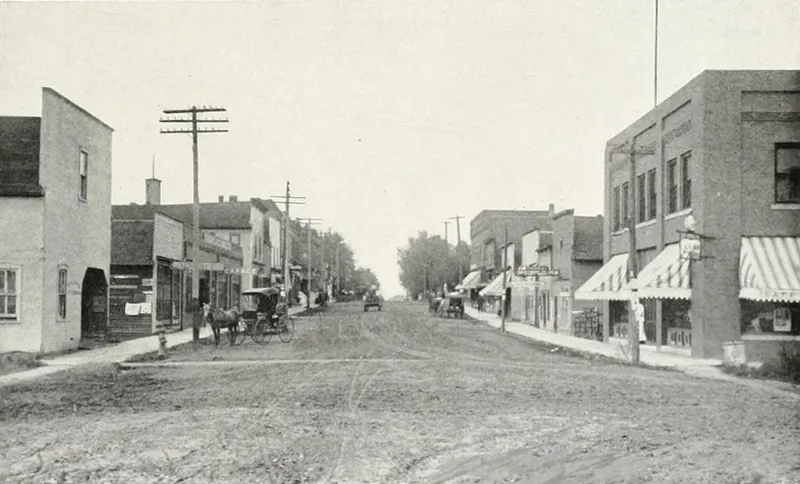
Angus: the boom camp in the southwest corner
For Union Township the 1914 history reprints a Register and Leader article, "The Rise and Fall of Angus," introducing it by calling Union's coal story the most interesting, remarkable and romantic in the county, perhaps in the state. The town began as Coaltown on the Des Moines Valley's northward extension of the early 1870s, and Hamilton Browne renamed it Angus after a railroad official.
The article says the first mine was sunk by John F. Dunscombe, a Fort Dodge capitalist, who sold out to the Climax Coal Company, a concern in which railroad magnate James J. Hill was interested. Climax ran three of the largest mines in the state, and one of its shafts once hoisted eighty cars in a day, fifty-three of them lump coal. Nine companies eventually worked Angus and its suburbs: Keystone, Climax, Standard, Moingona, Panic, Milwaukee, Dalbey, Ohio and Armstrong. The seam ran three to five feet with a good roof. John McKay, Sr., of Des Moines, superintendent of the Standard Mine, remembered a best day of 650 tons, and the company was said to have made $34,000 in one year from that single mine.
Sizes in the volume do not agree. The Register and Leader piece calls Angus in 1885 by far the largest coal mining town in Iowa, with something over five thousand people at its height. The same volume's newspaper chapter puts the peak at an estimated thirty-five hundred, the figure O. M. Brockett says he was given when he arrived in February 1883, when the town was about three years old.
The strike, the militia and the long decline
The article calls the big strike the most exciting chapter in Angus history. It began in September 1884 when every miner, backed by the Knights of Labor, walked out over the usual fall raise in the mining rate, which the operators refused. Offers of compromise and arbitration failed. The operators finally landed a trainload of strikebreakers at Snake Creek, three miles west of the depot. On a cold winter night strikers found the men barricaded in a lodging house, partly tore it down, set it on fire and drove them out of town. Two Third Regiment companies came from Des Moines the next morning, H under Capt. Franklin DeFord and A under B. W. Bartlett, found all quiet, and the strike was settled by arbitration. The newspaper chapter of the same volume dates the strike to the fall of 1883 and says it closed every mine but one, so check the year against other records.
In less than five years after the strike, the article says, half the population had moved away and most of the big mines had shut down. Some went back to the old country, more to other camps, and many of Des Moines' prominent coal operators had once worked at Angus. A brief revival in 1892 produced J. Y. Steir's Angus News, which never reached its first birthday. A. T. Pearson's private bank failed on August 7, 1893, during the panic, and depositors got back about thirty-five cents on the dollar.
The article reports hundreds of Perry homes rebuilt from Angus buildings, more at Rippey, Dawson, Berkley and Fraser, and some cut into sections and shipped by flat car to the mining settlements around Des Moines. The vacant lots went to tax sales and back to farmland. The newspaper chapter describes what remained as a modest cluster of houses holding perhaps one to two hundred people.
“There are today hundreds of residences in Perry that have been reconstructed out of buildings moved from Angus.”
Churches, papers and the people of Angus
According to the article, Angus drew its miners from all the coal districts of the Union and many from the coal regions across the seas. The first church was built by the Swedish population and used for services by the Reformed Lutherans. In 1884 the Welsh Congregationalists built near the center of town, and that same year the Methodist Episcopal church went up in Miller's addition. Rev. William A. Morris, a Primitive Methodist the article calls a "missionary miner," arrived in 1883 and held street prayer meetings; with T. A. Ray he started a Union Sunday school in the Swedish church. The article blames the saloon element for burning the Methodist church in May 1886. Meetings moved to the Welsh church, and revivalist Mrs. C. Watson came from Grant County, Wisconsin.
Angus papers are worth looking for. The Black Diamond, founded about 1881 or 1882 by lawyer Robert A. Lowry (spelled Lowrey in the article), ran about five years; its May 27, 1887, issue warned that it might shut for the summer, and it did. The Tenderfoot, run by O. M. Brockett and G. A. Clark, later took the name The Iowa Times. By 1914 two churches remained: Methodist Episcopal and Primitive Methodist.
Zenorville, Moingona and Coal Valley
Zenorville, on Section 12 in Jackson Township, grew after coal was found there in the mid 1870s, and considerable coal was mined from 1876 to 1890. The 1880 mine inspector's report, as the 1914 history quotes it, listed three mines: the J. Clemens Mine with 50 men, the Hutchinson Brothers Mine with 35 and the Joseph York Mine with 8, all on a vein four feet, two inches thick. Their families made a village of about four hundred, with a store, post office, blacksmith shop, meat market, church and schoolhouse. When the coal was worked out the houses and shanties were sold and moved off, and the site went back under cultivation. Its Evangelical church and schoolhouse were moved west to a public road.
Moingona, laid out July 6, 1866, was a product of the Chicago & North Western and the nearby mines, and for a while it had about one thousand people and its own city government. Its churches were Swedish Lutheran, Swedish Mission and Presbyterian. When the veins gave out and the railroad straightened its line to cross the river four miles upstream, business fell off and the town surrendered its charter. A Mr. Livingston told the 1914 historian Moingona still had 300 people.
Coal Valley, laid out by Amos Elliott in September 1867 on Section 2 in Marcy Township, was meant as a miners' town only. Coal was shipped from it for several years; when the mines gave out the miners left.
Miners' families: the Gartlands and the Crowes
Two biographies in the second volume show how miners reached the county. Phillip Gartland was born January 6, 1835, at Carrickmacross, just inside County Monaghan, Ireland. He worked a blast furnace at Durham, England, sailed from Liverpool on June 30, 1863, made bayonets in Connecticut, mined anthracite at Wilkesbarre, Pennsylvania, and married Ann Hughes at Derby, Connecticut, on October 9, 1864. After coal mining at Hubbard, Trumbull County, Ohio, he brought his family to Moingona in May 1867. The sketch says he mined there until 1893, though it also has him leaving for Seymour, Wayne County, in 1892. At Moingona he was justice of the peace from 1877 to 1891 and school board secretary for eight years. He later mined at Marceline, Missouri, then worked in the Northwestern round house at Boone until 1909. His son Edward, born at Moingona March 13, 1870, went into the mines with his father at eight and a half, drove mules and became a full miner.
William Crowe, Sr., born February 17, 1847, in Scotland, left the village of Larkhall in 1866 at nineteen and worked through Pennsylvania, Illinois and Ohio, marrying Elizabeth Marshall of Hubbard, Trumbull County, in 1871. He reached Boone in 1876 and mined for a time at Ames before entering the Boone coal trade, first with George Rogers and then with John Marshall, who died in November 1899. On March 6, 1900, he organized the Crowe Coal Mining Company, with James Crowe as vice president and secretary and Garvin Crowe as treasurer. It developed mines in Des Moines Township, and his biographer says he employed more men than anyone else in Boone coal mining in his time. Gartland mined at Hubbard and Crowe married a Hubbard woman, so Trumbull County, Ohio, is worth searching for both.
People from this history in our records
These Boone County residents have biographies on our site from the county histories, and each one mentions the mines. Their sketches name parents, spouses, and where the family came from.
- Fred Johnson (b. 1840)
- Andrew G. Anderson (b. 1867)
- Ira D. Johnson (b. 1870)
- John M. Anderson (b. 1866)
- Leonard E. Johnson (b. 1864)
Finding your ancestor in Boone County
- Census records (free through 1950) list each person's occupation and town, so a mining family shows up decade by decade.
- Death records: search our Iowa database by surname.
- The county histories themselves: the biographical sections of History of Boone County, Iowa, Vol. 1 and History of Boone County, Iowa, Vol. 2 hold hundreds of family sketches.
- Newspapers on the Library of Congress's Chronicling America carried obituaries, accidents, and local news.
Tell us one grandparent's name. We'll take a free first look at the records and email you back.
Ask about my family →Frequently asked questions
Why was Swede Point renamed Madrid?
The 1914 History of Boone County gives the account of postmaster E. P. Dalander: Charles W. Gaston, administrator of Anna Dalander's estate, quarreled with her sons and, when he had the third plat surveyed in 1855, replaced the Swedish name with Madrid, the capital a Spanish employee of his often spoke of.
How large was Angus, Iowa, at its peak?
The sources disagree. A Register and Leader article reprinted in the 1914 history says Angus had something over five thousand people at its height and was by far Iowa's largest coal mining town in 1885. The same volume's newspaper chapter estimates thirty-five hundred.
What happened in the Angus coal strike?
Backed by the Knights of Labor, every miner walked out over the fall mining rate. When operators brought strikebreakers to Snake Creek, strikers burned their lodging house and drove them out. Two Third Regiment militia companies came from Des Moines, and the strike was settled by arbitration. The volume dates it both 1883 and 1884 to 1885.
Where did the houses of Angus go?
According to the reprinted article, buildings were sold cheaply and moved away. Hundreds of Perry residences were rebuilt from them, others went to Rippey, Dawson, Berkley and Fraser, and some were cut into sections and shipped by flat car to mining settlements around Des Moines.
Photographs on this page are in the public domain. About the images and their sources.