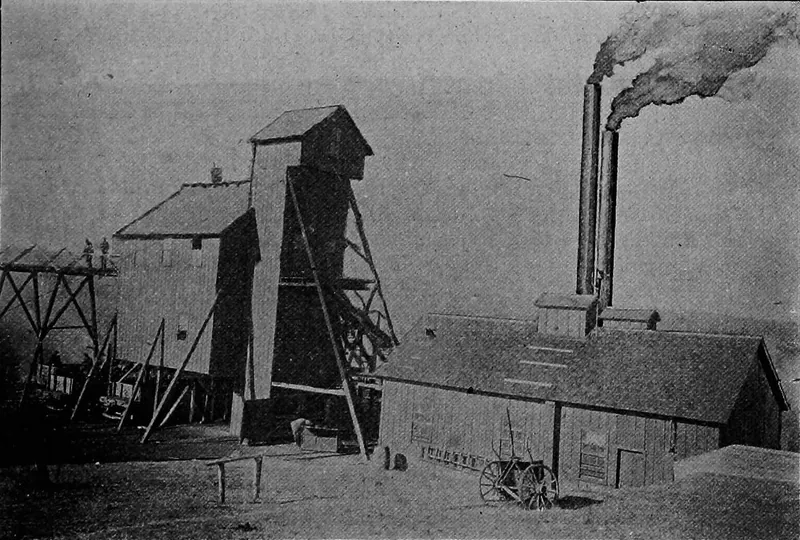
Two county histories, printed eighteen years apart, catch Monroe County's coal trade at two very different moments. The 1878 History of Monroe County describes farmers stripping coal from small banks and a few shaft mines around Albia, Avery, and Coalfield. By the 1896 Illustrated History, company camps such as Foster, Hynes City, and Hiteman had grown up around single employers, and the miners had just come through a strike the book calls one of the most far-reaching the country had seen.
Written from 2 county histories, all free to read on the Internet Archive: The History of Monroe County, Iowa (1878); An Illustrated History of Monroe County, Iowa (1896). Everything below comes from those books, and where they give an opinion, we say so.
Farm banks and the first shafts, to 1878
The 1878 history says coal lay under much of the county, and farmers in many places worked small banks, stripping out wagon loads of what the book calls an inferior grade and selling it in Albia and other towns. The real wealth, the book said, came from deep, systematic mining by organized companies.
In 1878 that kind of mining was furthest along in Pleasant and Troy townships. The Consolidated Coal Company was operating very extensively at Coalfield on the Central Railroad of Iowa, which had built up a little town near its works. The Union Coal and Mining Company had large interests at Avery, on the Burlington line about six miles east of Albia. West of Albia, the Cedar Valley Coal Company and the Albia Coal Company had mines. The book put the county's commercial output at no less than 500 tons a day, with 600 to 800 men in the business.
The 1878 township directory credits E. W. Byers of Avery with sinking the first shaft in the county. Born in Mercer County, Pennsylvania, in 1835, he came to Monroe County in 1864, ran a drug business in Albia, went into coal mining at Avery, moved there in 1869, and was appointed postmaster in 1872.
Underground at the Albia Coal Company, 1878
The 1878 writer went down into the Albia Coal Company's mine, run as a copartnership. Its mines covered 480 acres on the Burlington main line about three miles west of Albia, three trains a day hauled the loaded cars from its side tracks, and a little hamlet had grown up nearby. Superintendent Miller took him down a shaft 135 feet deep, divided in two so one cage rose as the other fell.
The writer credits the mine's success to a Mr. Ramsey, an Englishman he describes as a graduate of the best mining and civil engineering college in England. Each room was worked by two men. Seven small mules lived below in fitted stables. The men spent ten hours of every twenty-four underground, carried their dinners in, and were paid by the amount they dug, not by the day. The book called it one of the best arranged mines in the state.
“…the half of a kerosene barrel was used as a "bucket" with which to hoist the dirt…”
Avery, Chisholm, and Hynes City
The 1896 history says Avery was established when the Burlington came through in 1868 and was strictly a mining town, about 400 people in 1896, the number rising and falling with the mines. Around 1870, the book says, Avery's mines were the most extensive in the county and the miners made good wages. They formed an association and built the Miners' Institute, a social club for the education and improvement of miners and their families, with a good library. By 1896 the club had gone down, though the building was still a public hall.
The nearby Chisholm Mines were about worked out by 1896, and the book expected the village of Chisholm to disappear with the coal. A new outfit, the Central Coal Company, began operations in 1896 with headquarters at Avery: about six hundred acres on the Iowa Central, a vein averaging four feet, worked by a slope. Its officers were Wm. Evans, president, Enoch Evans, treasurer, and Thos. L. Evans, secretary. Its camp was to be called Lockman, for Thos. D. Lockman of the First National Bank of Albia.
Hynes City, one and three-fourths miles southeast of Avery, was also known as Smoky Hollow. The Smoky Hollow Coal Company, eleven years in business by 1896, entered its mines by two slopes ventilated by fans and had a capacity of about 1,000 tons a day. The book names J. L. Evans as head of the concern, but it signed the 1894 strike settlement as J. J. Evans, proprietor. John T. Evans built the first six houses in 1892. By 1894 there were forty more, and Horace Barnes of the Albia Union christened the place for P. H. Hynes, the company's secretary and manager of the Avery Supply Company. The town held 250 to 300 people, a large store owned by the Avery Supply Company, and a schoolhouse.
Foster and the Deep Vein Coal Company
Foster began as Soap Creek Siding, a side-track the Milwaukee road put in near Soap Creek about nine miles southeast of Albia. The 1896 book dates that line's completion through the county to 1889 in its Foster account but says in its railroad chapter that it was built in the summer of 1886. Ira Phillips and E. I. Foster opened a mine there called the Soap Creek Coal Company, and the Ottumwa Supply Company, an auxiliary of the coal company, put up a boarding house and a company store. Wages came in cash once a month; a miner short before payday drew scrip, good only at the store, which the book says was not popular. The town was named for E. I. Foster of Cedar Rapids, the principal investor.
While the shaft was being sunk in 1888 or 1889, two young men, Ed. Dial and a man named Williams, were being hoisted out of the pit in half a kerosene barrel. Williams struck his head on a cross-bar at the top and fell nearly 200 feet to his death. Phillips, who was running the hoisting engine, was harshly criticized, and W. D. Kinser, administrator of the estate, won a small damage award in a civil suit.
In October 1891 G. W. Bever of Cedar Rapids invested, and the company was reorganized as the Deep Vein Coal Company, with E. I. Foster president and Chas. Fugle manager. By 1896 it had $200,000 in a plant the book calls next to the largest in the county, with a capacity of 1,000 tons a day and a usual output of 500 to 700. It first bought 320 acres at about $40 an acre and had taken out 30 per cent of the coal beneath it. Its steam coal sold in Iowa, Minnesota, and Dakota. The company kept no store, paid every two weeks, and paid out $100,000 that year. Foster had about 800 people, and the Hilton Coal Company, whose mine was near Hilton, kept its headquarters there.
“In a camp of say 1000 population there are about a half-dozen different families by the name of Thomas…”
Hiteman and the Wapello Coal Company
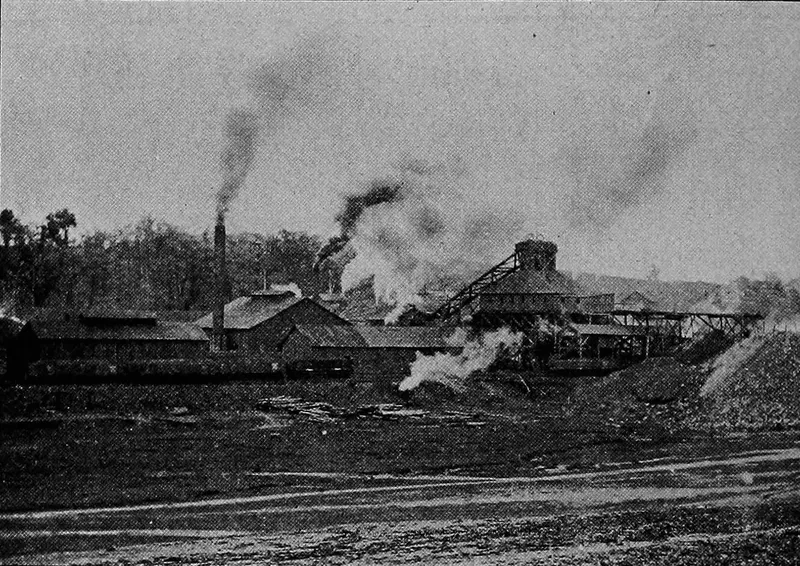
The 1896 history calls Hiteman the largest town in the county outside Albia: 1,400 to 1,500 people on Cedar Creek, six miles northwest of Albia, platted September 1, 1890, on broken ground the book says was chosen to suit the Wapello Coal Company rather than for beauty. That company, incorporated in 1880 with an authorized capital of $900,000, was headed by J. C. Peasly of Chicago, with H. L. Waterman vice-president and H. E. Jarvis of Burlington secretary. It owned about 5,500 acres bought at about $24 an acre and worked one vein, averaging 5 feet, from a shaft 160 feet deep. About 450 men worked there. Capacity was 1,000 tons a day and output about 800, and the Burlington railroad took it all. The book puts a miner's average net earnings at about $500 a year and the year's payroll at $250,000.
The men in charge in 1896 were civil engineers Phil Waterman and his father, H. L. Waterman; mechanical engineers John Zentz and Thomas McGuire; hoisting engineer L. S. Cousins; pit-boss W. B. Powell; inside foremen Wm. Barkwell and Owen Reese; top-boss Mark Greeley; and blacksmiths R. D. Morgan and A. L. Hirst. Its store, the Hiteman Supply Company, incorporated in 1890 with J. P. Early as manager, is called by the book by far the most extensive mercantile firm in the county, handling everything from lumber to nutmegs.
Who the miners were, and where to find their names
The 1896 history describes Hiteman's people as almost all miners: Americans, English, Welsh, Swedes, Scotch, Germans, and Black families, who lived in the southern part of town. Foster was mostly English and Welsh, with a number of Swedes and a few Italians and Scots. The book sketches each group through drinking stereotypes of its day, and adds that every miner of ten or twenty years had his injuries and narrow escapes.
Anyone tracing a Welsh miner should heed the book's note that a camp of 1,000 might hold half a dozen separate Thomas families, and as many Jameses, Morgans, Lewises, Williamses, Reeses, Hugheses, Llewellyns, and Joneses. It explains the Welsh custom of adding ap, meaning son of, with the father's and grandfather's names.
Lodges and clubs supply names. At Hiteman the Masons founded Perfect Square Lodge No. 526 in 1893, with officers including Thos. Bridges, Owen Reese, J. W. Lewis, and W. L. Morgan; the Odd Fellows organized Hiteman Lodge No. 548 in 1894 with 79 members; and the Knights of Pythias, Lodge No. 151, had 108 members. At Foster, pit-boss Hughes, a music lover, drew band players to the mines, and the book says a good player could always find work there. The Foster Cornet Band roster includes Samuel, Harry, and Jack Webb, several Dalzels, Winter Giles, Joseph Thomas, John Marshall, and James Kennedy. The 1878 directory lists households by post office, including Avery and Coalton.
Output, pay, and the strikes of 1890 to 1895
The 1896 history ranks Monroe third among Iowa coal counties in 1895, with 313,354 tons valued at $391,692, behind Mahaska and Appanoose. It blames the panic of 1894 and 1895 and the strike, noting the county produced 641,805 tons in 1893. Monroe had 18 mines in 1895, six of them slopes or country banks. The author predicted Monroe would lead the state within five years.
Miners were paid by the ton. Under the 1893 basis, the Central District, which included Monroe, paid 75 cents; locally the rate was 70 cents in summer and 80 in winter.
Monroe miners struck for several weeks in the 1890 eight-hour movement and went back without gains. In 1893 the Iowa Miners' Association formed with headquarters at Foster, J. T. Clarkson president and Richard Williams of Foster secretary and treasurer. After the national order to strike on April 21, 1894, a convention met at Albia on May 3. A motion to stop work lost by one vote, then passed by eleven the next day. A joint convention at Oskaloosa, in a resolution dated June 9, 1894, restored the 1893 scale, and work resumed June 13; the book says the strike touched fourteen thousand mine employees. The Deep Vein Coal Company, which had never cut its rate, refused to sign, so Foster stayed out some weeks longer and the company lost coal contracts. Families were reduced almost to destitution, and the book records that farmers refused to give. A reduction after the 1895 Ottumwa Agreement brought another strike.
The 1896 author was no friend of the strike. He calls the fifty days' strike of 1894 ill-advised, describes the Eastern miners Iowa struck in sympathy with in the ethnic contempt of his era, and writes of so-called agitators who found themselves shut out of work camp after camp. His mining chapter includes a list of accidents for the two years ending June 30, 1895.
Finding your ancestor in Monroe County
- Census records (free through 1950) list each person's occupation and town, so a mining family shows up decade by decade.
- Death records: search our Iowa database by surname.
- The county histories themselves: the biographical sections of The History of Monroe County, Iowa and An Illustrated History of Monroe County, Iowa hold hundreds of family sketches.
- Newspapers on the Library of Congress's Chronicling America carried obituaries, accidents, and local news.
Tell us one grandparent's name. We'll take a free first look at the records and email you back.
Ask about my family →Frequently asked questions
Who sank the first coal shaft in Monroe County, Iowa?
The 1878 History of Monroe County credits E. W. Byers, born in 1835 in Mercer County, Pennsylvania. He came to the county in 1864, kept a drug business in Albia, then went into coal mining at Avery, moved there in 1869, and became postmaster in 1872.
Which was the biggest mining town in Monroe County in 1896?
The 1896 Illustrated History calls Hiteman the largest town outside Albia, with 1,400 to 1,500 people. It was platted September 1, 1890, around the Wapello Coal Company's 160-foot shaft, where about 450 men worked a single vein averaging five feet.
Where did Monroe County's coal miners come from?
The 1896 history lists Hiteman's miners as Americans, English, Welsh, Swedes, Scotch, Germans, and Black families. Foster was largely English and Welsh, with a number of Swedes and a few Italians and Scots. The book says a camp of 1,000 might hold half a dozen unrelated Thomas families.
Were Monroe County miners part of the 1894 coal strike?
Yes. A miners' convention at Albia on May 3, 1894, voted to join the national suspension. A joint convention at Oskaloosa, resolving on June 9, restored the 1893 scale, and work resumed June 13. Foster's Deep Vein Coal Company refused to sign, so its strike lasted some weeks longer.
Photographs on this page are in the public domain. About the images and their sources.