Clement L. Martzolff's History of Perry County, Ohio, published at New Lexington in 1902, calls coal mining the greatest of the county's industries. He dates the coal era to 1870, when railroads pushed into the southern hills and New Straitsville, Shawnee, Corning and Rendville were laid out within a few years of each other. For anyone tracing a family through these camps, the book offers founding dates, seam and furnace names, and the men it credited with the boom.
Written from History of Perry County, Ohio (1902). Everything below comes from that book, and where it gives an opinion, we say so. You can read the full book free on the Internet Archive.
Coal before the boom, 1816 to 1870
The 1902 history says the county's pioneers had no idea of the wealth buried under their farms. Many did not know coal was there at all, and the timber they were clearing for fields gave them all the fuel they needed. Martzolff could not say when coal was first found, but he reports that by 1816 it was already in limited use, and that it soon found its way into some of the better-off homes in town and into public buildings. Somerset drew its supply from mines near St. Joseph's.
Small operations followed. Dr. Ponjade, whom the book identifies as a Frenchman, worked a mine near Rehoboth in 1830, and mines in Mondaycreek and Saltlick opened at about the same time. When the old Cincinnati, Wilmington and Zanesville road (by 1902 the C. & M. V. Railroad) was built, mining became of some importance around McLuney, with the coal shipped mostly to towns along that line.
Col. James H. Taylor and the coal era of 1870
Martzolff marks 1870 as the start of the county's coal era and gives the credit to Col. James Taylor "and others," whose efforts made the county's mineral resources known to the world. Capital came in and railroads were built. In the book's view, Taylor had more to do with developing those resources than any other man.
From 1865 to 1868 Taylor prospected the hills of Perry County, going from farm to farm with an old carpet bag that he filled with specimens of coal and ore. When he told farmers there was a wonderful vein on their land, the book says, they looked on him as a sort of lunatic, though a harmless one. Martzolff credits him with a working knowledge of mineralogy and calls him a vigorous writer; once Taylor was satisfied the mineral wealth was abundant, he began writing a series of articles on it.
Taylor is buried in the New Lexington cemetery, and Martzolff called every village in southern Perry, every coal mine and every railroad a living monument to him. Writing in 1902, Martzolff also claimed that no county in Ohio surpassed Perry in coal production or in the use of modern mining equipment.
“…carrying with him an old carpet bag, in which he placed specimens of coal and ore.”
Railroads and the boom towns
In the book's account, each railroad that reached the coal field left a town behind it. The Hocking Valley Railroad ran a branch to Straitsville, and New Straitsville became quite a village in a short time. The Baltimore and Ohio extended into Saltlick and opened that territory, "and Shawnee is the result." The Atlantic and Lake Erie, later the Ohio Central, pushed into the Sundaycreek Valley, where Corning and Rendville "sprang up as if by magic." The Columbus and Eastern, later the Columbus, Sandusky and Hocking, gave Clayton township and its coal access to a ready market.
New Straitsville, which Martzolff calls the pioneer mining town of the county, was laid out by a mining company in 1870 and, he says, had a phenomenal growth. Shawnee, "the metropolis of the county" in his words, began in 1872 and was laid out by T. J. Davis. The book says the Shawnee people once had a village there, reached by an old trail that ran by way of Buckingham and Hemlock, and that the town and the stream, Shawnee Run, both keep their name.
Corning, which the book calls the county's "oil city," was laid out in 1878 by Joseph Rogers. The Sundaycreek valley cuts through the Great Coal Vein north of town, and Corning itself sits at the level of the Upper Freeport coal. The oil came in August 1891, when a Toledo and Ohio Central well drilled at the round house in search of water was bored to 1,507 feet and threw oil over the top of the derrick. Rendville was platted the year after Corning by Capt. T. J. Smith and W. F. Rend.
Congo, built in 1891 and 1892, was the newest of the mining towns when the book appeared, and Martzolff calls it a model mining town. Its mine, he says, was one of the model mines of the country, and in about ten years of work tens of thousands of tons of coal had passed over its screens. The book prints photographs of the Congo mine, its coal tipple and its power house.
Towns that faded, and the old names to watch for
Not every settlement lasted. Ferrara, which the book notes had "a distinctly Italian name," was laid out in 1871 between the sites of Rendville and Corning; once Corning was organized, the name disappeared. Dicksonton, built in 1875, was a deserted village by the time Martzolff wrote, and he puts Baird Furnace among the county's "has beens." Buckingham was laid out in 1873. Hemlock appears in these pages only in passing, as a point on that old trail toward Shawnee.
Several towns went by other names first. A settlement on the site of Junction City had a post office called East Rushcreek. George Wolfe laid out a village on his farm and named it Damascus, and a Mr. Edmiston started a rival on the next farm called Trio City, for its three railroads. A compromise in 1872 settled the present name; the place had also been known as Wolfe's Station after the C. & M. V. was built. McCuneville dates from salt works put up in 1829 and was simply "the Salt Works" until the McCunes platted it in 1873; for a time it was also known as Tallyho. Moxahala, on the South Fork of the Moxahala, was laid out as a furnace town in 1873, and Crooksville, the "clay city," was organized in 1874.
“New Straitsville is the pioneer mining town of the county, having been laid out by a mining company in 1870.”
The Great Vein and the other seams
The seam that built the boom towns was the Great Coal Vein, also listed as No. 6, the Middle (Upper) Kittanning, or the Upper New Lexington. Martzolff calls it the most general and most valuable coal in the county. At Shawnee, New Straitsville, Congo and Baird Furnace it ran ten to fourteen feet thick; at Dicksonton, McCuneville, McLuney and along the C., S. & H. railroad in Bearfield township it was only about four feet. The book's table of elevations puts the Great Coal Vein at New Straitsville at 870 feet above sea level.
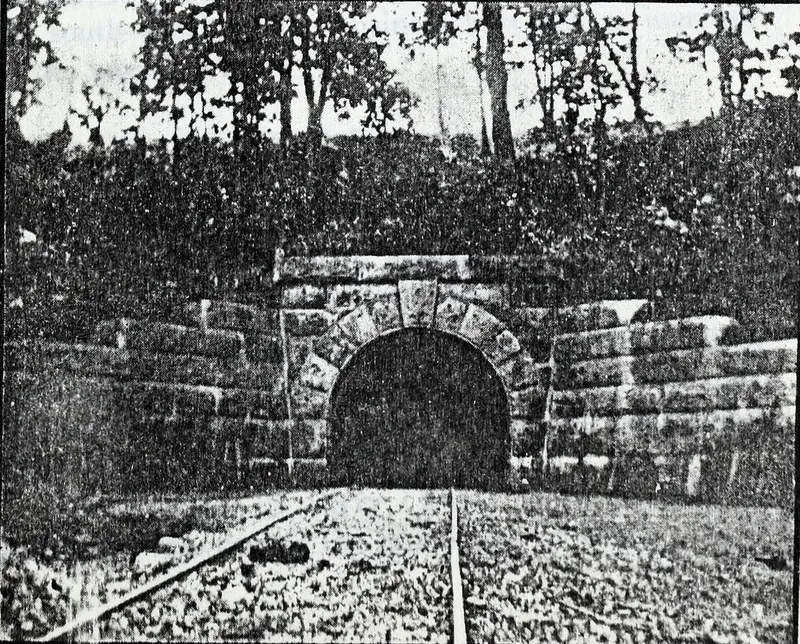
Below it lay the Lower Kittanning, known as No. 5, the Lower New Lexington or the Lower Moxahala. It had been mined at New Lexington and in 1902 was being mined at Nugentville and Redfield. At the Bristol tunnel it was worked in the same hill as the No. 6 above it and loaded over the same tipples. The book calls it a valuable steam coal, about four feet thick.
Above the Great Vein came the Norris coal (Lower Freeport), named for a man called Norris who once mined it at Millertown; it could reach six feet but was usually much thinner. The Upper Freeport, locally the Stallsmith, about five feet thick, was mined at Hamburg. The highest seam, a thin streak on the hilltops of the southeast, was once mined near Chapel Hill as the "Patriot coal." Lower in the column were thinner seams: the Quakertown, found at times two feet thick and quarried by farmers; the Tionesta, known for years on Coalbrook in Mondaycreek as cannel coal; and the Sharon, the lowest, with a small minable area in Section 14 of Hopewell township.
The book also explains a problem miners kept running into: ancient stream channels, now buried, that had cut the coal away. Borings often found the coal absent or very thin, and tracts thought to hold coal turned out to have none. Miners at the Congo mine, Martzolff writes, frequently found the coal missing, and from those gaps the winding course of the old channel could be followed.
Coal-fired iron: Baird Furnace and the others
Coal also fed the county's iron industry. According to the book, Perry County's furnaces were the first to use raw coal in making iron, and at one time seven blast furnaces burned in the county. The pioneer was Baird Furnace in Mondaycreek, built by Samuel Baird, who had been in charge of the old charcoal furnace at Logan. Many experienced iron men thought it rash, since the site was three miles from a railroad.
Baird set the stack against a hill. Coal was mined a few rods behind it and a track ran from the mine to the top of the stack, while local ore and Maxville and Zoar limestone served as flux. The American Manufacturer printed an estimate that the book reprints: two and three-fourths tons of coal at 50 cents a ton went into each ton of iron, for a total cost of $13 a ton, at a time when stone coal pig sold for $21 to $31. The furnace cost $45,000, and even counting the road over which oxen hauled the iron as a current expense, the first year's net profit was $25,000, or 55 percent of that cost.
Others followed. Gen. Thomas built a furnace at Gore just across the county line, and Winona stood a few rods from the Perry line on Little Mondaycreek. Moss and Marshall built the Bessie Furnace near Straitsville, still running in 1902. Shawnee had three, the Fannie, the XX and the New York, with only the New York still running. Another at Moxahala ran until it was moved to Columbus. Martzolff blames the end of large-scale ironmaking in the county on larger mineral fields found elsewhere and the fall in iron prices. Coal, he insisted, was another matter: the field was in no way exhausted, towns were still springing up and new mines were being opened.
Using the 1902 history for family research
For genealogists, the mining pages are strongest on places and dates. New Straitsville dates from 1870, Shawnee from 1872, Corning from 1878, Rendville from 1879 and Congo from 1891 and 1892, which helps narrow when a family could have lived in a given camp. The older names, East Rushcreek, Damascus, Trio City, Wolfe's Station, Ferrara and the Salt Works, are worth knowing when reading earlier documents.
The census table in the book shows the scale of change: 18,453 people in 1870, 28,218 in 1880 and 31,841 in 1900. The 1860 and 1870 counts had both declined, which the book blames on gold seekers leaving for California and on the Civil War. It does not explain the jump after 1870, but that jump fell in the first decade of what Martzolff calls the coal era.
These pages do not name ordinary miners or say where they came from. The people they record are operators, founders and promoters: Taylor, Baird, Davis, Rogers, Smith and Rend, Moss and Marshall, the McCunes, Dr. Ponjade and the Norris of the Norris coal. Martzolff dedicated the book to his Alsatian grandparents, both sides of whom were among the pioneers of Perry County, a reminder that immigrant families were part of the county from its early days.
Finding your ancestor in Perry County
- Census records (free through 1950) list each person's occupation and town, so a mining family shows up decade by decade.
- Death records: search our Ohio database by surname.
- The county histories themselves: the biographical sections of History of Perry County, Ohio hold hundreds of family sketches.
- Newspapers on the Library of Congress's Chronicling America carried obituaries, accidents, and local news.
Tell us one grandparent's name. We'll take a free first look at the records and email you back.
Ask about my family →Frequently asked questions
When was New Straitsville, Ohio founded?
According to the 1902 History of Perry County, New Straitsville was laid out by a mining company in 1870, the year the book gives as the start of the county's coal era. Martzolff calls it the pioneer mining town of the county and says it had a phenomenal growth after the Hocking Valley Railroad ran a branch to Straitsville.
Who laid out Shawnee in Perry County?
The book says Shawnee began in 1872 and was laid out by T. J. Davis, after the Baltimore and Ohio extended into Saltlick and opened that territory. Martzolff called Shawnee the metropolis of the county, and three blast furnaces, the Fannie, the XX and the New York, were built there.
What was the Great Vein in Perry County?
The Great Coal Vein, also called No. 6, the Middle (Upper) Kittanning or the Upper New Lexington, was the county's most valuable coal in the book's view. It ran ten to fourteen feet thick at Shawnee, New Straitsville, Congo and Baird Furnace, but only about four feet at Dicksonton, McCuneville and McLuney.
Who was Col. James H. Taylor?
The 1902 history credits Col. James H. Taylor, more than any other man, with developing Perry County's mineral resources. From 1865 to 1868 he prospected the hills farm to farm with a carpet bag of coal and ore specimens, then began writing articles. He is buried in the New Lexington cemetery.
Photographs on this page are in the public domain. About the images and their sources.