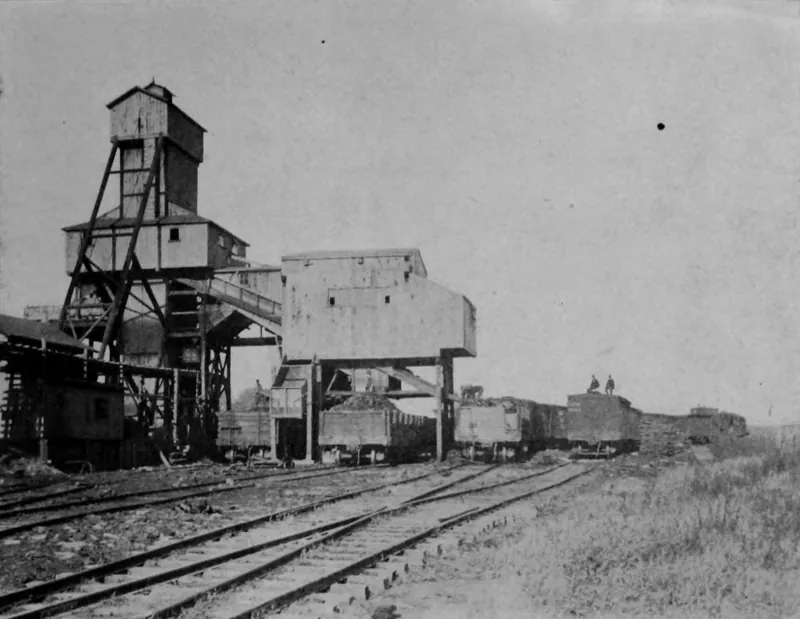
Polk County's coal story starts at the fort. The county histories of 1880, 1898 and 1911 trace the trade from coal banks dug for the garrison's blacksmiths, through Wesley Redhead's stubborn deep shaft of 1873, to a county that by 1898 had twenty-three working mines employing more than 800 men and boys. Here is what those three books say about the mines, the companies, the camps and the families who ran them.
Written from 3 county histories, all free to read on the Internet Archive: The History of Polk County, Iowa (1880); Annals of Polk County, Iowa, and City of Des Moines (1898); Des Moines, Together with the History of Polk County, Iowa (1911). Everything below comes from those books, and where they give an opinion, we say so.
Coal banks at the fort, 1843 to 1864
The 1880 History of Polk County passes along the story that soldiers who built and occupied Fort Des Moines were the first to notice coal around the site, and that the garrison's blacksmith shops drew coal from banks close by. It records that A. N. Hays and Capt. Allen opened a coal shaft and stone quarry on the banks of the Des Moines as early as 1843. The 1898 Annals of Polk County agrees that the first mining was done by Captain Allen's direction while the troops were here, with one or two banks opened.
For years after, little more was done. Timber was plentiful, the 1898 book explains, so early openings worked only the first veins, mostly as drifts or entries. The 1880 history says very little coal was used before 1865. People picked it out of the river bluffs in wheelbarrows and dumped it into wagons, thirty bushels to an unweighed load, and the writer doubted a load ever came to more than twenty-five bushels.
Wesley Redhead and the first coal company, 1864 to 1880
The 1880 and 1898 books both credit Wesley Redhead, the town's first bookseller and longtime postmaster, born near Penrith in Cumberland County, England, with the first systematic mining. The 1880 history says he organized the first coal company in November 1864. In August 1865 the Des Moines Coal Company formed with eleven members: Redhead, James M. Starr, William Vincent, B. F. Allen, William Phillips, Hoyt Sherman, John Teesdale, James W. Davis, L. W. Dennis, Frank Butler and E. Sandford.
Redhead had been digging on the old Peet farm in the north part of the city. The company bought Fairbanks scales, and the 1880 book says the first coal weighed in the city was weighed by Redhead. The coal lay in "pockets" that ran out fast, until mining there stopped paying. Redhead bought out his partners and by 1874 was sole owner. In May of the year the 1880 history was printed, James P. Clark became a partner and the firm was renamed the Pioneer Coal Company, a change the 1898 Annals also records.
“…gathered here and there in the bluffs along the Des Moines river in wheelbarrows, dumped into wagons, thirty bushels being called a load…”
The Black Diamond strike at South Park, 1873
Redhead was sure better coal lay deeper. The 1880 history tells how he found it twice, from Dixon's centennial history of Polk County and from the Des Moines Leader of June 4, 1873, and the versions differ. In Dixon's, a drill went down in 1873 a few rods south of the Coon railroad bridge under foreman John Gibson of Derbyshire, England. At seventy feet, past three poor veins, it hit flint rock so hard that Gibson advised quitting. Redhead learned twenty feet of rod was left and ordered every inch used. Four weeks at three inches a day took the drill through three feet of rock and into a vein five feet thick of black diamond coal. Redhead then went to banker B. F. Allen and secured an investment of thirty-five thousand dollars.
The Leader describes a shaft begun the previous January in South Park near the Seventh Street bridge, worked night and day by two gangs of eight men. At one hundred and eleven feet the foreman and other experienced miners judged it hopeless, but Redhead was "bound to dig to China, or find coal." At one hundred and twenty-five feet, ninety feet below the bed of the 'Coon river, the shaft struck a vein four and a half feet thick on June 2. It was to be known as Black Diamond Coal and mined by the Des Moines Coal Company, with a track laid from the Indianola branch of the Rock Island. The paper called Redhead the first to bring anything like system to Des Moines coal mining.
Dixon puts Redhead's own outlay before the strike at over eight thousand dollars; the Leader says about six thousand. The 1898 Annals sides with Dixon on the vein: five feet, near the banks of the Raccoon inside the city.
Shafts around the city, 1867 to 1879
The 1880 history quotes Prof. White's 1870 state geology. White called Polk nearly central among Iowa's coal counties but said coal had been mined only at and right around Des Moines: Redhead & Co. in the Des Moines valley just north of the city, another firm in the Raccoon valley just south, and others in East Des Moines south of the capitol. The coal was three beds lying so close they mined as one, a compound bed traced west to Redfield in Dallas County and south to Indianola in Warren County. At Rattlesnake Bend, about eight miles below the city, a three-foot bed in the river channel was quarried for local use at low water. Clay from the coal beds fed two pottery works.
The Watson Coal Company, organized in the winter of 1867 by wealthy Boston capitalists under president Rufus Ford, with stock limited to $200,000, sank a shaft east of the Rock Island round-house. The Iowa Central Coal Company, organized in 1867 by Henry Wightman and a partner, worked a shaft on School Street on the West Side until it was abandoned in 1879. W. W. Fink and A. G. Smith's Hawkeye Company (1872) went down about a mile north of the city, and the Eclipse Company (1873) just outside the southern limit. In 1874 B. W. Sypher opened a shaft south of the city that became the Polk County Coal Company. In 1875 the Pleasant Hill Company sank a shaft on the Winterset railroad and the Eureka Coal Company one south of the 'Coon near the schoolhouse.
“…to use his own expression, was ‘bound to dig to China, or find coal.’…”
Twenty-three mines in 1898, and the camp at Sevastopol
The 1898 Annals says the two lower seams lay sixty to one hundred and sixty feet below the bed of the Des Moines river and estimated more than 660,000,000 tons of merchantable coal. The principal mines were within three miles of Des Moines, with others near Runnells, near Commerce, at Polk City and at Mitchellville. Citing the State Mine Inspectors, it counted twenty-three mines and about half a dozen coal pits employing over 800 men and boys. Of the year's output, 200,000 tons stayed in the county, nearly all burned in Des Moines; the rest went to the railroads or was shipped west and north. Slack sold at the mines for about seventy-five cents a ton.
The larger mines it named were the Christy, Carbondale, Des Moines, Eureka, Gibson 1 and 2, Maple Grove, Van Ginkel, Proctor, North Riverside, Keystone 1 and 2, Lake Forest, Flint, Eagle, Oak Park, Manbeck, Clifton Heights, Acme, American, R. Dale, Merchant and Rees Griffith. Carbondale appears here only as a mine name.
Sevastopol, south of the Raccoon in Bloomfield township, was started by James Sherman in 1855 and named for the Russian fortress of the Crimean War; it was later incorporated and taken into the city. The 1898 book says some of the county's best and largest coal mines were in and around it and that many coal miners lived there. Residents it lists include John Webber, G. Van Ginkel, B. F. Young, Valentine Lehman, Lawrence Heidt, F. X. Spitz, Chris and John Munzenmair, Louis Stehm, Thos. Beck, Charles Wagner and William Jensen, though it does not say who mined.
Its sketch of Mr. Van Ginkel says he gardened south of the Raccoon, got interested in the coal lands nearby, drifted into mining, opened three mines and always kept on good terms with his miners.
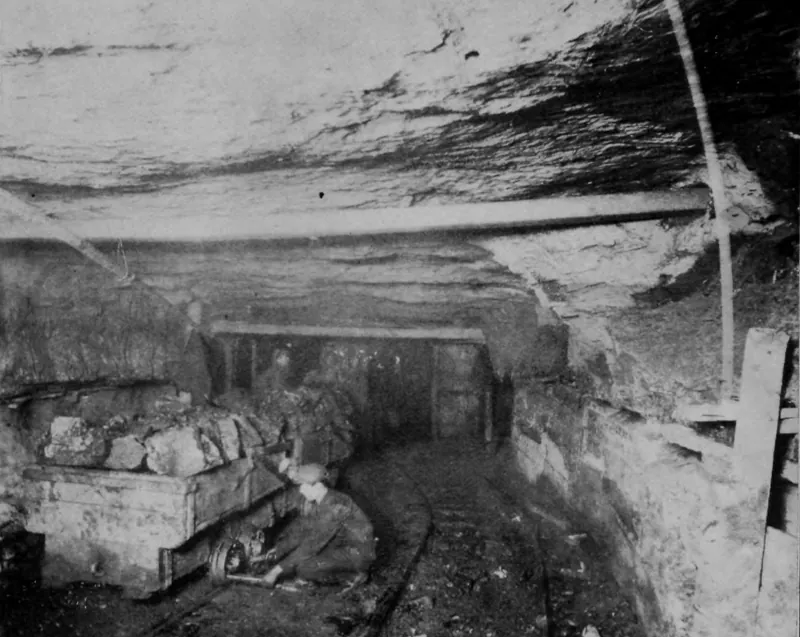
The north side: Saylor township, Saylorville and Polk City
The 1880 history says Saylor township was poor farm country that made up for it in other resources: "Coal has been mined to a considerable extent," and rough land made good grazing. A report of oil wells there once caused intense excitement that soon died away. The book explains that the north part of the old township, with land from Madison township, became Crocker township.
Saylorville was laid out by John B. Saylor in 1850 in the center of section three, with New Saylorville platted beside it in 1855. Saylor held the contract to supply the fort's troops with beef cattle and hay, and the 1898 book credits him with the first claim on the Des Moines above the city and calls his town an early rival of Fort Des Moines for the county seat. The 1911 history says he died at Vicksburg in July 1863. When the Des Moines & Minnesota Railroad passed about two miles east, Saylor Station went up on section twelve and, the 1880 history says, the old town had been "going back" since. A Methodist class formed in 1848 built a church at Saylorville in 1858; the 1880 book names James O'Bleness, J. W. Scholey, Wm. Birch, David McKibben and J. C. Gregg of Crocker township among the zealous Methodists of those early days.
Farther up the river, Polk City is listed in 1898 among the places outside Des Moines with working mines. A geology section the 1880 history printed from near the north part of the county lists shales and limestones full of marine shells, with no coal bed in it.
Operator families in the 1911 history
The 1911 history profiles several mining families. Andrew W. Carlson was born in Sweden on April 6, 1852, came to America at thirteen in 1865, lived in Knox County, Illinois, and moved to Webster County, Iowa, in 1868. After six months as a Rock Island teamster he became a weigher of coal at mines in Des Moines township. In 1880 he bought a small mine east of the city, the Enterprise mine, and ran it two years, though the same sketch moves him to Stratford in 1881. He was later superintendent for the Giant Coal Company and the Valeria Mining Company in Jasper County, then organized the Maple Grove Coal Company and opened the Maple Grove mine; a Maple Grove mine also appears among the larger mines named in 1898. His son Andrew W. Carlson Jr., born in Des Moines May 8, 1884, to Andrew and Julia A. (Gustafson) Carlson, was secretary of the Delaware Coal Company and tied to the Zimbleman Coal Company of Boone and the High Bridge Coal Company of Madrid: three mines, over four hundred and fifty men, twelve hundred and fifty tons a day.
Edward A. Sayre, born in York, Nebraska, on October 28, 1879, earned a mining engineering degree at Iowa State College in 1906, organized the Eagle Coal Mining Company, bought the old Eagle mine on Twentieth Street, sank a new one west of Chautauqua Park and was opening Eagle No. 3 in Highland Park, with his brothers Charles E. and Clinton V. in the firm. Edward C. Smith of the Smith-McClure Coal Company of Ogden succeeded John P. Reese as president of the Iowa Coal Operators Association.
For family researchers, the books point to the Leader of June 1873, Dixon's centennial history, the State Mine Inspectors' reports, and for Swedish families the Swedish-language papers the 1911 history names, the Svithiod and the Iowa Posten. These passages give no wages, strikes or accidents; the inspectors' reports are the place to look for individual miners.
Finding your ancestor in Polk County
- Census records (free through 1950) list each person's occupation and town, so a mining family shows up decade by decade.
- Death records: search our Iowa database by surname.
- The county histories themselves: the biographical sections of The History of Polk County, Iowa and Annals of Polk County, Iowa, and City of Des Moines hold hundreds of family sketches.
- Newspapers on the Library of Congress's Chronicling America carried obituaries, accidents, and local news.
Tell us one grandparent's name. We'll take a free first look at the records and email you back.
Ask about my family →Frequently asked questions
When did coal mining begin in Polk County, Iowa?
The 1880 History of Polk County says A. N. Hays and Capt. Allen opened a coal shaft and stone quarry on the Des Moines as early as 1843, and that the fort's blacksmiths used coal from nearby banks. Systematic mining began when Wesley Redhead organized the first coal company in November 1864.
What was the Black Diamond coal mine in Des Moines?
It was Wesley Redhead's deep shaft in South Park near the Seventh Street bridge. According to the Des Moines Leader of June 1873, quoted in the 1880 history, it struck a vein four and a half feet thick at 125 feet, and the coal was to be known as Black Diamond Coal and mined by the Des Moines Coal Company.
Where were Polk County's coal mines in 1898?
The 1898 Annals of Polk County says the principal mines were within three miles of Des Moines, with others near Runnells, near Commerce, at Polk City and at Mitchellville. It counted twenty-three mines and about half a dozen coal pits employing over 800 men and boys.
Was coal mined in Saylor township, north of Des Moines?
Yes. The 1880 History of Polk County says coal had been mined in Saylor township to a considerable extent, where poor farmland was made up for by other resources. The township also had a brief oil well excitement, and its old town of Saylorville declined after the railroad passed two miles east.
Photographs on this page are in the public domain. About the images and their sources.