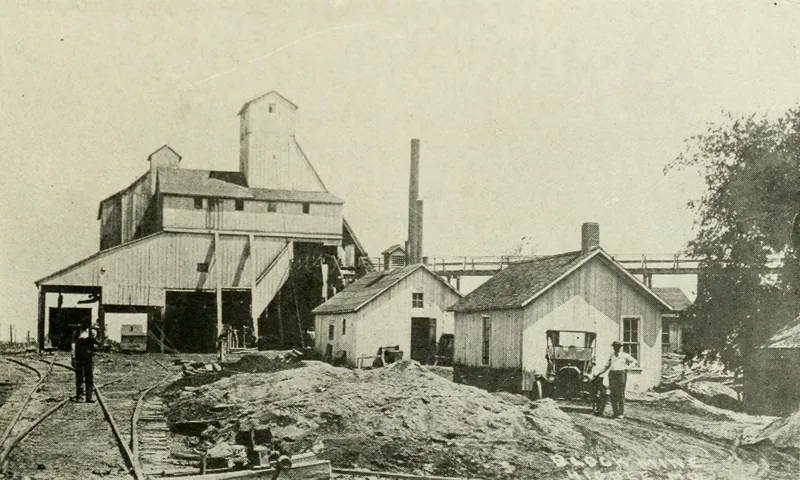
The 1920 History of Randolph County, Missouri says practically the whole county rests on coal, and its family sketches show who dug it, ran it and sold it. Mines worked south of Renick, all around Higbee, west to Yates, and around Huntsville nearly to the Moberly railroad shops. Operators came from England and Wales by way of Pennsylvania, Illinois, Iowa and Kansas, and by 1905 nearly every mine in the county had been folded into one company. Here is what the book records.
Written from History of Randolph County, Missouri (1920). Everything below comes from that book, and where it gives an opinion, we say so. You can read the full book free on the Internet Archive.
A county sitting on a coal bed
The 1920 history opens its account of natural resources with geography. Randolph County covers 307,677 acres and straddles the grand divide between the Mississippi and Missouri rivers. The towns of Clark, Renick, Moberly, Cairo and Jacksonville sit on that ridge, which early settlers called the Grand Prairie. The book says that "practically all of Randolph County rests upon coal beds" at different depths. From the edge of the divide prairie westward, a vein three and a half to four feet thick runs nearly to the western county line, and from Jacksonville west the coal measures run past the county limits.
The book lists where mines had been opened and worked: at and south of Renick; at and on all sides of Higbee, and west of it to Yates; at and around Huntsville, to within a mile of the machine shops at Moberly; and west of Jacksonville. It describes the coal as soft and bituminous and calls it unexcelled for steam purposes. It also claims only a few hundred acres of the field had been mined, and that the rough timber land above the rest was worth far more for its coal than for grazing, once there was a way to ship it. That is the confident voice of a 1920 county history, and it reads best as the book's opinion.
Elliott and the Fleming family
The fullest mining story in the book belongs to the Flemings. Thomas Fleming, a native of England whose wife Janet Simpson was born in Scotland, came to America about 1854 and mined coal at McKeesport, Pennsylvania. About 1858 he moved to Kewanee, Illinois. He enlisted in the Union Army in 1862, marched with Sherman to the sea, and afterward went back to Kewanee to operate coal mines. In 1872 he went to Fort Dodge, Iowa, as a mine superintendent, and in 1876 to Chetopa, Kansas, where he had charge of mines in Missouri, Kansas and Indian Territory for the Osage Coal and Mining Company. He moved to Clinton, Missouri, about 1879 and died at Nevada, Missouri, in 1895.
His son Jacob C. Fleming started at 17 as a telegraph operator for the Missouri, Kansas and Texas Railway. In 1884 he took charge of the Osage company's store at Elliott in Randolph County, and later of its coal mine there. In 1890 Thomas Fleming bought the Elliott mine property, and Jacob ran it until 1905, when, the book says, practically all of the coal mines of Randolph County were absorbed by the Randolph-Macon Coal Company. (The Fleming sketch spells the town Elliott; other sketches write Elliot Coal Company and Elliot.) In 1906 the Fleming heirs organized the Moberly Foundry and Machine Company, which cast parts for the Wabash Railway, also made coal mine equipment and machinery, and employed about 18 men.
“Practically all of Randolph County rests upon coal beds of varying thickness…”
Higbee and Yates
Higbee shows up as a mining town through the Walton family. William Walton, born in England Sept. 5, 1844, came to America at age ten with his parents, who settled in Canada. He later lived in Ohio and Iowa, and in 1886 he settled at Higbee and went into mining. He organized two mining companies there, helped organize the Citizens Bank of Higbee and served as its first president, and was mayor for a time. He died Jan. 17, 1918. His son Thomas H. Walton, who the book says was practically brought up in the mining business, was elected mayor of Higbee in 1894 and became a stockholder in the Walton Coal Company in 1910. In 1896 he married Nettie M. Jackson of Huntsville.
James W. Marshall's career shows men moving between companies. Born near Renick Aug. 25, 1861, he became auditor for the Elliot Coal Company in 1901 and stayed until 1907, when he went on the road as its salesman. Two years later he came to Higbee as auditor for the Northern Central Coal Company. On Sept. 1, 1919, after buying a large block of stock, he became vice-president of the Citizens Bank. His grandparents Wiley and Fannie Marshall, both Virginians, had come to Prairie township in 1844 in a prairie schooner pulled by oxen.
Yates marks the western end of the Higbee field as the book describes it. S. W. Creson kept a store at Yates from 1884, ran a general store there with R. M. Allen from 1899 to 1912, and was one of the organizers of the Yates Savings Bank, serving as president until 1913. In 1912 the two men moved to Moberly and started the Moberly Wholesale Grocery Company. The book does not tie Creson to the mines themselves, but his store and bank are the Yates institutions it names.
Huntsville and Jacksonville operators
Around Huntsville the book names several coal men. W. T. Rutherford, a pioneer from Kentucky, first owned and managed two tobacco factories that employed many Black workers. He later went into coal mining and, in the book's words, became a large operator in this district. He died in 1905 in his 91st year. John Breckenridge, a coal operator, kept a company store at Huntsville, and William C. Smith had charge of it from 1897 until 1899 before he incorporated the One Price Mercantile Company in 1903.
The Busy Bee Coal Company was working near Huntsville when the book was written. Grocer I. B. Jackson, who opened his Huntsville store in 1910, held an interest in it. The company worked a vein four and a half feet thick, employed about 20 men, and took out 75 to 100 tons a day, with plans to enlarge the plant.
Jacksonville had its own operation. On Sept. 26, 1918, George W. Morris came there as superintendent of the Jacksonville Coal Company, and by 1920 he was also serving as mayor of Jacksonville. His working life, traced in the next section, touched several of the camps in the county.
“…at the early age of 12 years he began working in the mines with his father…”
A miner's working life: the Morris family
Charles Morris, a native of Wales born July 23, 1833, married Sarah Scott in England on Jan. 18, 1859, and came to America in 1869. He mined coal first at Duquoin, Illinois, then at Savannah in Indian Territory from 1882 until 1884, then at Rich Hill, Missouri, for five years. After that he lived at Ardmore in Macon County, the county just north of Randolph, and he died at Huntsville Nov. 5, 1911.
His son George W. Morris was born at South Shields, Durham, England, on April 7, 1867, and went to school at Caseyville, Illinois. His first job in a coal mine was mule driver. He ran air machinery at a mine for five years, fired a switch engine at McAllister, Indiana, for the Pacific Coal Company, and ran hoisting machinery at a mine at Rich Hill. He was mine foreman at Ardmore for a year, then at Renick for the same company, then back at Ardmore for eight years. He next opened a mine between Huntsville and Moberly as a partner in Jones-Davis and Morris. A year later he joined the Elliot Coal Company as foreman, opened the San Diego mine three miles west of Elliot, and was superintendent of mines No. 1, 2 and 3 of the Wabash Coal Company. After two years with the Randolph-Macon Coal Company he left for railroad work around Kansas City, then returned to run the Jacksonville mine in 1918.
Morris married Vetura Shaw on April 24, 1892, and owned 130 acres a mile and a half east of Huntsville. For a family researcher, his record is a map of a mining career: a new town, a new company and a new job every few years, crossing back and forth between Randolph and Macon counties.
The union, the brick plant and Moberly's coal trade
Moberly was the district's union headquarters. George Hepple, born in Westmoreland County, Pennsylvania, May 7, 1884, came to Missouri as a small child when his father Thomas settled at Bevier in Macon County in 1886. George went into the mines with his father at 12 and worked there until 1912, when he was elected secretary-treasurer of District No. 25 of the United Mine Workers of America, headquartered at Moberly. The district took in Northern Central Missouri and Leavenworth County, Kansas, and the book counts over 8,000 miners in it. In 1920 his father was still mining coal at Bevier at 61, and two of George's brothers were miners there.
Moberly itself was a coal market more than a camp. The Moberly Paving Brick Company, which the book calls the largest paving brick plant west of the Mississippi River, turned out 20,000,000 bricks a year and employed 110 men at the plant. Until 1917 it burned coal shipped in from Illinois. That year it acquired the W. H. McKieman coal mine (the name as printed), built two miles of railroad from the mine to the plant, and employed 30 men at the mine. Local dealers sold the rest: E. W. Ragsdale entered the coal and wood business in 1903, James S. Hedges Jr. began handling ice and coal in 1914, and J. C. Capp is listed as a coal dealer in Moberly.
Every mining sketch here is a success story, which suits a 1920 county history built on flattering biographies; its author, the book notes in passing, had once been mayor of Moberly. The mining sketches say nothing of strikes or mine accidents. For genealogists, the best leads are the names the book gives: the Osage, Elliot, Wabash, Northern Central, Walton, Busy Bee, Jacksonville and Randolph-Macon coal companies, the Citizens Bank of Higbee, the Yates Savings Bank, and UMWA District No. 25 at Moberly.
Finding your ancestor in Randolph County
- Census records (free through 1950) list each person's occupation and town, so a mining family shows up decade by decade.
- Death records: search our Missouri database by surname.
- The county histories themselves: the biographical sections of History of Randolph County, Missouri hold hundreds of family sketches.
- Newspapers on the Library of Congress's Chronicling America carried obituaries, accidents, and local news.
Tell us one grandparent's name. We'll take a free first look at the records and email you back.
Ask about my family →Frequently asked questions
Where were the coal mines in Randolph County, Missouri?
The 1920 history says mines had been opened at and south of Renick, at and on all sides of Higbee and west to Yates, at and around Huntsville to within a mile of the Moberly machine shops, and west of Jacksonville. Sketches also name mines at Elliott, the San Diego mine west of Elliot, and the Jacksonville Coal Company.
What was the Randolph-Macon Coal Company?
According to the 1920 history, in 1905 practically all of the coal mines of Randolph County were absorbed by the Randolph-Macon Coal Company. That consolidation ended the Fleming family's run of the Elliott mine, and George W. Morris worked two years for the company before leaving for railroad work.
Where did Randolph County coal miners come from?
The book's mining families came largely from Britain by way of other coalfields. Thomas Fleming was English, William Walton was English, Charles Morris was Welsh and his son George was born at South Shields, England. Others came through Pennsylvania, Illinois, Iowa, Kansas and Indian Territory, and the Hepple family came from Westmoreland County, Pennsylvania.
What union represented miners around Moberly?
District No. 25 of the United Mine Workers of America had its headquarters at Moberly. The 1920 history says it covered Northern Central Missouri and Leavenworth County, Kansas, with over 8,000 miners. George Hepple, a former Bevier miner, was elected its secretary-treasurer in 1912.
Photographs on this page are in the public domain. About the images and their sources.