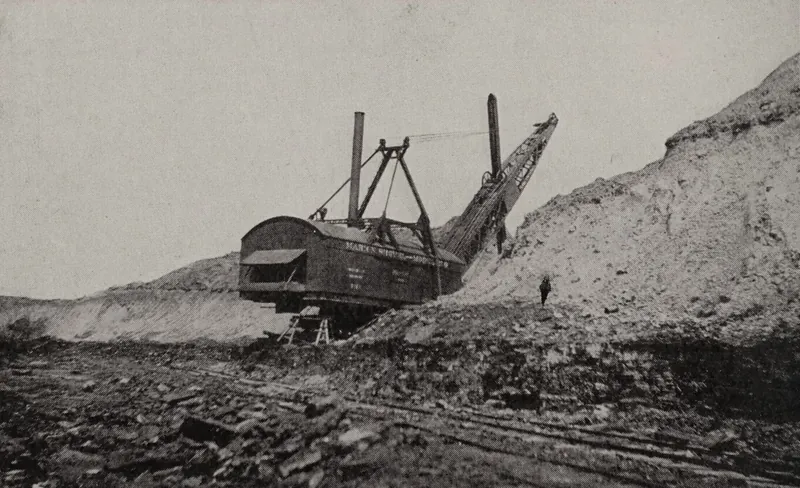
The 1881 History of St. Clair County, Illinois calls bituminous coal by far the county's most important mineral resource, and it treats the coal as the engine behind Belleville. Scattered through its geology chapter, town histories, biographies and patron lists is a working record of the county's mines: who opened them, how deep they went, who ran them in 1880, and who was hurt in them. This page pulls those pieces together for families tracing miners and operators.
Written from History of St. Clair County, Illinois (1881). Everything below comes from that book, and where it gives an opinion, we say so. You can read the full book free on the Internet Archive.
Smoke in the bluff: how the coal trade began
The book takes its discovery story from Reynolds, whose sketches were published in Belleville in 1857. A resident of the American Bottom noticed smoke rising out of the ground for weeks, then found the coal in the bluff on fire. Reynolds put the start of the coal trade soon afterward, in the early 1820s.
The book's history of Belleville tells it a little differently. There, coal was first found in High Prairie, six or seven miles south of the city, and burned by Messrs. Smith, Small and other blacksmiths. The first coal mine was opened by William Fowler in 1825, south of Belleville on the bluff where Richland creek strikes the highlands and bends sharply to the left. The two passages do not quite line up: one dates the trade to the early 1820s, the other dates the first mine to 1825.
According to the geology chapter, the Belleville seam was the first ever worked in Illinois. Because it cropped out along the bluffs so close to St. Louis, it was dug first in open trenches and by tunneling into the face of the bluff, long before anyone suspected it ran on under the highlands to the east. The book calls the railroad built in 1837 from Pittsburg, at the foot of the bluffs, to the Mississippi opposite St. Louis an advanced step for the mines, and says Belleville's growth kept pace with the coal interest.
The Belleville seam: what the miners worked
The book says most mining was in one bed, the Belleville seam, which the geologists numbered No. 1 C. Near Belleville it ran 5 to 7 feet thick, and the book says the thickest coal was perhaps at Freeburg, where it reached eleven feet. The seam had a limestone roof, which the book says made working it safe and economical. In a few places, as in John Maule's mine, a layer of slate between the coal and the limestone was strong enough to serve as the roof on its own.
The seam was not uniform. The upper two layers, no more than twenty-four inches thick, were purer and brought a premium of two cents a bushel over the lower coal, which was charged with sulphuret of iron. A thinner bed, No. 1 A, only about eighteen inches thick, had been worked along with the fire clay above it with small success. Around Belleville a shaft might pass three strata of coal, and the book says the lowest was the best, often eighty or one hundred feet down.
The coal dipped gently east, by the book's reckoning not more than five to six feet to the mile, so shafts got deeper toward the eastern side of the county. At the Alma shaft coal was found 170 feet below the surface. The same shafts also yielded clay for tile and stoneware.
The book is openly boastful about the field. It speaks of great and inexhaustible beds and passes along an estimate that the seams then being worked would produce four billion and fifty million tons. It also prints analyses by Henry Pratten, a former assistant geologist and chemist to the survey, and concludes the county's coal compares favorably with that of surrounding counties.
“The first coal mine was opened by William Fowler, in the year 1825.”
Caseyville: a coal company lays out a town
In the book's telling, Caseyville was a coal company's town from the start. It was named for Zadock Casey, elected Lieutenant Governor in 1830. Before the town existed, Charles Harbour, described as a wealthy Frenchman, built a large brick house and a steam saw mill, the mill in 1845. In 1849 the Illinois Coal Company laid out the village. Its members included Casey, Judge Walter B. Scates, Harbour, Dr. Charles Barrett and John Roy. The company worked two drifts into the side of the bluffs rather than shafts.
Until 1851 the coal went to St. Louis in ox and mule teams across the bottoms. In February 1851 the company finished a railroad from Caseyville to Brooklyn. The first house after the platting went up in the spring of 1849, built by Jameson Robinson. Dr. Barrett built four houses, John Roy eight and Governor Casey two. Belshazar Warner, Ralph Whitehead, Edward Bone, William Grice and a Frenchman the book calls Mr. Bumesaw also built homes in 1849. Bumesaw was killed in the mines the next year, and the book names him the first miner killed in the village.
The town grew with the mines. It had about forty people in 1850, gained about one hundred and fifty when the railroad came, and had about 800 by 1881. The post office did not open until 1856, with Maj. E. M. Mallory as first postmaster, and the village was incorporated by special charter in April 1869. In 1881 the Savitz Brothers of St. Louis ran two mines on the O. and M. track just east of town, the Union and the St. Clair, about 160 feet deep with six-foot veins and about 120 miners between them. Walter Williams sank the Union shaft in 1858 and Thomas Mayer and his brother sank the St. Clair in 1862. The Black Diamond, sunk by Smith and Winnemier in 1864, was idle.
Elsewhere in Caseyville precinct, where the book says coal mining was the leading interest, three mines sat on the Vandalia line. Abby shaft No. 1 was sunk by Maule and Williams in 1868, 160 feet deep on a vein averaging six feet. Abby No. 2 followed in 1873, sunk by the Abby coal mining company, which employed about 160 men and boys. Farther east, the Springwell mine was sunk in 1874 by the Bartlett Coal Company and later run by the Springwell Company.
Belleville's mining families: Yoch, Reinecke and Brosius
The biographies show how farm families became coal operators. The Yoch family came from Prussia in 1847 and farmed a mile and a half west of Belleville, then moved to the old Breeze farm, two and a half miles west. In 1859 the elder Mr. Yoch opened what became known as Yoch's coal mine, and in 1864 he handed the business to his sons. By 1881 the Yoch Brothers had two mines of their own, interests in many others, and handled over three and a half million bushels a year. Joseph Yoch, born in Prussia in 1844, ran sales and shipping in St. Louis. John, an experienced miner, superintended the mines. Bernhart, a machinist, invented the self-propelling B. Yoch Engine. Joseph married Catherine Isch of St. Clair County in 1878. Her parents were natives of Alsace who came to America in 1843.
Conrad Reinecke was born in Hesse-Cassel, Germany, in 1844, and his family landed at New Orleans in June 1857. He learned blacksmithing and did work for coal miners, then worked in the mines and became a superintendent. In 1872 he put a small sum into buying and selling coal, sank a shaft of his own six months later, and made $7,000 in his first winter selling coal in St. Louis. Another leased shaft left him $6,000 in debt, which the book says he soon paid off. It credits him with two of the best mines in the county. In 1864 he married Eliza Reeves, a native of Staffordshire, England, daughter of John and Eliza Reeves. Three of their children were living in 1881: Caroline, Clara and Freddy.
Coal also heated the town. From December 1879 Jacob Brosius piped steam from works at Kronthal, his home, and in the winter of 1880 to 1881 supplied fifty-five places in Belleville. Twenty acres of coal land next to the works were expected to fuel it for thirty years.
“He then with that money leased land, sunk a shaft, and when completed he was $6000 in debt.”
Freeburg and Lementon: shafts in the southern precincts
Around Freeburg the book notes that numerous veins had been opened and many were already deserted. The largest operation was the Freeburg Coal Co., with a steam-powered shaft 156 feet deep on a seven-foot vein, 20 to 30 men, and about six cars of coal shipped daily to St. Louis. Joseph Reichert's shaft was about as deep, with a vein as thick as 10 feet in places, ten to twelve men, and 3 to 5 cars a day.
The biography of Joseph Reichert Jr. explains how a miller ended up in coal. Born November 17, 1828, in Bargen, Baden, he came with his parents in 1847 and opened a cooper shop in Freeburg in 1854. In 1862 he bought the mill property, largely on credit. He owned and controlled a coal mine, which the book calls a necessary adjunct to a mill, and held an interest in another.
Lementon was platted July 9, 1874, by Edward F. Leonard, John T. Lemen and Robt. Moore, on the Cairo Short Line railroad midway between Freeburg and New Athens. The book calls the small village quite a shipping point for grain and coal.
James Ward's 1880 mine list and its accidents
The geology chapter reprints the annual report of the mine inspector, James Ward, dated September 1, 1880. The OCR of its table is badly broken, so depths and worker counts cannot be read with confidence, but many operator and mine names come through. They include the Abby Coal Co.; the Gartside Coal Co. with its Alma, New Pit and No. 3 mines; G. F. Savitz; C. Reinecke; Yoch Bros.; Schurmann Bros.; A. Brandenberger; the Freeburg Coal Co.; the Kennedy Coal Co.; Donk Bros.; Jas. Beatty; and Henry Taylor's Great Western. Most entries list engine hoisting, but Beatty's and Taylor's used a horse gin, and Donk Bros.' New Drift used mules.
Ward reported three accidents, all from falling coal and all called accidental. One miner in a Gartside mine was bruised. Edward Morgan was killed in the Abby mine. A third man had his foot crushed in the Knecht mine, and it was later amputated. Ward wrote that he visited every mine but found compiling the annual tonnage impossible.
Finding a mining ancestor in the 1881 book
The book never describes the miners as a group, so its township patron lists are the best place to look. Each entry gives a name, post office, section, occupation and birthplace. In township 1 North, Range 8 West, around Belleville, John Beaumont and Thomas Hirst appear as coal operators, William Izatt as a partner in the Pollock mining company, Thomas Morrisey as engineer at the Yoch mines, and John Schilling and John Wild as miners. In West Belleville, Thomas Wild and Mark P. Emery are listed as coal miners. Farther north, John H. Bell was pit boss at the Gartside mine and Thomas Millett its superintendent. In the O'Fallon list, Richard Hill was superintendent of the Van Court mine and Joseph Morris proprietor of the Morris mine.
The birthplace columns are mixed, and the OCR does not always line names up with places. Still, the West Belleville list includes natives of Somersetshire, Stafford and elsewhere in England, Wales, Rhenish Bavaria and Prussia, and the Ridge Prairie and Caseyville list includes people from Cheshire and Lancashire. That points to English, Welsh and German mining families, though the book never says so outright.
Finding your ancestor in St. Clair County
- Census records (free through 1950) list each person's occupation and town, so a mining family shows up decade by decade.
- Death records: search our Illinois database by surname.
- The county histories themselves: the biographical sections of History of St. Clair County, Illinois hold hundreds of family sketches.
- Newspapers on the Library of Congress's Chronicling America carried obituaries, accidents, and local news.
Tell us one grandparent's name. We'll take a free first look at the records and email you back.
Ask about my family →Frequently asked questions
When was the first coal mine opened in St. Clair County, Illinois?
The 1881 county history says William Fowler opened the first coal mine in 1825, on the bluff south of Belleville where Richland creek meets the highlands. A separate passage, quoting Reynolds's 1857 sketches, places the start of the coal trade in the early 1820s, after a resident found coal burning in the bluff.
Who founded Caseyville, Illinois?
The Illinois Coal Company laid out Caseyville in 1849. The book names its members as Zadock Casey, Judge Walter B. Scates, Charles Harbour, Dr. Charles Barrett, John Roy and one other partner. The company mined by drifts in the bluffs and in February 1851 finished a railroad from Caseyville to Brooklyn.
How thick was the coal around Belleville and Freeburg?
The book says the Belleville seam, No. 1 C, ran 5 to 7 feet thick near Belleville, and that the thickest coal was perhaps at Freeburg, reaching eleven feet. Joseph Reichert's Freeburg shaft had a vein as thick as 10 feet in places, and the Freeburg Coal Co. worked a seven-foot vein.
Does the 1881 history record mining accidents?
Yes. Mine inspector James Ward's report of September 1, 1880 lists three accidents from falling coal, including Edward Morgan, killed in the Abby mine. The Caseyville history also says a Frenchman called Mr. Bumesaw, killed in the mines around 1850, was the first miner killed in that village.
Photographs on this page are in the public domain. About the images and their sources.