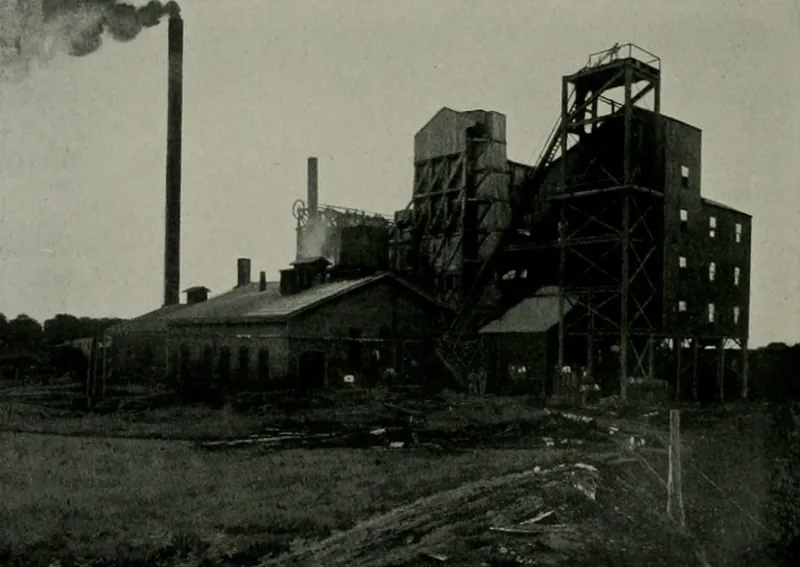
Vermilion County sits on the far northwest edge of the Indiana and Illinois coal field, and its coal lay open in the river bluffs long before anyone sank a shaft. The 1911 History of Vermilion County, Illinois follows mining from hillside drifts south of Danville to the big shafts around Grape Creek and Westville, naming operators, managers and a few of the miners. For a family researcher, it is a map of who ran which mine, and when.
Written from History of Vermilion County, Illinois, Vol. 1 (1911). Everything below comes from that book, and where it gives an opinion, we say so. You can read the full book free on the Internet Archive.
Drift Mines and Strippings Along the Vermilion
The 1911 history explains that the valleys of the Vermilion and its forks, while they spoiled farmland and blocked roads, opened up natural cross sections that showed the coal beds. South of the latitude of Danville, the author writes, the steep cliffs of shale along the streams often revealed coal. The book calls the county only the extreme northwest border of the Indiana and Illinois coal field, and describes it as an agricultural and mining community rather than a manufacturing one. The first mining was done in the hillsides, by drifting in and following the vein, or by stripping.
The earliest names are scattered. W. Caruthers and Mr. Ball began operations in 1853. Dudley Lacock owned considerable coal land west of Danville but did very little mining on it, and he moved to Livingston County in 1854. In February 1855 the General Assembly chartered a mining company for Ward H. Lamon and his associates, but nothing was done under the charter. William Kirkland opened drift mines east of the Wabash Railway bridge, south of Danville. About 1860 Chandler and Donlan became the first to mine on an extensive scale, followed by Peter R. Lonard, and as early as 1860 Michael Kelly started an extensive strip mining business. Charles Dobins, William Shaw and B. Bensel did a profitable business for several years stripping coal along the bluffs of the North Fork.
The biographical chapters add the men around the mines. N. A. Kimball came from New Hampshire in 1859 to work for Colonel Chandler, who needed a weigh-master in the coal mines; Kimball later farmed, sold furniture, and spent his last years selling coffins. A. C. Daniel, born in Roxbury, New York, in 1835, reached Danville at twenty-two owning an extra suit of clothes and $2.50. He worked in every department of the coal mine and died, the book says, both rich and very influential. The author ranks him with Michael Kelley as the most conspicuous figure in the county's coal interests. W. C. McReynolds came to Danville in 1867 for the coal business but soon left it for the mill.
Grape Creek, 1866: Kirkland, the Belgians and the Ellsworth Shafts
The book dates the real beginning of the county's great coal industry to 1866, when William Kirkland, Hugh Blankeney, Mr. Graves and Mr. Lafferty opened mines at Grape Creek. J. S. Morin was in charge of the Kirkland mines. Kirkland could not find enough miners, so he brought in two carloads of men and stripped coal with horses and scrapers northwest of Tilton. That still was not enough, and the book says a whole shipload of Belgians (it spells them "Belgiums") was imported to work the mines. Kirkland sold most of his coal to the Illinois Railway Co., which laid tracks to his mines.
About 1870 A. C. Daniels (the coal chapter adds an s to his name) sank shaft No. 2 for the Ellsworth Coal Co., and two years later he sank No. 4 for the same company. The Consolidated Coal Co. later took these properties over. Shafts Nos. 2 and 3 both burned: No. 2 by accident, No. 3 at the hands of strikers. The miners who set fire to No. 3 were caught, prosecuted and sent to the penitentiary in 1874. In 1879 Daniels was operating the Ellsworth mines; he bought the Carbon Coal Company and several other mines to the south and ran them all under the Consolidated Coal Company name.
“…a whole shipload of Belgiums were imported to work in the mines…”
Michael Kelly and the Lower Vein
The 1911 history gives Michael Kelly a great deal of the credit for the industry's growth. He left his strip mine on the North Fork, bought coal land in the Grape Creek field, and was soon supplying the Chicago & Eastern Illinois Railroad Company with coal for its locomotives. Kelly then found a second vein at a depth of 90 feet, 8 to 9 feet thick and better than the top vein. That discovery moved the big Grape Creek operations down to the lower vein, and after it, the book says, little coal came out of the top vein except from small workings. L. T. Dickerson took an interest in Kelly's business; Kelly later bought him out, added land, and ran two mines.
Other companies crowded in. Paul W. McKay and Mr. Hutchinson organized the Pawnee Coal Co. in 1888 and worked extensively at Grape Creek. Mr. Sandmeyer's Brookside Coal Company ran a mine near the Pawnee. Bernard and Charles Himrod formed the Himrod Coal Company, took over the Pawnee mines, bought more land and opened the Himrod mine under the management of W. W. Keefer. In 1903 Kelly bought out the Himrod company for $260,000, and the book says he then became the largest individual coal operator in the state. In 1905 W. B. McKinley formed a syndicate that took over Kelly's mines for three million dollars.
Catlin's Six-Foot Vein
Catlin, a village on the Wabash railroad, had its own shafts. According to the Catlin township history, the first shaft was sunk by Mr. Hinds in 1862. John Faulds put down a shaft in 1863 and struck a six-foot vein 147 feet below the surface. That was counted a great event, and in June 1864 it was celebrated with a grand banquet. Capt. W. R. Timmons presided, and G. W. Tilton sang a song whose verse he had written himself. The author notes that this mine, once the pride of Catlin, would look crude next to the modern mines of 1911.
Coal also shows up in Catlin's plats. Guy Merrill and Josiah Hunt laid out the village in 1856, and in October 1867 McNair & Co. platted the coal shaft addition along the railroad, west of Josiah Sandusky's second addition. The singer at the banquet, G. W. Tilton, had come to Catlin from Indiana in 1862 with his brother Samuel, and the two kept a mercantile business together for years.
“The coal industry in Vermilion County at this time had reached its zenith, some two and a half million tons were mined in 1906.”
The West Field: Moss Bank, Missionfield and the Hartshorns
In 1870 there was considerable mining in west Vermilion Heights, where John Short opened a fine body of coal land long known as the "Moss Bank Coal Mine." The Paris and Danville railroad took it over in 1873. The Consolidated Coal Co. began large stripping operations in the Missionfield district west of Danville, and in 1873 William and Henry Butler contracted to strip its coal. Butler Bros. struggled for several years, could not make it pay, and practically abandoned the place in 1900; others tried after them and none succeeded. The book says the coal land west of Danville was generally less profitable than the south, though Sylva Parle ran a mine near the town limits for several years, selling to consumers and local dealers.
In 1892 J. G. Hammond was operating the "Economy" mine on the Peoria and Eastern Railway. Labor and other troubles dragged on for a year or two, and he sent to Iowa for two friends, Wm. G. and John G. Hartshorn. They bought an interest and made the mine profitable. In 1903 the Hartshorn brothers and J. A. Barnard, general manager of the Big Four Railroad Company, organized the Electric Coal Company and opened the "Electric" mine four miles west of Danville. They also acquired a mine at Muncie. In 1909 the Hartshorns took over what the book calls the "ill fated" Missionfield mine, organized the Missionfield Coal Company, and made the stripping pay despite the heavy losses of earlier operators. Their success raised land values in the west field, and in 1910 options on hundreds of acres were taken at one hundred dollars an acre.
Westville, the Steel Company and the 1906 Peak
About 1900 Mr. Gerety organized the South Westville Coal Company and soon had a large mine running south of Westville. J. K. Dering and R. R. Hammond then formed the Dering Coal Company to take over the South Westville mines, bought more land, and had four mines in operation. The book puts the industry's zenith at about this time, with some two and a half million tons mined in 1906. W. G. Halbert managed the Dering mines and W. G. Hartshorn managed the McKinley mines. In 1907 L. T. Dickerson organized the Little Vermilion Coal Company, whose large mine was run by Alva Halbert.
Then a steel company arrived. In 1908 the Bunsen Coal Company of Pittsburg, Pennsylvania, a subsidiary of the Illinois Steel Company, bought several thousand acres of coal land near Westville, Georgetown and Catlin. It bought out the Little Vermilion Coal Company and later acquired the Kelly properties from the McKinley syndicate. By 1910, the book says, ownership of the county's coal industry had narrowed to three: the Illinois Steel Company and the Dering Coal Company in the south field, and Hartshorn Brothers in the west field.
Coal, Clay and Clues for Family Researchers
Coal and clay came out of the same ground. Before 1888 only surface clays had been worked in the county. About that year the Grape Creek Coal Company built a brick plant near Grape Creek, southeast of Danville, using the shale between the Nos. 6 and 7 coals. Dr. Joseph Fairhall managed it on and off until it was abandoned in 1895, and the book calls it the pioneer in working the coal measure clays. The Western Brick Company, opened in 1900 about two and a half miles west of Danville, uncovered six-foot No. 7 coal as it stripped its shale and mined all of its own coal. It owned about 350 acres underlaid with coal and shale and employed 300 men a year; the 1911 history calls it the largest brick plant in the world. The Danville Brick Co. took its paving shale from below the No. 7 vein, and the book says the closing of the mines had very little effect on it.
For genealogists, the book's spellings shift. The coal chapter writes Kelly, Daniels and Dickerson, while the biographical pages write Michael Kelley, A. C. Daniel and L. T. Dickason. That Dickason came from Ohio in 1867, dealt extensively in coal and timber at Danville, partnered with C. L. English in the coal and lumber trade, and was elected mayor for three terms. The book does not say outright whether these are the same men, so search every spelling. It also mentions that Brooks Point in Georgetown township is now Kelleyville, and it points to a book in the county recorder's office that records towns and villages that no longer exist, a good place to look for vanished settlements and old plats like Catlin's coal shaft addition.
Finding your ancestor in Vermilion County
- Census records (free through 1950) list each person's occupation and town, so a mining family shows up decade by decade.
- Death records: search our Illinois database by surname.
- The county histories themselves: the biographical sections of History of Vermilion County, Illinois, Vol. 1 hold hundreds of family sketches.
- Newspapers on the Library of Congress's Chronicling America carried obituaries, accidents, and local news.
Tell us one grandparent's name. We'll take a free first look at the records and email you back.
Ask about my family →Frequently asked questions
When did coal mining start in Vermilion County, Illinois?
The 1911 history says W. Caruthers and Mr. Ball began operations in 1853, and William Kirkland opened drift mines south of Danville. Chandler and Donlan were the first to mine extensively, about 1860. The book dates the real beginning of the large industry to 1866, when Kirkland and others opened mines at Grape Creek.
Where did Vermilion County's early coal miners come from?
The book gives only a little detail. It says William Kirkland was short of miners at Grape Creek, so he brought in two carloads of men and then a whole shipload of Belgians to work the mines. Individual biographies mention men from New York and New Hampshire who worked in or around the mines.
Who was the biggest coal operator in Vermilion County?
The 1911 history credits Michael Kelly, who found a richer lower vein at Grape Creek. In 1903 he bought the Himrod Coal Company for $260,000, and the book says that made him the largest individual coal operator in Illinois. In 1905 a W. B. McKinley syndicate bought his mines for three million dollars.
Who owned the Vermilion County coal mines in 1910?
According to the 1911 history, ownership had narrowed to three: the Illinois Steel Company, through its Bunsen Coal Company, and the Dering Coal Company in the south field, and Hartshorn Brothers in the west field west of Danville.
Photographs on this page are in the public domain. About the images and their sources.