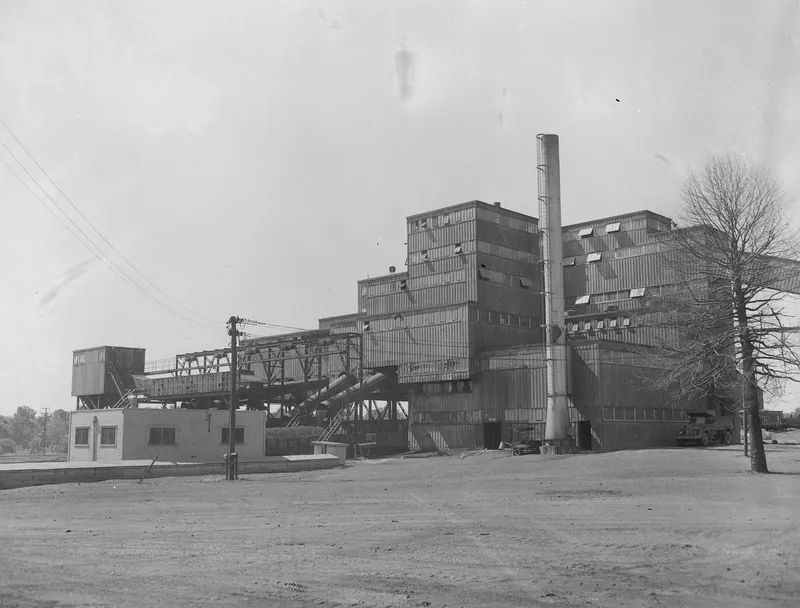
Vigo County's coal story runs from a few wagonloads of surface coal sold to Terre Haute blacksmiths around 1833 to a county that mined 1,868,465 tons in 1905 with 3,222 miners. This page follows it through Greater Terre Haute and Vigo County (1908, two volumes): the veins under the county, the Coal Bluff Mining Company and the towns it founded, Seelyville and its shaft, and the English, Welsh and Southern-born men who ran the mines.
Written from 2 county histories, all free to read on the Internet Archive: Greater Terre Haute and Vigo County, Vol. 1 (1908); Greater Terre Haute and Vigo County, Vol. 2 (1908). Everything below comes from those books, and where they give an opinion, we say so.
Three veins under the county
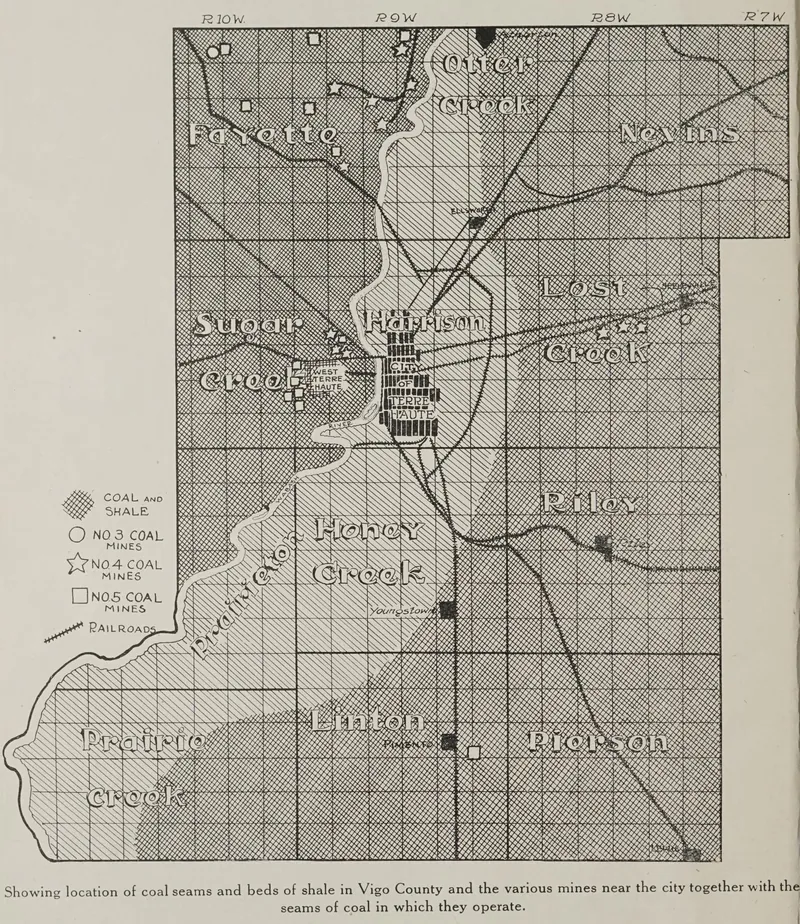
The 1908 history describes three coal veins under Vigo County, which it labels "N," "M" and "L." A well bore at St. Mary's found coal "N" 125 feet below the surface, "M" at 190 feet and "L" at 280 feet, and the three veins together measured twenty-one feet thick. The book called the quantity of coal under the county enormous.
East of the Wabash the veins behaved differently. The upper vein "N" was generally not strong there. The middle vein "M" ranged from six feet thick near Lockport, the old name of Riley, down to two inches near Seelyville. The big vein east of the river was "L," six to ten feet thick. North of the old National Road it lay so close to the surface that half of its area had eroded away.
Early attempts, 1816 to 1852
Coal was noticed early. David Thomas, traveling through the region in 1816, mentioned a coal outcrop along the Wabash and predicted that coal would one day be one of the great resources of the country. The early county commissioners leased coal deposits on school lands. The Indiana Gazetteer for 1833 reported that some of the county's coal had been shipped to New Orleans, where it brought as high a price as Pittsburgh coal.
Local use was modest. According to S. H. Potter, writing in the Terre Haute directory for 1872, about 1833 a few wagons of inferior surface coal came into town from Honey Creek and were sold to blacksmiths, at a time when wood cost $1.25 a cord. One of the first attempts at a real coal business was made by Jacob Thompson, who came from New York about 1838. With a partner he mined on the high bluffs six or eight miles up the river and loaded barges for New Orleans, but low water kept the barges from passing downstream and they sank along the shore, ending the venture.
For many years after that, the book says, coal was mined only for local household use, apart from small amounts carried down the river, and the authors admit they did not know how much coal moved on the old canal. The railroad changed the outlook. In the third annual report of the Terre Haute & Richmond Railroad, published January 5, 1852, Chauncey Rose wrote that the road would need a large number of coal cars because he expected coal to be a heavy part of its business.
“Low water prevented their passing down the river, and they sank along the shore…”
From 222,320 tons to nearly two million
The statistics in the 1908 history show how fast the industry grew. In 1887 Vigo County mined 222,320 tons, second only to Parke County, with Clay third. By 1905 the county mined 1,868,465 tons, more than eight times the 1887 figure, and the increase from 1904 to 1905 alone nearly equaled the whole 1887 output. Neighboring counties grew faster still: by 1905 Greene County led the state, Sullivan was second and Vigo third.
That year Vigo had 3,222 miners and twenty-eight mines. It ranked third among the fourteen coal-producing counties of Indiana in tonnage and in miners, tied Greene for third in number of mines, and produced nearly one-fifth of the state's coal. The book says the miners made up a considerable share of the population and gave Vigo "much of the character of a coal center."
Coal also fed Terre Haute's factories. The history credits the opening of the coal area after the Civil War with giving manufacturing a substantial start, then describes a setback. When the Indiana natural gas fields opened in the late 1880s, new industries settled among the gas wells, and manufacturers, the book says, disdained coal while gas was plenty and cheap. By the close of the century the gas had all but failed, and the coal mines once more became the chief source of factory fuel.
The Coal Bluff Mining Company and its towns
The largest coal name in these volumes is the Coal Bluff Mining Company. It was incorporated in 1875 with capital of $7,500 and began with one mine, and the history notes that its capitalization was never increased. By 1908 it operated nine mines in Vigo, Clay and Greene counties along the Big Four, the Chicago & Eastern Illinois and the Southern Indiana railroads, employed about 1,600 men and produced over a million tons a year. The 1908 history calls it one of the largest independent coal companies in the state.
Through its many mines in northeastern Vigo and the large number of miners it employed, the book says, the company had the credit of founding two of the county's important towns, Coal Bluff and Fontanet. Fontanet was once known as Fountain Station. Both names appear on the county's post office lists for 1890 and 1902.
Three officers had long careers with the company. J. Smith Talley was its secretary at the start and by 1908 its president, after some thirty years in the business. William E. Eppert, born in Clay County in 1858, became manager of the company store at Carbon in 1880, was made a director and secretary eight years later, moved to Terre Haute in 1888 and rose to vice president. He was also president of the Eureka Block Coal Company, organized in 1894 to work one Clay County block-coal mine with about 100 men, and had at one time been secretary of the Bituminous Coal Operators' Association of Indiana. James Wesley Landrum, a former Terre Haute school principal born in Morgan County to Tennessee parents, managed the Terre Haute Coal and Lime Company from its organization in 1887, with Talley as president and Eppert as vice president. He was also Coal Bluff's secretary until 1907, though his sketch dates the start of that term to 1893 in one sentence and 1892 in another.
“Leaving England on November 3, 1879, Mr. Richards came to the United States and directly to Indiana…”
Seelyville, Burnett, West Terre Haute and Riley
The 1908 history says several villages that began with coal mining were by then among the most populous in the county. Seelyville grew up around the McKeen coal shaft in Lost Creek Township, which brought a post office and a small business center. J. Seely laid out the town, and the post office was established about 1878. A few months before the book was written, Seelyville voted to incorporate.
The biographies fill in the town. Edward P. Shipley, born in eastern Virginia and raised in Claiborne County, Tennessee, brought his family to Seelyville in 1898 and spent about three years in the mines. In 1906 he operated the Swamp Angel mine, which he had recently sold. His son Samuel B. Shipley, who had worked with him in the mine, was appointed Seelyville postmaster on August 15, 1907, and the book calls him the youngest postmaster in the county. Mont Elmer Taber bought the only drug store in Seelyville from Benjamin German, and Dr. Francis H. Hemphill practiced medicine there. The sketches also mention lodges of the Red Men and the Knights of Pythias at Seelyville.
Burnett was the home of the Grant Coal Mining Company, run for years by the Welsh engineer James L. Devonald. West Terre Haute, which appears on the 1902 post office list but not the 1890 one, had the mines of the Deep Coal Mining Company and the Lower Vein Coal Company, the latter on the Big Four Railroad. Smaller operators were often farmers. William Soules of Lost Creek Township had been in the coal mining business about nineteen years and operated a mine in that township, and Sugar Creek Township farmer Lorenzo Barnhart, who came to the county in 1874, had worked at coal mining among other trades.
Riley began as Lockport, a canal town platted in November 1836. When the post office opened it was named Riley, and the book says that a few years earlier it had been the largest village in the county. Its later excitement was oil rather than coal: in the fall of 1906 the Vi-Clay Oil Company, made up of local farmers and other citizens, brought in a well two miles southeast of the village that yielded 132 barrels its first day.
Mining men from England and Wales
George Clement Richards was born near Ashby-de-la-Zouch in Leicestershire, England, on January 31, 1843. He went into the coal mines at nine, served a two-year apprenticeship in mine engineering and studied three years at the Bristol Mining School. He left England on November 3, 1879, with his wife, Sarah Street of Sheffield, and six children. His first work of note was in Sullivan County, where he cleared the gas from the idle Curryville mine of the Chauncey Rose estate and bought it for ten thousand dollars. His first-born son, Harry, was killed by a fall down the Curryville shaft. After later ventures in Sullivan County and at Linton, Richards spent two years as president of the Deep Coal Mining Company at West Terre Haute, then organized the Lower Vein Coal Company there, with his son George H. Richards as a director and superintendent of the mines.
James L. Devonald was born in 1862 to Welsh parents named Lewis. His grandfather, David D. Devonald, paid three hundred dollars to have the boy's surname changed from Lewis to Devonald, a detail worth knowing for anyone tracing the family. He spent twelve years with a South Wales surveying troop, then became assistant manager of a coal company in South Wales, and in 1888 left for the United States because of poor health, settling first at Knightsville, Indiana, and then at Rosedale in Parke County. In 1895 he came to Vigo County, ran the Grant Coal Mining Company at Burnett for five years, superintended the Coal Bluff Mining Company at Fontanet for two, and then returned to Burnett as Grant's general manager. His half-brother William J. Robert was foreman of mine No. 3 of the Grant company. His wife, Margaret Lewes, was also from South Wales, the daughter of a man who spent his whole life as a coal miner.
For family researchers, these sketches show the pattern of the district: skilled managers from the coal fields of England and Wales, Southern families like the Shipleys who moved north to the Seelyville mines, and local farm families such as the Soules who worked small mines alongside their land. The 1890 and 1902 post office lists are a quick check on which coal villages existed at each date.
Finding your ancestor in Vigo County
- Census records (free through 1950) list each person's occupation and town, so a mining family shows up decade by decade.
- Death records: search our Indiana database by surname.
- The county histories themselves: the biographical sections of Greater Terre Haute and Vigo County, Vol. 1 and Greater Terre Haute and Vigo County, Vol. 2 hold hundreds of family sketches.
- Newspapers on the Library of Congress's Chronicling America carried obituaries, accidents, and local news.
Tell us one grandparent's name. We'll take a free first look at the records and email you back.
Ask about my family →Frequently asked questions
When did coal mining begin in Vigo County?
The 1908 history says David Thomas noted a coal outcrop along the Wabash in 1816. About 1833 a few wagons of surface coal from Honey Creek were sold to Terre Haute blacksmiths. Around 1838 Jacob Thompson, from New York, mined on the river bluffs for New Orleans, but his loaded barges sank in low water.
Which company founded Coal Bluff and Fontanet?
The Coal Bluff Mining Company, according to the 1908 history. Incorporated in 1875 with $7,500 in capital and one mine, it grew to nine mines in Vigo, Clay and Greene counties with about 1,600 men. Fontanet was once known as Fountain Station.
How did Seelyville start?
Seelyville grew up around the McKeen coal shaft in Lost Creek Township. J. Seely laid out the town and the post office was established about 1878. The 1908 history says Seelyville had voted to incorporate a few months before the book was written.
How much coal did Vigo County produce?
The county mined 222,320 tons in 1887 and 1,868,465 tons in 1905, when it had 3,222 miners and twenty-eight mines. That year it ranked third in Indiana behind Greene and Sullivan and produced nearly one-fifth of the state's coal.
Photographs on this page are in the public domain. About the images and their sources.