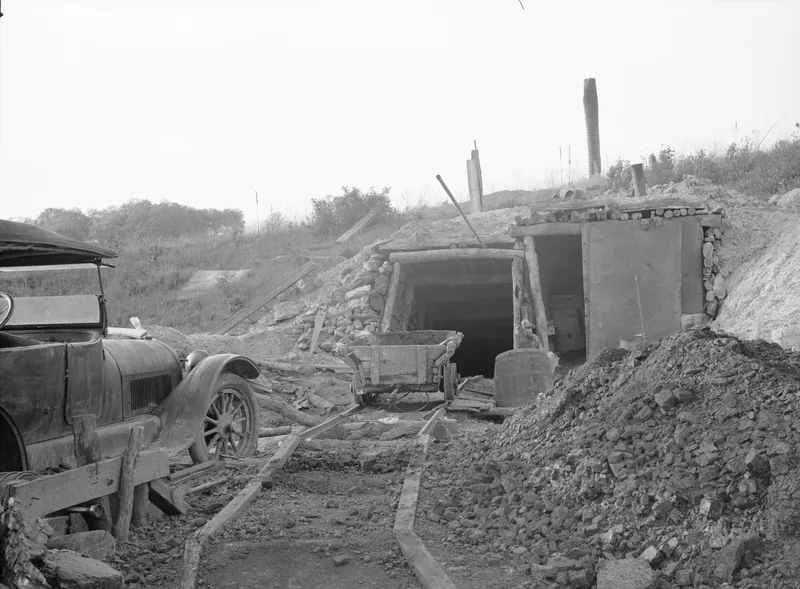
Wapello County was digging coal almost as soon as it was settled, and for a generation it sat at or near the top of Iowa's coal counties. Two county histories, one from 1901 and one from 1914, record the mines at Happy Hollow, Kirkville, Alpine and Keb, the railroads that hauled the coal, the Ottumwa Coal Palace of 1890, and a handful of Welsh-born miners who rose to run the pits.
Written from 2 county histories, all free to read on the Internet Archive: History of Wapello County, Iowa, and Representative Citizens (1901); History of Wapello County, Iowa (1914). Everything below comes from those books, and where they give an opinion, we say so.
The first mines, 1857 to 1867
The 1914 History of Wapello County says mining went on "almost from the earliest settlement of the region." As early as 1857 there were mines near Kirkville and Dahlonega, in the river bluffs four miles below Eddyville, and along Bear Creek four miles west of Ottumwa. Coal was still counted in bushels then. In 1862 the county produced 327,650 bushels, which the 1914 book says was nearly three times as much as any other county in Iowa.
The same book draws on a visitor named White (no first name is given) who toured the district in 1867 and listed its leading mines. C. Dudley & Company worked a four-foot seam one mile south of Dudley on Middle Avery Creek, fifty feet above the Saint Louis limestone. Henry Shock & Company had mines in Happy Hollow in a five-foot seam. Brown & Godfrey ran the Union mine in section 33, township 73 north, range 14 west, where the coal was four to four and a half feet thick.
The big producer of that era was the Alpine Coal Company, with a large mine at Alpine station, two miles below Cliffland on the Des Moines Valley Railroad. Its seam ran four to five feet, and large quantities of its coal were shipped to Keokuk. White reported that the mine had turned out about a million bushels since it opened, which the 1914 book judged was probably more than any other mine in the state had produced up to 1867.
Happy Hollow and the Kirkville mines
By 1877 two mines led the county. The Union Coal Company mine put out 608,977 bushels that year, and the Postlewait mine at Happy Hollow produced 582,507. The Postlewait mine was tied to the Chicago, Burlington & Quincy Railroad, more than a mile away, by a tram road. Most working seams ran four to five and a half feet, but the 1914 book reports that in the Happy Hollow mine and the mines just south of Kirkville the coal reached six and a half and even seven feet in places.
The largest operation either book describes is the Wapello Coal Company, which for a number of years before 1890 worked extensive mines just south of Kirkville, in section 17. The Ottumwa & Kirkville Railroad connected the mines with the Chicago, Rock Island & Pacific. The vein averaged five and a half feet, more than four hundred acres were worked out, and over three hundred miners were employed. The 1914 book puts the total output of these mines at between one and two million tons.
The 1901 book fills in the company's management. Its sketch of Mr. Waterman, a civil engineer who served as mayor of Ottumwa from 1880 to 1884, says he had been general manager and vice-president of the Wapello Coal Company since 1884, and that his son, Philip H. Waterman, was the company's superintendent. So the company was still in business in 1901, though the 1914 book dates its big Kirkville workings to before 1890.
“James A. Campbell was but nine years of age when he entered the Cedar Valley coal mines as trapper…”
Where the coal lay and how it was dug
According to the 1914 book, mining had been confined chiefly to the northwestern part of the county, in Richland, Center, Columbia and Cass townships. Aside from the Laddsdale mine and the old mine at Alpine, very little coal had come out of the south and southeast. Coal outcropped in the hills near Ormanville, and there were small country banks in Green Township. In Pleasant Township, a deep well on the land of Norman Reno, in section 12, was reported to have passed through a three and a half foot seam at 135 feet. The book blamed the gaps mainly on distance from railroads, plus rough country and plentiful timber in the south and thick drift in the northeast.
The seams were lens-shaped and pinched out within a few miles, so prospectors had to sink several holes. A vein several feet thick in one hole might be two or three inches thick, or missing, a few hundred feet away. The 1914 text argues that coal is no likelier under valleys than under uplands; the book's editor then adds a bracketed note disagreeing, calling the valley belief well founded in Iowa.
Every mine used the room and pillar system, and the coal was shot from the solid without undercutting. Nearly half the mines hoisted with steam power and most of the rest with a horse gin. About a third were ventilated by fans and the rest by furnaces. The Eldon Coal and Mining Company tried the Jeffery mining machine for several years but gave it up because stony concretions in the coal damaged it, and by 1914 the coal was mined entirely by hand. The Keb mine's main shaft, described in 1901, was only 63 feet deep, in a vein four to five and a half feet thick.
Ottumwa as a coal town and the 1890 Coal Palace
The 1901 History of Wapello County and Representative Citizens calls Ottumwa the distribution point for "a vast tonnage of coal" and the headquarters of the White Breast company and other coal firms. In the two years ending June 30, 1900, the territory around and tributary to Ottumwa produced 6,230,750 tons. The book lists prices of $2.50 a ton for lump, $1.25 for mine run and $1.00 for steam coal, which it called low compared with other cities and a draw for factories, among them makers of steam hoisting machines for mines.
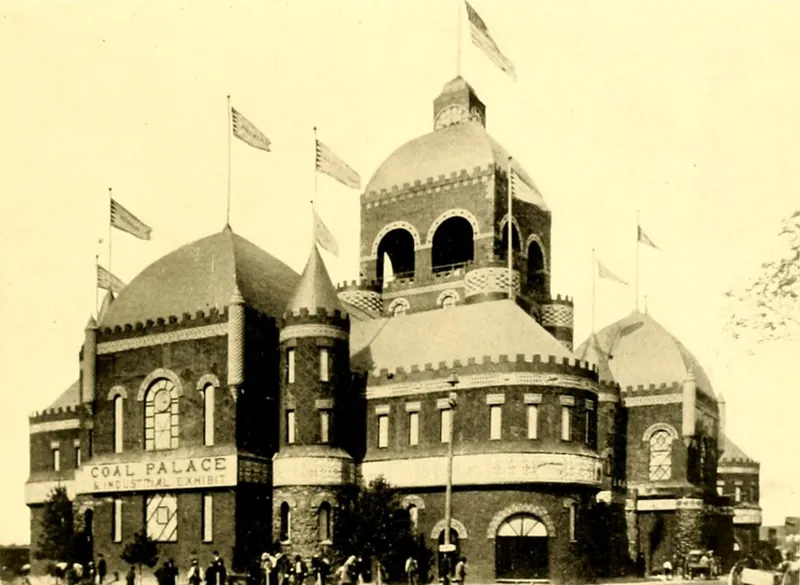
To advertise the coal field, Ottumwa businessmen raised over $20,000 by subscription in 1890 and built a Coal Palace on ground just north and west of the Union Depot, property of Col. P. G. Ballingall. Both books give the same description: 230 by 130 feet, two stories, with a 200-foot tower, the coal used as decoration rather than as building material. The basement held a representation of a coal mine that the 1901 book called quite realistic. The palace opened September 16, 1890, and closed October 11, with special days for Van Buren, Jefferson, Monroe, Davis, Lucas and other counties. Calvin Manning usually acted as manager and announcer.
The 1901 book prints the full list of incorporators of the Ottumwa Coal Palace Company, among them Henry Phillips and W. R. Daum, with P. G. Ballingall as president, Samuel A. Flagler as vice-president, Calvin Manning as secretary and W. T. Fenton as treasurer. A South Ottumwa reminiscence in the 1914 book says the merchants and wage earners of the south side put up $1,600 for the palace fund, and the writer called it a good investment that brought thousands of people to town.
“The coal palace and the meetings held in it brought thousands of people to Ottumwa…”
Welsh miners who ran the mines
The mining sketches in the 1901 book keep circling back to South Wales. Thomas J. Phillips was born there in 1841 and came to America at six or seven, landing at New Orleans and growing up in St. Louis. His father, John T. Phillips, worked in coal in Wales and America and died in Lucas County, Iowa. Thomas was a foreman for the Northern Missouri Coal & Mining Company and then the W. B. Jackson & Brothers Coal Company before joining the Whitebreast Fuel Company in 1879. He was mine superintendent in Lucas County from 1879 to 1884, general superintendent with offices at Cleveland until 1890, and then moved the general office to Ottumwa. He served as mayor of Ottumwa from 1897 to 1901, and on August 21, 1901, the Democrats nominated him for governor.
W. E. Williams, the son of a South Wales coal miner, landed at New York in September 1869. He mined two years at New Pittsburg in St. Clair County, Missouri, seven years at Sand Creek, Indiana, where he became inside boss, five years in Fountain County, Indiana, and one year at Grape Creek, Illinois, where he sank a shaft for a Chicago company. He then worked seven years in the mines at Kirkville. In 1892 he moved to Keb, in Richland Township, mined two months, became outside boss, and by 1901 had been superintendent of the Keb coal mine for eight years. The mine averaged 225 men and sold its coal to railroads. His second wife, Margaret Loyd, was also born in South Wales.
John Daniels, born in South Wales in 1876, came with a father who arrived in America in 1879, mined in Illinois and then settled at Ottumwa. In 1899 the son leased the Wallace mine on the Wallace farm two miles south of Ottumwa and sold all its output in the city. James A. Campbell, the 1901 book says, entered the Cedar Valley coal mines as a trapper at nine years old, came to Ottumwa in 1885, and was appointed state mine inspector by Governor Jackson in 1894, then reappointed by Governor Drake and Governor Shaw.
The Phillips family, the mining trades and the 1913 operators
Ira Phillips, born in Madison County, Ohio, on May 28, 1830, farmed in Van Buren County until he came to Ottumwa in 1875 and went into mining. The 1901 book says he opened and operated the first coal mines on the Chicago, Milwaukee & St. Paul Railway northwest of Ottumwa. He established the Phillips Fuel Company and opened mines in the town of Phillips, which was platted later, and worked them until 1891, when the company opened mines at Foster. His son Henry Phillips, born in Van Buren County in 1858, was its secretary, treasurer and manager.
Henry Phillips also backed W. E. Hunt's box car loader, a machine meant to load coal into box cars without breaking it. The two books disagree on the dates. The 1914 book says Phillips bought a half interest and organized the manufacturing company in 1881. The 1901 book says the Ottumwa Box Car Loader Company was established in October 1899, that the city donated $2,500 toward a brick plant built in 1900, that it employed 40 men, and that a complete machine sold for $2,000.
Ottumwa also made the miner's kit. Inventor Martin Hardsocg started making mining tools at Avery and moved to Ottumwa, where, the 1914 book says, about sixty people made coal picks, wedges, drills, shovels and overalls. The American Mining Tool Company in East Ottumwa made mining tools and miners' clothing. The 1914 book lists the companies operating mines in the county in 1913: the Alpine, or Fowler & Wilson Coal Company; the Anchor Coal Company under W. R. Daum; the Morey Clay Products Company under D. F. Morey; the Phillips Coal Company under Henry Phillips; the Star Coal Company under W. F. Metz; and the Trio Coal Company under Howell Price.
People from this history in our records
These Wapello County residents have biographies on our site from the county histories, and each one mentions the mines. Their sketches name parents, spouses, and where the family came from.
- Henry Phillips (b. 1858)
- Thomas J. Phillips (b. 1841)
- Francis W. Simmons (b. 1854)
- Joseph Brown (b. 1831)
- William Z. Davis (b. 1836)
- Captain Charles Perry Brown (b. 1840)
Finding your ancestor in Wapello County
- Census records (free through 1950) list each person's occupation and town, so a mining family shows up decade by decade.
- Death records: search our Iowa database by surname.
- The county histories themselves: the biographical sections of History of Wapello County, Iowa, and Representative Citizens and History of Wapello County, Iowa hold hundreds of family sketches.
- Newspapers on the Library of Congress's Chronicling America carried obituaries, accidents, and local news.
Tell us one grandparent's name. We'll take a free first look at the records and email you back.
Ask about my family →Frequently asked questions
Where were the main coal mines in Wapello County?
The 1914 History of Wapello County says mining was concentrated in the northwest, in Richland, Center, Columbia and Cass townships. Major mines it names include Happy Hollow, the Wapello Coal Company mines just south of Kirkville, and the Alpine mine below Cliffland. The 1901 book adds the Keb mine in Richland Township and the Wallace mine south of Ottumwa.
Where did Wapello County coal miners come from?
The county histories do not give a general count of miners by origin. The mining sketches in the 1901 book describe several Welsh-born men, including Thomas J. Phillips of the Whitebreast Fuel Company, Keb superintendent W. E. Williams and operator John Daniels, who had mined in Missouri, Indiana or Illinois before reaching Wapello County.
What was the Ottumwa Coal Palace?
It was an exhibition hall built in 1890 with over $20,000 raised from Ottumwa residents to advertise the region's coal. It measured 230 by 130 feet with a 200-foot tower, had a model coal mine in the basement, and was open from September 16 to October 11, 1890, according to the 1901 county history.
How much coal did the Wapello Coal Company mine at Kirkville?
The 1914 history says the company worked extensive mines just south of Kirkville for a number of years before 1890, employed over three hundred miners, worked out over four hundred acres of a vein averaging five and a half feet, and produced between one and two million tons in total.
Photographs on this page are in the public domain. About the images and their sources.