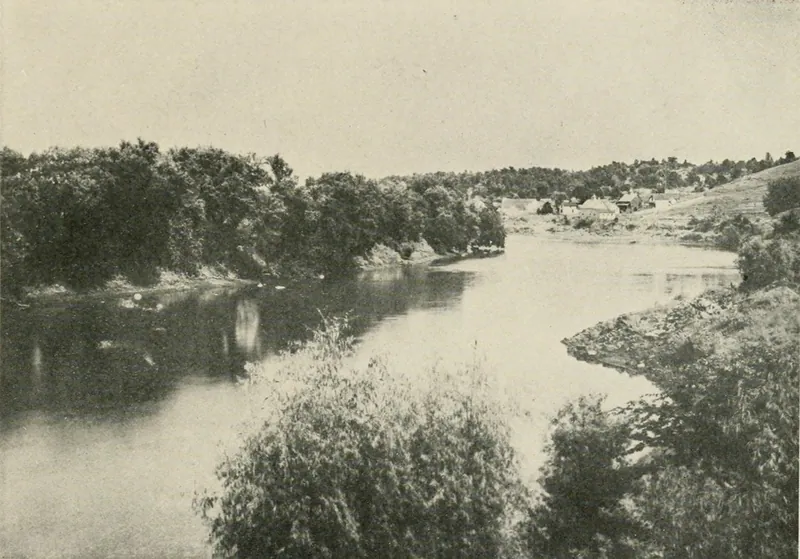
Webster County sat at the northern edge of Iowa's coal country, and the 1913 History of Fort Dodge and Webster County treats its mines as the root of much of the county's industry. Soldiers at the fort dug outcropping coal in 1854. By 1902 the county's output had reached 140,000 tons, and Coalville, Kalo and Lehigh had become its main mining districts. This page gathers what that book records about the seams, the men who opened them, and the towns they left behind.
Written from History of Fort Dodge and Webster County, Iowa (1913). Everything below comes from that book, and where it gives an opinion, we say so. You can read the full book free on the Internet Archive.
The Seams Under the Des Moines River
Webster County's coal lies in the Des Moines stage, which the book also calls the Lower Coal Measures. The coal beds make up only a small part of those strata, but the book calls them a very important part and says their mining formed the basis of much of the community's industrial life. It ties the county's early start in mining to its position as the most northerly coal producing area in the state.
The seams sit stacked one above another, separated by shale and sandstone. The book prints a composite section through the Lehigh coal seams that names them from the top down: the Harper vein, the Tyson seam, the Pretty seam, and at the bottom the Big seam, with four inches of bone in its center. Near Coalville the coal lay in three horizons, the lowest a cannel coal. The book says the "Big Coal" there seems to have been laid down in the abandoned channel of an ancient river, so it runs in a narrow strip that is thicker in the middle than at the edges. Cannel coal, it adds, has a somewhat lower fuel value than good bituminous coal because it holds more gas and less carbon.
Soldiers, Major Colburn and the First Mines, 1854 to 1869
The book gives the first digging to the soldiers at the fort. In 1854 they took a little outcropping coal about a mile and a half above the fort, on the east side of the river. The vein was about three feet thick and the coal was very soft, light and free burning. While it was being worked the mine caught fire, and because of the nature of the coal it burned through nearly an acre before it could be put out. But the book says the soldiers had not really opened a mine.
That credit goes to Major Elliot E. Colburn, who came to Fort Dodge in 1855 with Messrs. Booth and Kavanagh and preempted a half section on the west bank of the Des Moines. According to the book he opened the first coal mine in Webster County in 1856. His seam became known to geologists and miners as the "Colburn vein," a very hard, heavy coal that sold at retail for ten to twelve cents a bushel. The actual work was done by Thomas Donahue, Thomas Flaherty and Walter Ford, and Donahue stayed in Colburn's employ for about four years.
The railroad Fort Dodge was counting on came slowly, and in 1859 Colburn went back to Ohio. He returned in 1866 after army service, laid out West Fort Dodge on part of his old claim, and set out to develop mines on the west bank of the river. He put $15,000 into the venture and lost all of it. The coal was of good quality, the book says, but faulty construction destroyed the shafts and water collected in the mines. He moved to New York in 1869 and died in Texas in 1875.
The next mine, the book says, was opened by Samuel Rees. Another early miner was Silas Corey, Sr., who came to the county in 1862 and settled on a farm on Holiday creek in Pleasant Valley township, six miles down the river from Fort Dodge. Alongside his farming he ran a coal mine on the creek, which the book calls the first mine to be worked permanently in the county. River traffic carried coal too. John F. Duncombe's Fort Dodge Sentinel of April 7, 1859, described the first steamboat pleasure excursion on the Upper Des Moines, aboard the Charles Rogers, which left Colburn's ferry, crossed the river, and loaded coal from the mines before heading upstream.
“This coal was very hard and heavy. It sold at retail for ten to twelve cents a bushel…”
Shipping Coal by Rail, 1870 to 1910
Commercial mining arrived with the railroads. In 1870, the book says, Hon. J. F. Duncombe and others opened the first shipping mine in the county. It was on Holaday creek, about three miles from the Dubuque and Sioux City railroad (by 1913 the Illinois Central), and a tramway connected the two. Other mines followed, and each new railroad gave the trade an added push. The book names Coalville, Kalo and Lehigh as the important districts from the beginning of operations to its own day.
The book's figures trace the rise and fall. The state census of 1862 credited Webster County with just 250 bushels. The federal census of 1870 counted 34,400 tons, which made Webster the fourth producing county in Iowa. Production climbed as high as 140,000 tons, reached in 1902. After that it declined, which the book puts down to the working out of the best seams. The output for 1910 was 49,973 tons, valued at $111,720.
The book uses "first" for several different starts: Colburn's mine of 1856, the first coal at Lehigh in 1858, Corey's mine as the first worked permanently, and the first shipping mine of 1870. Read together they mark stages rather than a contradiction. It also spells the creek two ways, Holaday and Holiday, so search for both.
Lehigh: From Slabtown to Coal Town
Lehigh began as a sawmill settlement. Oliver Tyson platted the town and was its first inhabitant, and the place was first called "Slabtown" after Tyson's sawmill, its first industry. It was later renamed for the Lehigh coal fields of the East. The book dates the first coal mined there to 1858. Walter Goodrich, Sr., who reached what is now Lehigh on October 7, 1855, served the settlement as carpenter, blacksmith, undertaker and Methodist Episcopal preacher until his death on July 7, 1901.
Two older settlements were folded into Lehigh. Vesper, first known as Tyson's Mills, stood on the west bank of the Des Moines, where Reed & Wright built a steam sawmill in 1855. Oliver Tyson later took over the site, added a flouring mill in 1858, and did business as miller, merchant, miner and farmer until the fall of 1875, when he sold to Bond & Post. Across the river, Lackawana was platted in July 1876 by the Webster City & Crooked Creek Railroad & Coal Company and named for the coal mines that company had just opened. It became East Lehigh.
The book lists the town's milestones. Oliver Tyson started the first store in the spring of 1871 and John Buck was the first postmaster. The H. W. Ross hardware store opened in 1877, the Crooked Creek road reached town in 1878, C. S. Hall & Sons organized the Lehigh Valley bank as a private bank in 1884, and S. D. Conlee opened his general store in 1885. Ira T. Brannigan, then principal of the Lehigh school, and Ned Howard, a boy of fifteen, printed the first Lehigh Valley Echo, as Howard recalled in the Lehigh Valley Argus of January 25, 1912.
By 1913 the book reports that Lehigh's coal output had greatly decreased, though a considerable quantity was still mined, and that the manufacturing of clay products had become the chief industry. The 1910 census counted 928 people in Lehigh, which straddled Sumner and Webster townships.
“Later the town was called Lehigh after the Lehigh coal fields of the east. The first coal was mined in 1858…”
Kalo, Otho and the Clay Works Mines
Kalo was a product of coal and the Minneapolis & St. Louis Railroad. The first Otho stood on section 28, along the highway north of the district No. 1 school. With the coming of the railroad and the development of the coal mines, the book says, that town was abandoned and the new towns of Otho and Kalo were established. The opening of the coal fields started Kalo at Hart's Ford. The railroad built a spur from its line at Craigs' Hollow to the Kalo mines and put up a depot at the junction, which it named Kalo.
During the coal mining days there was a considerable settlement along the river and at both Craigs' Hollow and Kalo. The store building from old Otho was moved to Kalo, where Hart and Fuller ran the first store, and N. H. Hart was the first postmaster. T. B. Apland later kept a blacksmith shop and general store there until his death. By 1913 the book calls Kalo a small village where the coal business was practically at an end, and notes that as Kalo lost people, Otho gained them.
Clay took over. A small tile factory begun in 1890 by S. C. and August Johnson was sold in 1895 to Schnurr Brothers, who by 1913 had nineteen kilns, employed about eighty men, and turned out $120,000 a year, mostly drain tile. Coal was still dug nearby at Clay Works, a post office on the Minneapolis & St. Louis that owed its start to the Johnston Brothers plant for hollow building block. The book says considerable coal was mined there: Craig & Dawson operated a mine, and Johnston Brothers had a mine of cannel coal.
Coalville, Linnburg and Gypsum
Coalville, in the book's words, was originally a coal mining town that sprang up with the opening of the mines in Pleasant Valley township. At first it was considerable of a town. As the mines were gradually worked out its population dropped, and the cheap company houses the miners had built were torn down or moved away. By 1913 Coalville had a general store, a two-room school house, three churches, and a single working mine.
Other places carry coal in their past. Linnburg, a small station on the Chicago & Northwestern in Dayton township, once had considerable coal mined in its vicinity. The station of Gypsum, at the junction of the Illinois Central and the Lehigh branch of the Chicago & Great Western, was a transfer point and a heavy shipping point because it sat near the gypsum mills and coal mines. It was formerly called Carbon Junction, and also the "Y."
Gypsum is the county's other mineral story. The book describes a bed of remarkably pure gypsum, ten to thirty feet thick, centered at Fort Dodge. Pioneer contractor John O'Loughlin, Sr., who came in 1856, quarried the gypsum and cut the stone for his own Fort Dodge home, a five-year job.
Finding Coal Families in the Records
The 1913 history names few ordinary miners, so its best leads are indirect. Its roster of Webster County volunteers in the Spanish-American War of 1898 gives each man's residence and birthplace. From Kalo it lists James Ballantyne and John Reid, Jr., both born in Pennsylvania, and Benjamin McClosky. Lehigh sent many more, among them Louis Frederickson and a Severene Fredickson (spelled that way in the roster), both born in Denmark, along with William H. and LeRoy J. Townsend, Ernest L. Corey, Charles Eksell and John H. Murphy. It gives no occupations, but it places these men in the coal towns.
The book's population table breaks the county down by township for 1890, 1900 and 1910, a quick way to see when a camp was filling or emptying. For newspapers, the book names the Lehigh Valley Echo, the later Lehigh Valley Argus (edited in 1912 by Hal C. Fuller), and the Fort Dodge Sentinel, which John F. Duncombe edited in 1859.
Finding your ancestor in Webster County
- Census records (free through 1950) list each person's occupation and town, so a mining family shows up decade by decade.
- Death records: search our Iowa database by surname.
- The county histories themselves: the biographical sections of History of Fort Dodge and Webster County, Iowa hold hundreds of family sketches.
- Newspapers on the Library of Congress's Chronicling America carried obituaries, accidents, and local news.
Tell us one grandparent's name. We'll take a free first look at the records and email you back.
Ask about my family →Frequently asked questions
When was the first coal mine opened in Webster County, Iowa?
The 1913 history credits Major Elliot E. Colburn with opening the first coal mine in the county in 1856, on the west side of the Des Moines near Fort Dodge. Soldiers at the fort had dug a little outcropping coal in 1854, but the book says they never really opened a mine. The first shipping mine came in 1870 on Holaday creek.
How much coal did Webster County produce?
According to the 1913 history, the 1862 state census credited the county with 250 bushels and the 1870 federal census with 34,400 tons, making it Iowa's fourth producing county. Output peaked at 140,000 tons in 1902, then declined as the best seams were worked out. The 1910 output was 49,973 tons, valued at $111,720.
What happened to Coalville and Kalo?
The book says Coalville shrank as its mines were worked out, and the miners' cheap company houses were torn down or moved; by 1913 it had a store, a two-room school, three churches and one working mine. Kalo, started at Hart's Ford with the coal fields, was a small village by 1913, its coal business practically at an end and clay works the chief industry.
How did Lehigh, Iowa get its name?
Oliver Tyson platted Lehigh, and it was first called Slabtown because of his sawmill, its first industry. The 1913 history says it was later named after the Lehigh coal fields of the East. The first coal there was mined in 1858, and the older settlements of Vesper and Lackawana (East Lehigh) later became part of the town.
Photographs on this page are in the public domain. About the images and their sources.