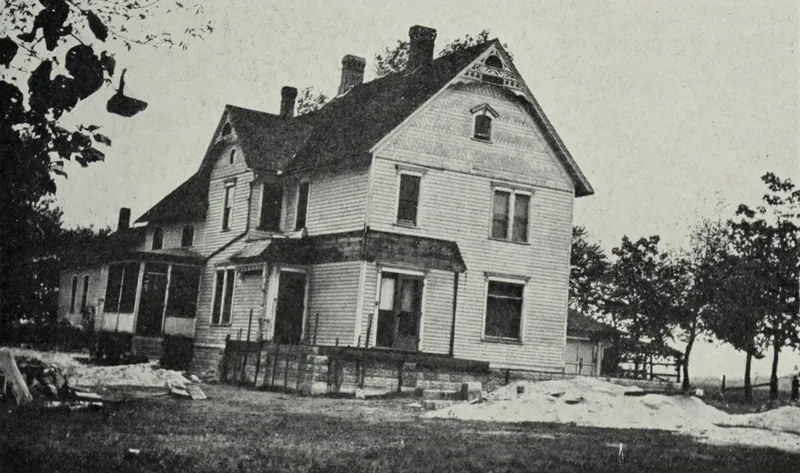
In 1878, the History of Will County described Braidwood as a city of wooden houses standing on top of its own coal. The town was laid out in 1865, and within a dozen years it had a mayor, a library, two big mining companies and an independent shaft run by the Scotsman whose name it carried. The book's Reed Township sketches are full of miners from Scotland, England, Wales and Ireland, which makes it a rich source for families who came to dig coal.
Written from The History of Will County, Illinois (1878). Everything below comes from that book, and where it gives an opinion, we say so. You can read the full book free on the Internet Archive.
Before the shafts: hay fields in Reed Township
The ground under Braidwood was farm and prairie only a few years before the mines. Frank T. O'Reilly, an Irishman from Meath, settled in Reed Township in 1855 and bought 200 acres at $6 an acre. His sketch says he was among the first settlers there, in country still wild enough for deer and prairie wolves. Timothy Keane, another Irish settler, came to Will County in 1856, bought eighty-five acres at $16 an acre, and once cut hay off the land the city of Braidwood later covered.
The 1878 history says the first building on the future town site was a little brick schoolhouse that predated the coal discovery. When the coal came, the town followed fast. The book dates the laying-out of Braidwood to 1865.
The first shafts: Braceville, Glenney, Eagle and Gardner
Several sketches let you piece together who sank the early shafts. David Moris, a Welsh miner born in North Wales in 1832, left Liverpool on June 25, 1860, and worked his way west through the Monongahela River mines, Palestine, Ohio, La Salle County and Morris. Working for Nicholas Cotton, he sank the first coal shaft on the C., A. & St. L. railroad near Braceville station. He then sank two shafts for a company, and the book says one of them was the first coal shaft sunk in Reed Township.
Herbert L. Cady, a New Yorker, took charge of the Braceville Coal Shaft in 1863, which his sketch calls the first operated in that locality. In 1866 the firm of Odell & Cady leased land from D. Glenney and opened the Glenney Shaft, then sold it to A. B. Meeker the next year. Moris later worked with Odell & Cady drilling for coal.
Not every shaft paid. Moris joined a company made up of miners, the Joint Stock Coal Mining Company of Gardner, which struck a large flow of water and abandoned its shaft after spending $25,000. James Braidwood was in the company that sank the Eagle Shaft near the depot in 1869, then lost $6,000 in cash on a Champaign County shaft that he gave up after six months without finding coal.
“He at one time cut hay off the land that the city of Braidwood now occupies…”
The companies and the pool
By 1878 two large companies dominated Braidwood. The Chicago & Wilmington Coal Company (the "Wilmington Company" of the township history) was run locally by superintendent Esaias Hall of Vermont, who came in 1866, with H. O. Alden and B. F. Washburn as clerks. The company kept two stores in town. Another sketch in the book says it had worked and partially abandoned eight shafts and was running two. James Kain, an Edinburgh miner who came to Illinois in 1866, was at one time its General Underground Manager.
The Eureka Mining Company began in 1865 as the Rhodes Coal Company under D. P. Rhodes. It was reorganized with A. B. Meeker as president and W. L. Brown as secretary and treasurer, and the book notes it also ran mines at Streator on the Vermilion River. In Braidwood it employed 425 men at two shafts, about 300 of them steadily, while the rest waited their turn and got work two to four days a week. It raised about 130,000 tons a year from shafts that could do more than 200,000, and its expenses ran about $18,000 a month.
The history explains that these companies, with others in nearby townships, pooled their interests and divided profits after expenses. The one notable holdout was James Braidwood himself. In 1876 he started a shaft on his own resources, stayed out of the pool, and sold most of his coal to the Bridgeport Rolling Mills at Chicago. He employed about eighty men, paid 85 cents a ton for mining, raised 130 tons a day and had $20,000 invested.
A wooden city over the coal
The 1878 history found Braidwood remarkable to look at. The land companies sold town lots with a clause reserving the right to mine the coal underneath, so nearly every building was a light wood frame that could ride out the ground settling. The book counts only two exceptions: the old brick schoolhouse and a bakery. The vein ran three to three and a half feet thick. Once a working was abandoned, the roof fell in and a matching dip appeared on the surface, usually within a year. The writer predicted the whole town site would someday be mined out.
The population churned. The book admits that in the first year or two people came and left so fast that many miners' names were never remembered. That warning matters for researchers: an ancestor who passed through Braidwood in 1866 may leave no trace in this volume at all.
Smaller mining camps show up in passing. Ira R. Marsh opened a grocery at Keifersville in 1866, which his sketch calls the first store at the mines. Cornelius O'Donnell of Tipperary worked in the coal mines at Goose Lake, then Keifersville, before moving to Braidwood in 1870.
“Many who came in to work in the mines left as suddenly as they came, and not even their names are remembered…”
Who the miners were and where they came from
The Reed Township sketches read like a roll call of British and Irish coal country, and many men started underground as boys. Peter Barr of Renfrewshire began in the mines at 8 and came straight to Braidwood in 1865. Robert Burt of Lanarkshire started at 9, mined in Pennsylvania, went home to Scotland, and returned in 1866. William Mooney, born in Lanarkshire to Irish parents, started at 9 and went to work for the C. & W. Coal Co. in 1866. William H. Steen went down at 9 in Renfrewshire, came over with his father in 1865 to Schuylkill County, Pennsylvania, and reached Braidwood in 1870. John Bamrick of Queen's County, Ireland, began mining at 10 and lost his left arm in September 1872 when steam cars ran over it.
England is well represented too. William Maltby, born in Selston, England, in 1840, became superintendent of the Rhodes Coal Co., later the Eureka, in December 1866. (The township history spells him Maltaby.) Edwin Wakefield of Monmouthshire mined for more than twenty-five years, served as a gunner in the Crimean war, and mined in Pennsylvania, Tennessee, Kentucky and Illinois. John Broadbent of Yorkshire built the Braidwood House hotel near the depot in 1871.
A pattern worth knowing: many of these men reached Braidwood by way of the Pennsylvania or Ohio coal fields, often after a year or more there. If your miner ancestor seems to vanish between landing in New York and turning up in Illinois, the sketches suggest looking in those mining districts first.
The Braidwood family and the founding story
James Braidwood was born in Scotland on March 1, 1831, and began coal mining at 9. He worked as a machinist and boiler maker, spent four years as a steamship engineer, landed at New York in October 1863, and came to the town in August 1865 to work for the Chicago & Wilmington Coal Co. His sketch says John H. Daniel named the city in his honor. He married Ellen Ralston in 1854 and had twelve children, eight living in 1878. His oldest son, James, was killed by lightning on July 16, 1871, at 17. Another son, John R. Braidwood, born in Elderslie, Scotland, in 1855, was secretary and manager of the Braidwood Coal Co.
The township history says James Braidwood had perhaps done more than any other man to develop the coal industry there, and that he helped sink most of the early shafts. On who came first, though, the book does not tell one consistent story. His own sketch says he claimed to have built the first house in Braidwood and sunk its first shaft. The township history instead names the brick schoolhouse as the first building and says the first dwelling was said to have been built by Paddy Nary, a miner for one of the first companies. David Moris's sketch, for its part, credits him with the first shaft in Reed Township. Treat these firsts as claims recorded in 1878, not settled fact.
From the pit to city hall
Miners did not stay underground forever, and their later careers are often how they appear in the record. Braidwood's first mayor, L. H. Goodrich, was elected in 1873. Its mayor in 1878, Daniel McLaughlin, was a Lanarkshire miner who had worked the coal and iron mines at Woodsides, Scotland, from age 10, came to Braidwood in September 1869, and was elected in April 1877 on the National Greenback ticket. Steen became city clerk the same year, Bamrick was elected Reed Township town clerk as a Greenbacker in 1878, and Mooney went to the Twenty-ninth General Assembly in 1873 on the Independent ticket and was admitted to the bar in 1875.
Others went into trade. Duncan Rankin of Fifeshire, who had run the Rankin Coal Shaft in Grundy County, came to Braidwood in 1869, opened a general store, and was serving as Inspector of Mines of Will County. Robert Huston arrived worth $54, weighed coal at the mines, and saved enough to open a store. Maltby was president and a founder of the Braidwood Library, which held 1,300 volumes. The I. Barker & Co. foundry, opened in December 1873, specialized in coal mine supplies.
For research, the most useful parts of this book are the Reed Township biographical sketches, which often give a miner's birthplace in Scotland or Ireland, his parents' names (including mothers' maiden names), his route to Illinois and his church. The volume also prints lists of real estate owners by township with each person's post office.
Finding your ancestor in Will County
- Census records (free through 1950) list each person's occupation and town, so a mining family shows up decade by decade.
- Death records: search our Illinois database by surname.
- The county histories themselves: the biographical sections of The History of Will County, Illinois hold hundreds of family sketches.
- Newspapers on the Library of Congress's Chronicling America carried obituaries, accidents, and local news.
Tell us one grandparent's name. We'll take a free first look at the records and email you back.
Ask about my family →Frequently asked questions
When was Braidwood, Illinois, founded?
The 1878 History of Will County says the town was laid out in 1865. The Eureka company's predecessor, the Rhodes Coal Company, also began operations in 1865, and James Braidwood arrived that August. The first building on the site was an older brick schoolhouse that predated the coal discovery.
Why were Braidwood's buildings all made of wood?
According to the 1878 history, the land companies sold lots with a deed clause reserving the right to mine the coal beneath. When abandoned workings caved, the surface settled, so residents built light balloon frames that settling would not damage. Only a brick schoolhouse and a bakery were exceptions.
Where did Braidwood's coal miners come from?
The Reed Township sketches in the 1878 history name miners from Lanarkshire, Renfrewshire, Fifeshire and Edinburgh in Scotland, from Selston, Yorkshire and Monmouthshire in England, from North Wales, and from Queen's County and Tipperary in Ireland. Many had mined first in Pennsylvania or Ohio.
Which coal companies operated at Braidwood in 1878?
The book names the Chicago & Wilmington Coal Company, superintended by Esaias Hall, and the Eureka company, superintended by William Maltby, which pooled interests with neighboring companies. James Braidwood ran an independent shaft outside the pool, and his son John R. Braidwood managed the Braidwood Coal Co.
Photographs on this page are in the public domain. About the images and their sources.