Milo Erwin finished his History of Williamson County, Illinois at Marion in December 1876, and most of its pages go to pioneers, mills, and the county's long feud. Coal gets only a few lines. Those lines still matter: they record ten veins under most of the county, one coal company shipping from Carterville, and a village that grew up on the railroad. Here is everything the book says, and what it leaves out.
Written from History of Williamson County, Illinois (1876). Everything below comes from that book, and where it gives an opinion, we say so. You can read the full book free on the Internet Archive.
Ten veins under three-fourths of the county
Erwin's description of the land comes early, right after he lays out the county's size: twenty-four miles east to west, eighteen north to south, 432 square miles in all, split into twelve townships and fifteen voting precincts. The county itself was young. It was created in 1839, when the Legislature divided Franklin County and called the southern half Williamson.
Then comes the coal. The book counts ten separate veins of bituminous coal, says the coal underlies three-fourths of the county's surface, and notes that in dozens of places it crops out where it can be mined cheaply and easily. The veins, Erwin writes, average nine feet thick. He closes the passage with the kind of boast county histories were known for: in the 1876 history's words, no country on the globe was better supplied with coal.
He also maps the streams that cut through that coal country. The Saline and the Crab Orchard run the length of the south side, Big Muddy River cuts deeply into the northwest corner, and Pond and Lake Creeks wind across the north until Pond Creek spreads into a two-mile grassy swamp, the Scatters, before emptying into Big Muddy.
Carterville and the Carbondale Coal and Coke Company
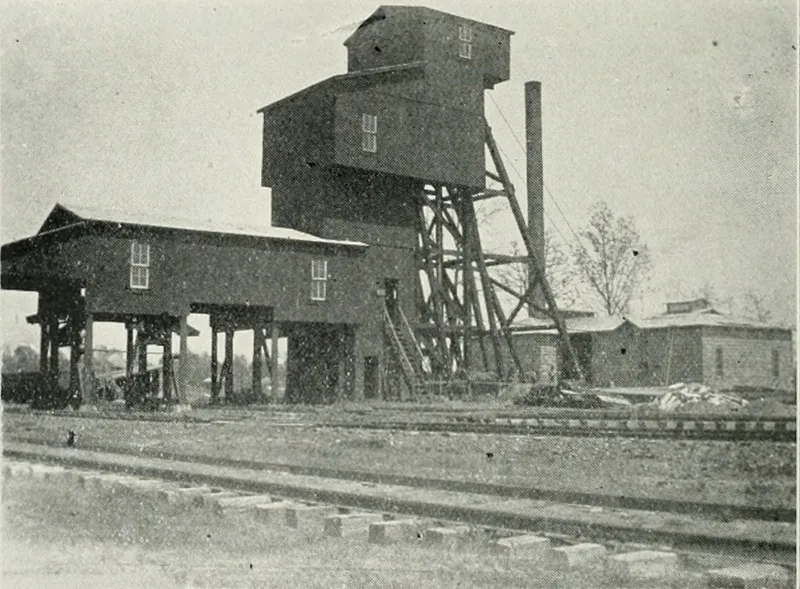
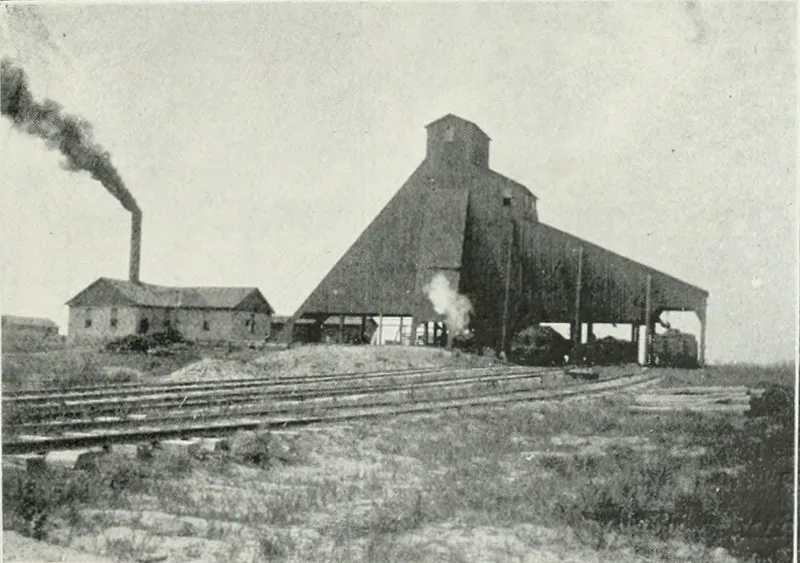
The book's only account of actual coal production is a single sentence. In 1872, it says, the Carbondale Coal and Coke Company was organized with a capital stock of $50,000, and it had been shipping coal from Carterville at the rate of 60,000 tons a year. Erwin gives no mine names, no shaft depths, no superintendents, and no names of the men who dug the coal.
Carterville itself gets a short entry among the county's towns. The 1876 history calls it a village of 500 citizens that sprang up on the railroad, eight miles west of Marion, and says it was incorporated as a village in 1873. The book does not say which railroad line ran through it.
One more detail sets Carterville apart. Erwin writes that there had been no saloons anywhere in the county since 1872 except at Carterville. That year lines up with the coal company's founding, though the book draws no connection between the two.
“Carterville is a village of 500 citizens, which sprung up on the railroad, eight miles west of Marion…”
Teamsters, ox wagons, and the call for a railroad
Before rails, everything the county sold had to be hauled out by wagon. The book says that from 1850 to 1872 a class of men known as teamsters spent their summers hauling the county's products to the railroads and the river. In the earliest days, Erwin adds, nothing could go to market unless it could walk. Ox teams stayed in use until 1866, when everybody switched to horses.
The hauling, the book says, became so extensive and costly that people demanded a railroad of their own. An Act approved March 7th, 1867, incorporated the Murphysboro and Shawneetown Railroad Company. In 1868 a petition signed by one hundred voters was filed with the County Clerk, asking that the voters decide whether the county should subscribe $100,000 to the company's stock.
Speakers canvassed the county for the measure. According to Erwin, people were led to believe they were buying stock that would pay them a yearly dividend large enough to cover the interest on the county's bonds.
Coal in a farming county
Where the coal sentence sits in the book says a lot about 1876. It comes at the very end of a long list of farm output, right after eggs. Erwin reports a usual tobacco crop of 1,500 hogsheads averaging 1,500 pounds each, about 1,000 hogs and about 1,000 beef cattle sent to market each year, and 40,000 dozen eggs sold annually. Tobacco had been the money crop since 1840, when it replaced cotton.
The county Erwin describes was still rural and growing. He uses a population of 23,000 when he figures the death rate, and says the county was worth over seven million dollars, against $19,500 for all real and personal property in 1826. Marion, the county seat, had about 1,200 people and had organized as a city in 1873. Crab Orchard had about 300.
The only other mining story in the book is much older and has nothing to do with coal. Erwin tells of Renault, an agent of the Mississippi Company, who left France with two hundred miners for that company's mining schemes in Illinois and bought five hundred enslaved people at San Domingo to work the mines. Erwin admits there is no evidence Renault searched Williamson County, though he thought it almost certain.
“In an early day nothing could be sent to market but such things as could walk.”
What the book offers family historians
If you are looking for a coal-mining ancestor by name, this book will not have him. It lists no miners, and it says nothing about where coal workers came from. What it does say about origins applies to the early settlers generally: most citizens of the county, Erwin writes, came from the South.
The book is stronger on the neighborhoods around the coal. Carterville and nearby Crainville turn up again and again in the feud chapters Erwin calls the Vendetta. In August 1874, for example, "Field" Henderson and Monroe Bulliner agreed to meet at Carterville to settle their differences, and that same month Deputy Sheriff W. J. Pulley arrested John Bulliner at Crainville. Families named in those chapters include the Bulliners, Hendersons, Hinchcliffs, Sisneys, and Crains, along with William Spence, whose store stood near Crainville.
Herrin's Prairie, also in coal country, appears from the earliest pages. The book says Isaac Herrin settled there in the 1810s and that the prairie was named for him, and that in 1862 Herrins, Polk and Harrison built the Herrin Prairie mill.
For records to chase next, Erwin names the county's newspapers. Most lasted only two or three years, but he says the Marion Monitor and the Egyptian Press were still running in 1876. He also explains how he worked: since he did not set out to invent facts, he drew on many sources, especially the county's old men and members of the Vendetta. Read his dates and names with that in mind, and check them against original records.
Finding your ancestor in Williamson County
- Census records (free through 1950) list each person's occupation and town, so a mining family shows up decade by decade.
- Death records: search our Illinois database by surname.
- The county histories themselves: the biographical sections of History of Williamson County, Illinois hold hundreds of family sketches.
- Newspapers on the Library of Congress's Chronicling America carried obituaries, accidents, and local news.
Tell us one grandparent's name. We'll take a free first look at the records and email you back.
Ask about my family →Frequently asked questions
Does the 1876 History of Williamson County name any coal mines or miners?
No. The book's only account of coal production is one sentence: the Carbondale Coal and Coke Company, organized in 1872 with $50,000 in capital stock, had been shipping coal from Carterville at 60,000 tons a year. It names no mines, operators, superintendents, or miners.
How much coal did the book say Williamson County had?
Milo Erwin counted ten separate veins of bituminous coal underlying three-fourths of the county, averaging nine feet thick, with outcrops in dozens of places where it could be mined cheaply. He claimed no country on the globe was better supplied with coal.
When was Carterville founded, according to the book?
The 1876 history describes Carterville as a village of 500 citizens that sprang up on the railroad, eight miles west of Marion. It says the village was incorporated in 1873. It also notes Carterville was the only place in the county with saloons after 1872.
How did Williamson County get its goods to market before the railroad?
By wagon. From 1850 to 1872, teamsters hauled the county's products to the railroads and the river, using ox teams until 1866 and horses after. The cost led to a demand for a railroad and the 1867 incorporation of the Murphysboro and Shawneetown Railroad Company.
Photographs on this page are in the public domain. About the images and their sources.